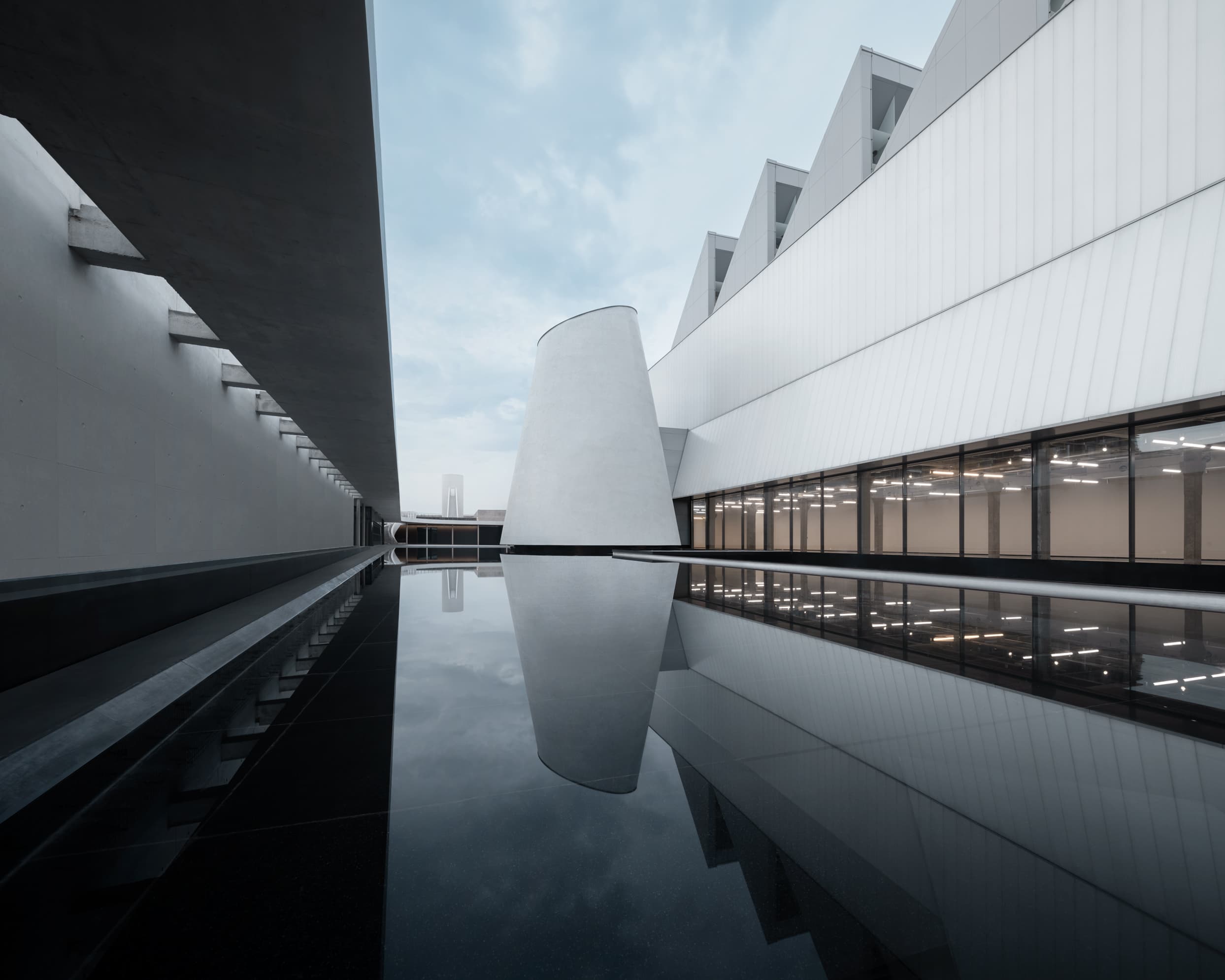
The central courtyard and cone-shaped Chapel at Dib Bangkok, 111 Soi Sukhumvit 40, Khlong Toei: a 1980s warehouse remade as Thailand’s first international contemporary art museum. Photograph by Wison Tungthunya / W Workspace, courtesy Dib Bangkok.
Start in the courtyard.
The cone sits in the pool. The old warehouse keeps its sawtooth roof. A single figure, small against the concrete, is enough scale. Kulapat Yantrasast, the Bangkok-born, Los Angeles-based founder of WHY Architecture, spent years designing other people’s museums before he got a courtyard like this at home. Thai visitors now meet contemporary art on terms set here.
The Financial Times has already walked the résumé. Why do the Metropolitan Museum of Art and the Musée du Louvre call a Thai architect trained in Tokyo when they need to rethink how cultures are shown?
Art Basel named him a 2026 medalist in the Cross-Disciplinary Creator category, beside Laurie Anderson and Sumayya Vally, the Johannesburg-born founder of Counterspace. The medalists were honored in Basel in June; Gold Awardees follow at Miami Beach in December. Pleasant news. The commissions are the story.
He spent eight years under Tadao Ando. He now has work on Fifth Avenue, in the Louvre’s Denon wing, and in this Khlong Toei warehouse, with more coming in Delhi, Makati, and Riyadh. Asian architects have long delivered impressive buildings in Asia. Yantrasast’s decade is about who gets to design the rooms where the world’s most powerful institutions interpret civilization.
“I really see myself as a matchmaker between art and people.” Kulapat Yantrasast, speaking to Dezeen, 2018
Bangkok, Tokyo, Los Angeles
He grew up in Bangkok, the son of an electrical engineer and a schoolteacher, and trained first at Chulalongkorn University. A Japanese government scholarship took him to the University of Tokyo for a master’s and a doctorate. Offered a summer job with Ando, he stayed eight years, from 1996 to 2003. Architectural Digest has described him as something of a surrogate son to Ando and his wife, Yumiko. The American work of that period included the Modern Art Museum of Fort Worth, completed in 2002: concrete, water, a lesson in how a museum can hold its nerve.
He has been frank about what he took and what he left. Japanese architecture, he has said, taught him tension, control, and the invisible order of a garden. Thai life pulled the other way: openness, mix, what he once called “human wetness.” The food metaphor he cannot quite retire is the honest one. Ando’s rooms behave like Japanese cooking, precision first. His own rooms want the improvisation of a Thai kitchen. That is a temperament, not a branding deck. It is also why encyclopedic museums, stuck with inherited hierarchies and timid lighting, keep hiring him.
He opened WHY in Los Angeles in 2004, later adding New York, with Bangkok and Paris now in the firm’s own map. The first ground-up museum was the Grand Rapids Art Museum in 2007, widely cited as the first art museum building to receive LEED Gold. In 2009 Thailand’s Ministry of Culture made him the first architect to receive the Silpathorn Award for Design. Useful facts. The career that matters here starts later, when the brief stops being a handsome new box and becomes a fight about how a collection is allowed to mean.
The Museum as Social Architecture
Yantrasast’s public language has been consistent for a decade. A museum should introduce two friends who do not yet know each other well, set the atmosphere, and leave the room. The architect who stays in every conversation is the problem. So is the white box that isolates art from life until the object looks important and the visitor feels scolded.
He wants culturally specific space: varied light, different proportions, a sense of city and climate in the room. “Museums are true sites of empathy” is the line he has used for both the Met and the Louvre. It can sound like a brochure. What he is actually selling, and what those institutions are buying, is a way out of the old encyclopedic habit of treating non-Western collections as a dim annex to the marble.
That is a social job. Lighting, portal widths, and the decision to let Central Park into an Oceanic gallery decide who belongs in the main narrative of a civic museum. If you collect, sit on a board, or write the check that becomes a wing, this is the practical point. Patronage that stops at the acquisition is only half a room. The other half is the architect who decides whether the work is allowed to look like art.
Read The Patrons Who Earned the Job for the board-seat version of that labor, and How the Sigg Collection Built M+ for what happens when a private Asian holding becomes public architecture.
Reframing the Met
The Michael C. Rockefeller Wing opened in 1982 as the Met’s answer to a gap: the arts of sub-Saharan Africa, Oceania, and the ancient Americas, assembled in large part from the collecting of Nelson Aldrich Rockefeller and named for his son. The gesture was serious. The architecture aged into a problem. Three continents sat inside one dim sweep, close enough that a visitor could confuse proximity with sameness.
WHY was selected as creative partner in 2016. The wing closed in 2021. It reopened on 31 May 2025 after a renovation of about 40,000 square feet, with Beyer Blinder Belle as executive architect, including the south-facing sloped glass. The three collections now stand as independent entities inside one wing, in dialogue with the museum rather than parked beside it. At reopening, more than 1,800 works were on view.
Yantrasast told Architectural Digest the brief in one sentence: “We need to give rightful definition between each continent and among each culture.” To Observer he was blunter about the inherited lighting. Africa and Oceania, often in wood and therefore light-sensitive, had been shown as if darkness were a cultural fact. “It’s such a cliché that they’re always seen as the dark continent.” The new rooms lift. Fritted and filtered glass brings Central Park in without cooking the objects. Materials change as you move. Portals stay large enough that you choose your route.
Alisa LaGamma, Ceil and Michael E. Pulitzer Curator of African Art and curator in charge of the wing, has said the new edition underscores the three collections’ autonomy from one another and foregrounds the artists. Walk it from the Greek and Roman galleries next door if you want the institutional argument in your feet. The architecture now has to treat three collections as three, and let them look like art.
A different Rockefeller project still sits uptown at Seventy Years of Asia Society, Still on Park Avenue: John D. Rockefeller 3rd’s collection as a public Asian brief. The family name rhymes. The hang does not. One building argues for Asia as a subject Americans needed to understand. The other argues that Africa, Oceania, and the ancient Americas were never a single subject at all.
Entering the Louvre
The Louvre’s ninth curatorial department, Byzantine and Eastern Christian Art, extends the same brief into France’s central museum. A French-American team, WHY with Paris scenographers BGC, won the international jury. Official museum language now points to an opening in 2028, later than the 2027 construction horizon that circulated when the selection was announced. Confirm before you plan a Denon morning around it.
The department gathers some 20,000 works, from the origins of the Christian image in the mid-third century through the early twentieth century, across a map that runs from Ethiopia to Russia and from the Caucasus to Mesopotamia. The Byzantine trail occupies refurbished space in the Denon wing, about 2,200 square meters in the Louvre’s own figures, and is meant to sit between the Roman route and a renewed presentation of Islamic art. Laurence des Cars, the Louvre’s president and director, praised the scheme for making those meeting points readable: “fluid, readable, open.”
The second half of the brief is the Roman antiquities trail, a continuous presentation of Mediterranean material the museum has not previously offered as one route. Yantrasast, announcing the win, reached for I. M. Pei’s pyramid, thirty-five years on, and repeated the empathy line. Fair enough. The sharper fact is who was asked. An Asian-American practice is now designing how France’s central museum narrates Christian East and Roman continuity.
That hire rhymes with a different Delhi story. Rabaté Leaves Louvre Abu Dhabi for Delhi's Nadar Museum tracks institutional talent moving toward India. Yantrasast’s path runs the other way, then comes home with the Met and the Louvre already on the drawings.
The Bangkok Homecoming
Dib Bangkok opened to the public on 21 December 2025 at 111 Soi Sukhumvit 40, Phra Khanong, Khlong Toei, between Rama IV Road and Sukhumvit 40. The late collector Petch Osathanugrah, the Osotspa heir who died in 2023, spent three decades building a holding of more than 1,000 works. His son Purat (Chang) Osathanugrah finished the museum. The Thai word dib means raw, or a natural state. The building is a 1980s warehouse redesigned by WHY with Bangkok’s Architects 49. Eleven galleries, a central courtyard of roughly 1,400 square meters, a sculpture terrace, and a penthouse for events.
Yantrasast has called the intent simple: reflect Bangkok’s arrival as an international art city, and keep the architecture from overpowering what it holds. The ground floor keeps the warehouse concrete. The second floor tightens, with a recovered Thai-Chinese window grille as a souvenir of the old fabric. The third floor goes pale under north-facing sawtooth light. The Chapel, a cone clad in porcelain mosaic, is the one unapologetic landmark. Petch asked for tesserae that nod to the broken porcelain on temple surfaces such as Wat Pho. James Turrell’s Straight Up, conceived in 1988 and realized here in 2025, is the artist’s first permanent work in Southeast Asia. Alicja Kwade’s stone spheres, Pars pro Toto, sit in the courtyard like a quiet solar system you walk through on the way to the ticket desk.
Dr. Miwako Tezuka, who previously directed the Japan Society Gallery in New York, is the inaugural director. The opening hang, (In)visible Presence, ran through 3 August 2026. Check dibbangkok.org for what is on the floor now before you cross town. Hours are Thursday through Monday, 10:00 to 19:00, closed Tuesday and Wednesday. Buy a timed ticket on the site; walk-up entry is not guaranteed. Published adult prices during the first season were THB 550 for Thai visitors and THB 700 for everyone else. Confirm before you go. Watthu-Dib, the bistro, takes non-ticketed guests on museum days.
Thailand already had rooms. MAIIAM in Chiang Mai made a private Thai and regional collection public. Marisa Chearavanont’s Bangkok Kunsthalle and Khao Yai Art Forest turned patronage into a raw urban ruin and a rural commission field. The Bangkok Art and Culture Centre, open since 2008, remains the city’s municipal attempt. Dib is the first Bangkok museum built around its own international contemporary collection, designed by a Thai architect who had already finished the Met wing. That is the homecoming that counts. Pair a morning here with a river night from Three Nights on the Chao Phraya. The Banquet Guide to Bangkok will sort the hotels and the taxi. For the Shanghai version of a private holding becoming a civic floor, read The Collectors Shaping Contemporary Asian Art.
“Making a museum is not about transmitting information. It is about creating inspiration.” Kulapat Yantrasast, on Dib Bangkok, art4d, 2026
The Asian Museum Century
The next rooms are not in New York or Paris.
In Delhi, a consortium led by Arcop Associates, the New Delhi firm that designed the G20 summit hall at Bharat Mandapam, won the design-consultant bid for Yuge Yugeen Bharat, the planned national museum in the colonial North and South Blocks on Raisina Hill. Yantrasast is the principal architect. Press language likes “largest in the world.” Skip the scoreboard. India’s state museum project wanted the same hand that redid the Rockefeller Wing, while Kiran Nadar separately hired Louvre Abu Dhabi’s founding director to professionalize a private campus. Two different Indian bets. Both assume the next serious museum intelligence will be exercised in Asia, not only exported from it.
In Manila, Ayala Foundation has commissioned Kontempo, a non-collecting contemporary art center on the Pasig at Circuit Makati, designed with Lor Calma & Partners and aimed at late 2028. Yantrasast talks about a single generous roof, palm and earth, a building that takes in the river.
In Riyadh, WHY’s ilmi Science Discovery & Innovation Center, in design since 2021, is an iridescent geodesic globe on a planted plinth: science and craft under Vision 2030. Same bet, different brief. Cultural rooms are now commissioned from Asian and Middle Eastern capitals with a Los Angeles and Bangkok practice on the drawings.
He has also been named artistic director of the second Bukhara Biennial, 3 September through 21 November 2027, succeeding Diana Campbell, who led the first edition from the Samdani Art Foundation in Dhaka. An architect asked to program a city is the same job in a different key: how cultures are shown, this time across caravanserais rather than vitrines.
Shenzhen’s Museums Are Rewriting the Hong Kong Weekend and In Venice, Asian Pavilions Are Rehearsing History follow the same transfer from other angles: new Chinese civic rooms, national pavilions learning to speak in the Giardini. Yantrasast is one of the few living figures who make it walkable. You can stand in his Met wing this month. You can book Dib on a Thursday. The Louvre rooms will follow. The Indian and Manila buildings will slip, as large museums do.
Go to Khlong Toei. Take the timed slot seriously; Rama IV does not forgive a romantic arrival. Walk the pool before you climb. The Chapel will look like a temple only if you need it to. What it actually does is hold the courtyard still long enough for a city that rarely stops.