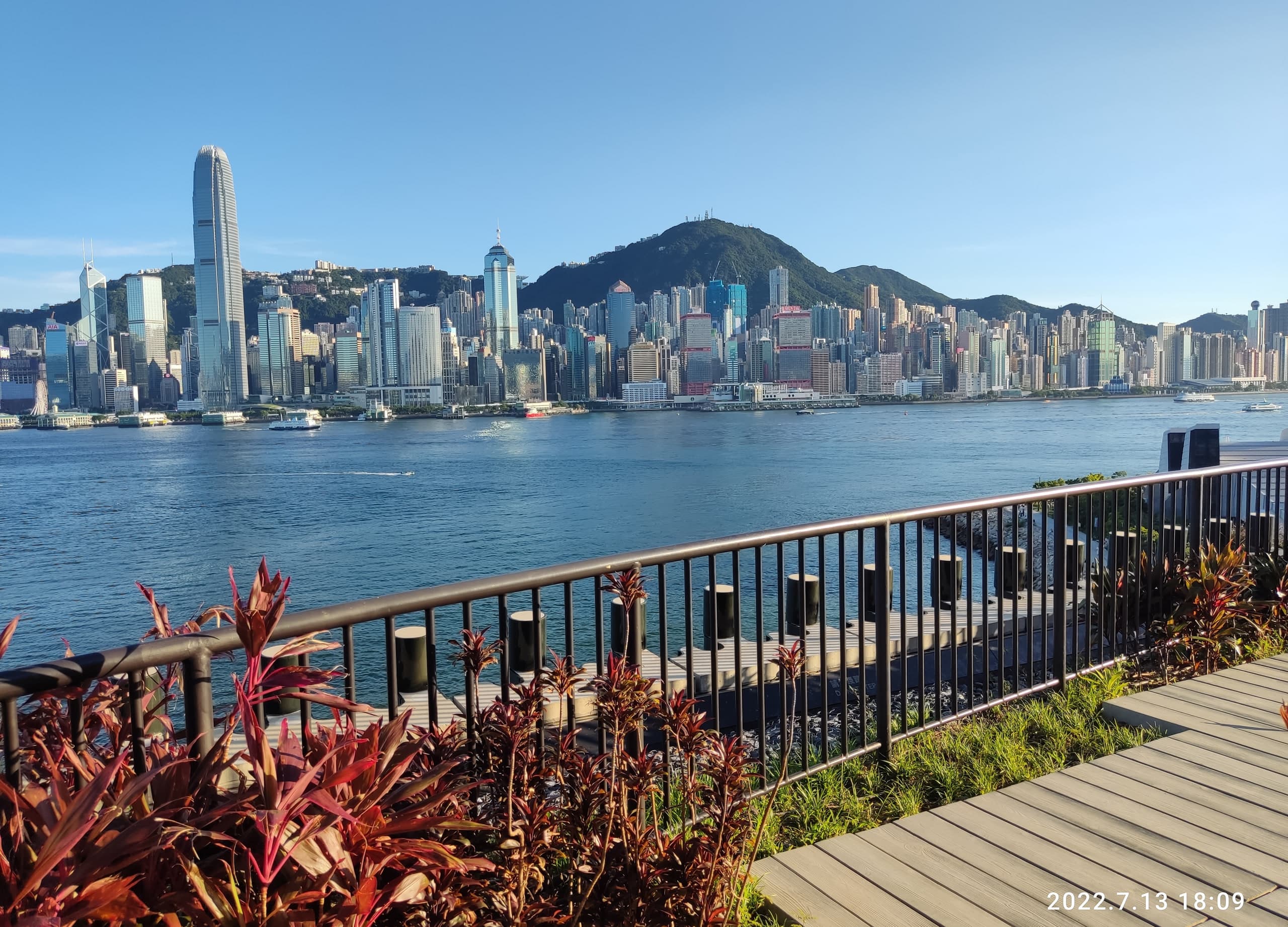
Victoria Harbour from the M+ roof garden, West Kowloon: the view after the board work becomes a building. Photograph by Px3.
The soft-power job is a board seat.
For Banquet readers, patronage that matters leaves a trail you can diary: a museum open on Museum Drive, a non-profit on King’s Road, an acquisition fund that puts Southeast Asian work into a public collection, a project space on Kim Yam Road that takes appointments. The Ambassadors series opens in Hong Kong, with people who treat those trails as the work.
“Before there was an actual building, it was just a museum committee. I’ve seen it go from an architectural drawing on a pdf to a physical building where thousands of people visit every day. It’s then you realise the extent of the impact you can have.”
Alan Lau, vice-chair of M+, speaking with Art Basel Hong Kong’s Angelle Siyang-Le, as reported by Tatler Asia
The Committee That Became a Building
Alan Lau is the cleanest case for the title. Born and raised in Hong Kong, trained in engineering at Oxford, made partner at McKinsey young enough to need something on a new office wall, he bought calligraphy by Tsang Tsou-choi, the King of Kowloon, and never stopped. Fintech and later roles at firms including Animoca Brands pay the day rate. The evenings go to institutions: vice-chair of M+; co-chair of Tate’s Asia Pacific Acquisition Committee; co-chair of the Guggenheim’s Asian Art Circle.
At Para Site, Hong Kong’s longest-running artist-founded contemporary art space, Lau joined the board in 2009, became co-chair in 2014, and steered more than a decade that included the move from Sheung Wan to Quarry Bay. In February 2025 he stepped down as chair, stayed on as a board member, and handed the seat to Alan Lo. That rotation is the point. Patronage here is succession planning for a laboratory, not a nameplate that never moves.
M+ itself, designed by Herzog & de Meuron with TFP Farrells and Arup, opened to the public on 12 November 2021 at 38 Museum Drive in the West Kowloon Cultural District. Lau’s PDF-to-building line reads as a job description for anyone who sat the committee years before the terracotta tower faced the harbour.
Two Alans, One Non-Profit, a Singapore Desk
Alan Lo is the other Alan, and the one now chairing Para Site. A Princeton-trained architect, entrepreneur, and longtime Design Trust figure (he chaired the grant platform founded in 2014 by Hong Kong Ambassadors of Design), Lo joined Para Site’s board in 2015. With his wife, restaurateur and JIA Group CEO Yenn Wong, he established the Singapore-based Yenn and Alan Lo Foundation in 2023 to support transnational Asian artistic practice.
The foundation’s most concrete public instrument was the SAM S.E.A. Focus Art Fund (2023–2025), which helped the Singapore Art Museum acquire works shown at S.E.A. Focus into the permanent collection. In 2025 the same foundation opened Kim Association, a project space on the ground floor of a River Valley shophouse at 63 Kim Yam Road, with artistic director Christina Li. The inaugural exhibition, Puppies Puppies (Jade Guanaro Kuriki-Olivo): Indigenous Power (Ancestral Wisdom), ran 12 September–7 December 2025. A co-commission with Kunsthalle Basel, Shuang Li’s Alliance, followed into 2026. Confirm current open status before you travel; the space has advertised private visits by appointment and has also posted temporary closures.
“Para Site remains a critical laboratory for new innovations in contemporary art, and many ‘firsts’ are achieved here. Often, it is where new talents are given their first institutional exhibitions in Asia-Pacific.”
Alan Lo, on becoming Para Site Board Chair, February 2025
That is Ambassadors language without the pageant. First institutional shows, first acquisitions into a museum collection, first project space that can host a Basel co-commission in a Singapore shophouse.
Evan Chow, a Hong Kong financier and M+ founding patron, sits the other side of the same map: the first Hong Kong-based trustee appointed to New York’s New Museum, a governor of the Hong Kong Arts Centre, and, since 2023, founder of the Evan Chow Art Prize at the Chinese University of Hong Kong. His Art Basel interview line is useful for this chapter: patronage prolongs an artist’s career when sales alone would not. Soften dynastic framing; the Banquet brief cares that the New Museum seat and the M+ founding circle leave exhibitions and prizes you can name.
Programming That Crosses Borders
Patrick Sun founded the Sunpride Foundation in Hong Kong in 2014 to put LGBTQ+ Asian art into public museums rather than only private dining rooms. The Spectrosynthesis series is the proof: Museum of Contemporary Art Taipei in 2017 (widely cited as the first major LGBTQ+-themed exhibition in an Asian public art museum); Bangkok Art and Culture Centre in 2019; Myth Makers: Spectrosynthesis III at Tai Kwun Contemporary in Hong Kong (2022–23); Spectrosynthesis Seoul at Art Sonje Center, on view through 28 June 2026; next stop planned for the Museum of Contemporary Art Tokyo in February 2027. Sun sits acquisition and council circles at Tate, the Guggenheim, and M+, and is a founding patron of the Hong Kong Palace Museum and a member of Asia Art Archive’s Collectors Circle. The collection spans roughly India to Japan; the method is institutional partnership.
In Seoul, Kathryn Hong chairs the Arumjigi Culture Keepers Foundation and serves as chief creative officer of Onjium, the research institute attached to that heritage brief. In February 2026 she joined the board of trustees of the Smithsonian’s National Museum of Asian Art in Washington, a four-year term that makes Korean “future heritage” work legible inside an American national museum. That is diaspora soft power in reverse and forward at once: Seoul craft research meeting a Mall museum board.
Corporate museum dynasties such as Leeum matter to Seoul’s map, and they sit in the next Ambassadors stop. This chapter stays with patrons who built or joined boards as a second profession.
How to Follow the Money Without the Gala
Start at M+, 38 Museum Drive, West Kowloon. Closed Mondays; typical hours run 10:00–18:00 Tuesday–Thursday and Sunday, later on Fridays, with seasonal Saturday extensions (confirm on mplus.org.hk). Buy timed tickets ahead for Art March and weekend afternoons. The roof garden is the practical reminder of Lau’s line: the committee became a view.
Cross to Para Site at 22/F, Wing Wah Industrial Building, 677 King’s Road, Quarry Bay (Wed–Sun 12:00–19:00; confirm on para-site.art). Take the MTR to Quarry Bay Exit C. This is where Lo’s “firsts” argument is tested on the floor: emerging and mid-career practices that larger museums still borrow later.
In Singapore, write Kim Association for an appointment at 63 Kim Yam Road before you assume walk-in hours. Pair a Hong Kong museum day with How the Sigg Collection Built M+ and Why Art Basel Hong Kong Owns March when the fair calendar is the reason you are in town. For the collecting side of the same cohort, continue to The Collectors Shaping Contemporary Asian Art.
What institutions still owe these patrons is clear enough: governance in writing, curator access within agreed boundaries, and programming ambitious enough that a gift changes what the public can see. What Banquet readers need is simpler. Name the people. Name the rooms. Diary the visit.
This piece opens The Ambassadors in Hong Kong. Continue to Seoul with The Names Behind the Canon Shift, then Manila for Payak Keeps the Weave Visible, and Basel when Why Design Miami Basel Matters is the classroom.