The humidity arrives before the dress code does. By the time you reach the hotel lobby in Orchard, your shirt has already decided whether the evening will be linen or failure.
Singapore exports a room more than a runway: a tropical crossroads where batik, tailoring, department-store luxury, regional wealth, and departure-lounge cosmopolitanism compress into one grammar. The useful question is who passes through, what they layer, and what still reads as Singapore when the plane leaves.
"Our power lies in duality, in living between worlds. Asian creatives carry centuries of heritage and the urgency of modernity within them." Prabal Gurung, at Vogue Singapore's Next in Vogue, 2025
The Port Grammar
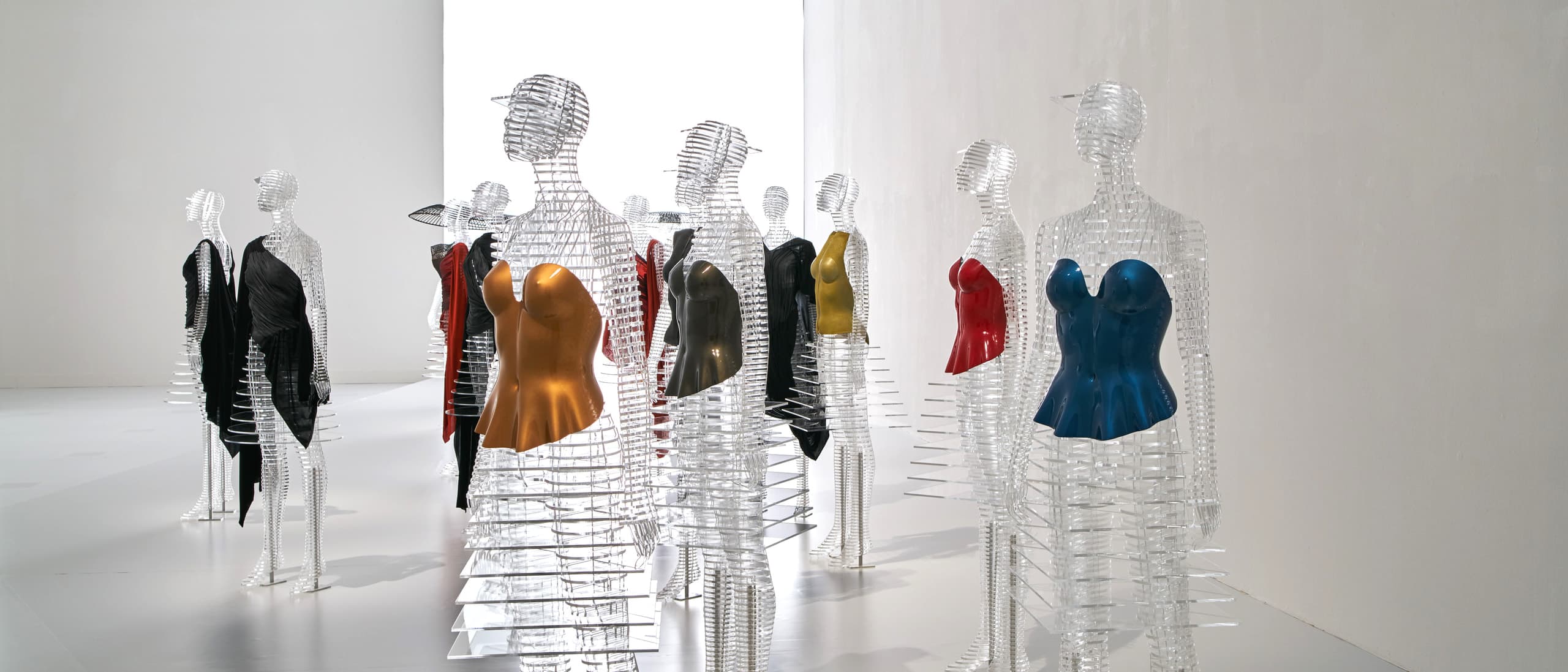
Start in the museum, because Singapore's style story is easier to see on a mannequin than on a runway.
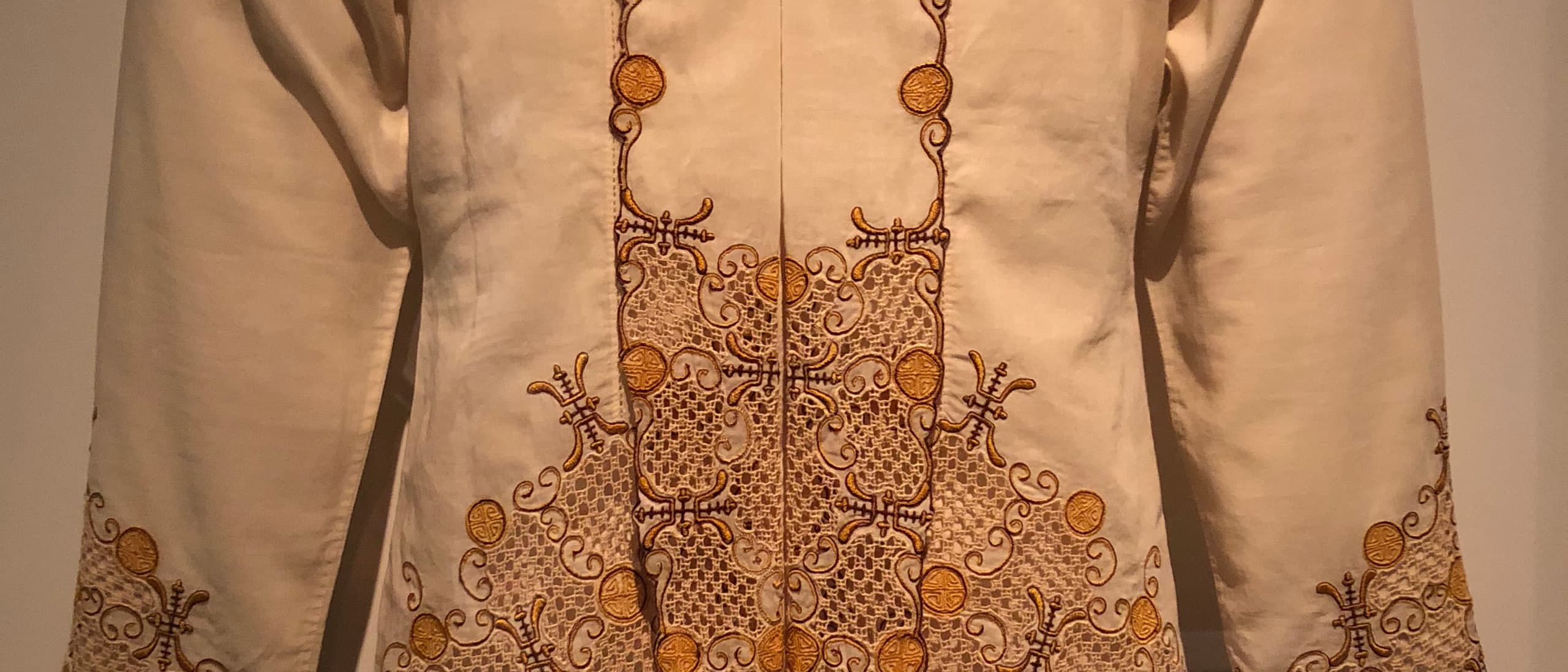
The Peranakan Museum on Armenian Street reopened in February 2023 inside the 1912 Tao Nan School, a mint-green neoclassical monument that has been a school, an Asian civilisations wing, and now the country's clearest classroom on layered identity. Walk the Style galleries and the argument is textile-deep: the sarong kebaya that Peranakan women wore for generations traces back to early Islamic garments carried along maritime trade routes, then absorbed Javanese batik, Malay tailoring, European lace, and Chinese embroidery until it became something no single origin could claim. A 1950s ochre kebaya in the collection carries that whole itinerary in one bodice.
The strongest proof of how tangled the garment is arrived in December 2024, when UNESCO inscribed the kebaya on its Representative List of the Intangible Cultural Heritage of Humanity. Five countries had to file the nomination together: Brunei, Indonesia, Malaysia, Singapore, and Thailand. It was Singapore's first multinational inscription and the largest Southeast Asian nomination by number of states, and the committee's own decision noted that the element transcends ethnicity. Some heritage belongs to one nation. This one required a coalition, which is exactly why it suits the city.
The oldest taste move on the island is still this one. Import a form, stress-test it in humidity, add another inheritance, wear it to dinner.
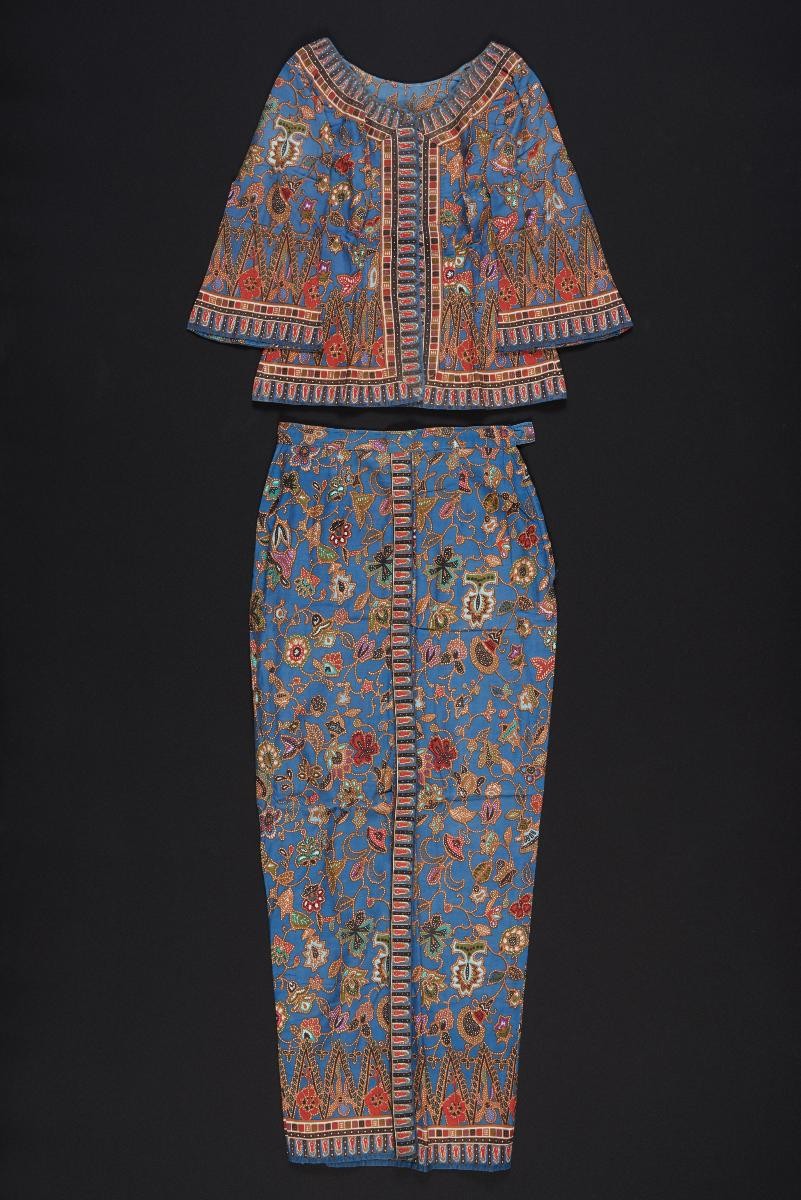
The national uniform makes the same point in flight, though the popular version of the story compresses about a decade. Cabin crew on Malaysia-Singapore Airlines were already wearing a sarong kebaya from 1963, cut in the Malaysian and Indonesian style with a V-neck lapel. In 1968 MSA commissioned Pierre Balmain, the French couturier who had dressed Queen Sirikit of Thailand and therefore understood that Southeast Asian dress could be modernised without being Westernised, to render it in batik as a deliberate claim on Malayan identity. When MSA split in 1972 and Singapore Airlines emerged as its own carrier, the new airline kept the uniform and brought Balmain back to refine it: crew neck for V-neck, front zip for brooches, four batik colourways to mark rank. Stewardess See Biew Wah was flown to Paris and asked to move as though she were working, so the cut would survive a real galley.
The print has been updated since. The silhouette has not. French couture, Javanese cloth, Singaporean service: three passports, one hem.
Orchard Road learned the same lesson from the ground up. Tang Choon Keng arrived from Swatow in 1923 selling fine lace and linen from his hometown, opened his first shop on River Valley Road in 1932, and after the war began buying Orchard land from residents preparing to leave Singapore, betting that everyone from Tanglin, Holland Road, and Johor passed this way heading into town. The department store he opened there in October 1958 wore a green-tiled pagoda roof and red columns modelled on Beijing's Imperial Palace, because spectacle was how a migrant merchant announced he had arrived. C.K. Tang did not invent Singapore taste. He built the first room where immigrant aspiration and imported merchandise could meet without apology, and Orchard Road grew up around him.
Equatorial Modern
Tropical cities teach cloth literacy faster than any fashion school, and Singapore teaches it in the ten minutes between a taxi door and a lobby.
Black tie here still means black tie on the invitation. The wise guest simply reads the climate first. Unlined or half-lined jackets in seven-to-nine-ounce tropical wool, high-twist cloth that recovers from a crush, silk crepe that survives a queue outside, shoes that tolerate marble lobbies and a four o'clock downpour with equal dignity. Read Tropical Formal for the Diaspora Wardrobe for the full packing logic. The short version: equatorial modern keeps the formality and re-engineers the construction.
That engineering has a local supply chain. CYC has been making shirts here since 1935 and now sits at Capitol Singapore on Stamford Road; Kevin Seah cuts bespoke out of The Mill on Jalan Kilang. Between them they dress the bankers, diplomats, and gallery patrons who need one wardrobe that works in a boardroom at eighteen degrees and on a rooftop at thirty-two. Nobody in this city romanticises linen. They ask what it weighs.
The Departure Lounge
Prabal Gurung was born in Singapore to Nepali parents, left for Kathmandu at four, studied in New Delhi, and built his label in New York after Parsons and five years designing for Bill Blass. Michelle Obama, the Princess of Wales, and Kamala Harris wear his clothes; he is a vice chairman of the CFDA and creative director at Tasaki. He belongs on any map of Asian designers in American luxury. What his career traces is departure: Singapore on the passport, New York on the label, Kathmandu and New Delhi in the cloth memory.
He came back in October 2025 to speak at Vogue Singapore's Next in Vogue, his first return in seven years, and told an audience of 700 that Southeast Asia's balance of reverence and reinvention is the region's advantage rather than its handicap. "The world is now having a conversation about the mix of West and East," he said afterwards to the Straits Times. "That's such a big part of our DNA, it is our way of being." Read How Prabal Gurung Dresses the Diaspora Idea of Home for how that split becomes cut and colour on a New York runway. Singapore gave him the first stamp in the passport, and everything after happened elsewhere. That is the useful part.
Andrew Gn draws the same map with different coordinates. Born in Singapore in 1966, trained at Central Saint Martins and Domus Academy in Milan with a term at Parsons in between, he assisted Emanuel Ungaro in Paris before founding his own house there in 1995. He remains the only Singaporean label to show consistently at Paris Fashion Week, and in 2023 he donated more than 160 garments to the Asian Civilisations Museum for a retrospective titled, without much subtlety, Fashioning Singapore and the World. The origin story is domestic and specific: his father, a merchant, brought batik, kimono silk, and Chinese cloth home from across Asia, and his mother carried it to a Chinatown tailor. A childhood spent watching imported fabric get cut to order in Chinatown produced a Marais atelier. No Singaporean fashion industry was required, and none existed to help.
Grace Ling is running the route a generation later: Singapore-born, Parsons- and Central Saint Martins-trained, now building conceptual womenswear in New York with 3D-printed aluminium. We covered her in Cut in Asian America because that is where the studio sits.
Three passports, one departures board. Judge Singapore by its runway calendar and it looks thin. Judge it by where its people end up and it looks like a training ground.
Orchard as Testbed
What stays in the city is the market, and the market is where taste gets rehearsed before it travels.
Luxury groups do not court Singapore for its population, which is smaller than Brooklyn's. They court it as a controlled launchpad for Southeast Asia: a place to trial a boutique concept, a café, a duplex flagship, or a capsule drop before rolling it out to Jakarta, Bangkok, or Ho Chi Minh City. When Gucci unveiled Demna's first capsule in 2025, Marina Bay Sands was one of only ten locations worldwide and the sole Southeast Asian door. Amrita Banta of Agility Research & Strategy explained the mechanics to Vogue: shoppers from Indonesia and Malaysia come here because they trust the goods are real and the service is consistent, so brands treat the island as a quality-assurance hub that happens to have more than 240,000 resident millionaires living upstairs.
The infrastructure has followed. Savills ranked Singapore fifth globally for new luxury store openings in 2024, and forecasts cited in the same Vogue report put local luxury sales rising between seven and ten per cent through 2025 while larger Asian markets cooled. ION Orchard now behaves less like a mall than a cultural venue, anchored by a Tiffany & Co. triplex, the first in the South Asia Pacific region, whose Blue Box Café runs a menu by Julien Royer of Odette. Further along the same stretch, A. Lange & Söhne opened a boutique in October 2025 that is the brand's largest in Asia-Pacific.
At Marina Bay Sands, retail leadership told the same report that the shopper split has moved to roughly even between tourists and locals since the pandemic. That matters for style. The local half arrives having already seen the collection online, priced it in three currencies, and decided whether this season justifies the walk from the office. Selling to them is closer to selling to a buyer than to a holidaymaker, which raises the floor for everyone working the room.
January compresses that audience into a single week. The fourth edition of ART SG, held in 2026, gathered roughly a hundred galleries from more than thirty countries, and behind it sits a collector base that mostly arrived recently: Pierre Lorinet, the Swiss former Trafigura executive now resident here, seeded the Singapore Art Museum's acquisition fund alongside Carmen Yixuan Li and Pure Yichun Chen. Fair week is also the hardest styling week of the year, when a National Gallery morning, an auction preview, and a Marina Bay dinner all have to come out of one suitcase in thirty-two degrees.
Who Layers and Who Ships
Not everyone leaves. The ones who stay are usually in the layering business, and the layering business is harder than it sounds.
Priscilla Shunmugam named her label Ong Shunmugam after her Chinese mother's surname and her Indian father's, then spent a decade arguing that the cheongsam, the kebaya, and the baju kurung could be cut for women who actually ride the MRT. A lawyer who retrained in fashion, she debuted in 2010, showed in Paris in 2012, and won Elle Singapore's Designer of the Year the same year. Her 2017 collection dedicated to Malay dress made the case that inclusive design is a cutting-room problem rather than a marketing line. In 2024 she printed palm trees with The Coconut Club for a River Valley pop-up, because the contemporary layer in this city usually involves food and fabric in the same afternoon.
Then she undercut all of it in public. At an Asian Civilisations Museum talk in September 2021, asked why the cheongsam recurs in her work, Shunmugam answered that Chinese women had "progressed significantly faster and further" than their Malay and Indian counterparts, offering Western dress and shaking hands with men as her evidence. The clip surfaced six months later and travelled fast. She apologised unreservedly, calling the remarks "clumsy, hurtful and insensitive," and the museum apologised for letting them pass unchallenged. The sharpest response came from the batik designer Oniatta Effendi, who declined the word clumsy: the framing, she said, required everyone to accept Western benchmarks for progress in the first place. Keep that objection nearby. A city built on layering is always one lazy sentence away from ranking the layers.
Effendi is the better model, and her supply chain explains why. She spent two decades in theatre and arts education before launching Baju by Oniatta in October 2016 with twelve pairs of Utama pants, wide-legged batik trousers with a front flap that reads as a sarong; they sold out in a week. Her shophouse gallery Galeri Tokokita, whose name means "our shop," sits on North Bridge Road in Kampong Glam, opposite the Malay Heritage Centre and around the corner from the Arab Street alleys where the batik trade first ran. Her grandparents came from Java, and the Asian Civilisations Museum has acquired her work. She is also blunt about the awkward fact underneath all of it: traditional batik is rare in Singapore because the country has no batik makers of its own, so the cloth comes from artisans in Solo and Jogjakarta whom she visits, credits, and pays. The national fabric is an import maintained by relationships.
Carolyn Kan arrived from the other direction, leaving a managing director's job at M&C Saatchi for a silversmith apprenticeship in Florence and founding Carrie K. in 2009. Her modular fine jewellery, made in a Neil Road shophouse atelier, builds stackable heirlooms from si dian jin, the four-piece gold set a Chinese bride traditionally receives, and from the star motifs of Malay songket. She also runs Keepers, a collective platforming independent Singapore makers, on the reasonable theory that a city of imports still needs a bench.
Charles and Keith Wong skipped the couture conversation entirely. They grew up in their parents' Ang Mo Kio shoe shop, opened the first Charles & Keith at Amara in 1996, moved into e-commerce in 2004 ahead of every other Singapore retailer, and built an accessories business of nearly seven hundred stores in more than thirty countries, reporting revenue near a billion Singapore dollars for the financial year ending March 2023. When LVMH-linked L Capital took a fifth of the company in 2011, the brothers eventually bought the stake back. Their export is a rhythm: festive calendars, fast turns, prices that survive a currency conversion. Orchard Road translated for Dubai, Shanghai, and Riyadh, with Paris never really consulted.
Government incubation runs on the same export logic. DORS, the Singapore Fashion Council's retail floor at Design Orchard, rebranded in late 2024 and stocks more than eighty local labels; its chief executive Zhang Ting Ting describes it as a launchpad rather than a souvenir shop. The annual New Class open call drew more than two hundred applications in 2025 and took seven. Plenty of ambition, a narrow front door, and a marked preference for brands that can explain Singapore to someone who has never been.
One City, Many Passports
Equatorial modern is easiest to recognise when the categories refuse to stay separate.
Spend a Saturday properly and the grammar shows itself: batik at the Peranakan Museum in the morning, a fitting at Ong Shunmugam or a bolt of Javanese cloth at Galeri Tokokita, modular gold at Carrie K., dinner at Odette inside the National Gallery, then a flight out served by cabin crew in a French couturier's version of a Javanese garment that five countries had to jointly nominate to UNESCO. Nothing on that itinerary originated here. All of it now reads as Singapore, which is the point people keep missing when they go looking for a national silhouette.
So the useful Singapore tastemaker is rarely the one with a house style. It is the person who moves between registers in a single fitting: the buyer who can price a collection in three currencies before the lift reaches the third floor, the designer who maintains her supply chain by remembering the names of artisans in Solo, the daughter who inherits her mother's kebaya and refuses to let it become costume.
Walk Armenian Street before you walk ION. Learn what the sarong kebaya borrowed before you buy the contemporary version. And when the next Singapore-born designer takes a bow in Paris or New York, resist the urge to claim the runway. Claim the departures board.
This is the Singapore chapter of The Tastemakers. Next: Bangkok, where social heat still sets the dress code before the invitation does.