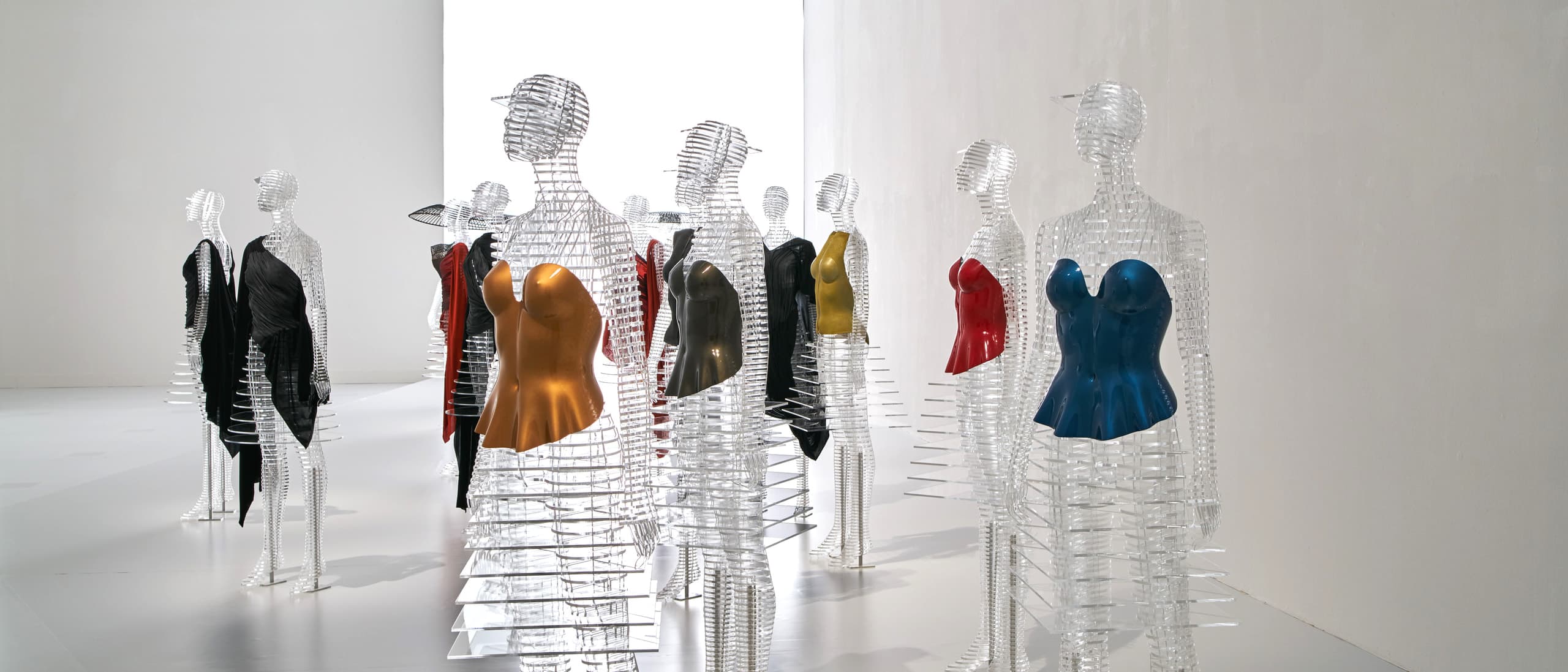
Paris in the early eighties was still selling a body it recognized: padded shoulder, cinched waist, lipstick you could see from the third row. Then two Tokyo designers walked clothes that refused the map. Black that swallowed light. Seams that stayed raw. Volumes that moved sideways. Critics reached for trauma language. Buyers queued anyway. Within a few seasons the vocabulary of fashion had to make room for holes, asymmetry, and the idea that a garment might argue with the body instead of flatter it.
Rei Kawakubo and Issey Miyake changed what a garment was allowed to ask: what is a silhouette for, what counts as beauty, how should cloth move, and at what point a dress becomes an object. Those questions went further than any Japanese look did. The laboratory never closed. It added textile engineers, retailers, patternmakers, and a generation who still take finished clothes apart to see what else they can become.
"The modes of expression that have always been most important to me are fusion, imbalance, unfinished, elimination, and absence of intent." Rei Kawakubo, on her own design principles, 2017
The Beauty of the Unfinished
Kawakubo took a degree in the history of aesthetics at Keio University in 1964, worked in the advertising department of the textile firm Asahi Kasei, and began making clothes as a freelance stylist because nothing in the shops matched what she wanted to shoot. She founded Comme des Garçons in 1969, incorporated in 1973, and opened her first boutique in 1975. The Paris debut came in April 1981: oversized black, frayed hems, knits punched with holes. Western press coined "Hiroshima chic" and "bag-lady look." The insults have aged worse than the clothes.
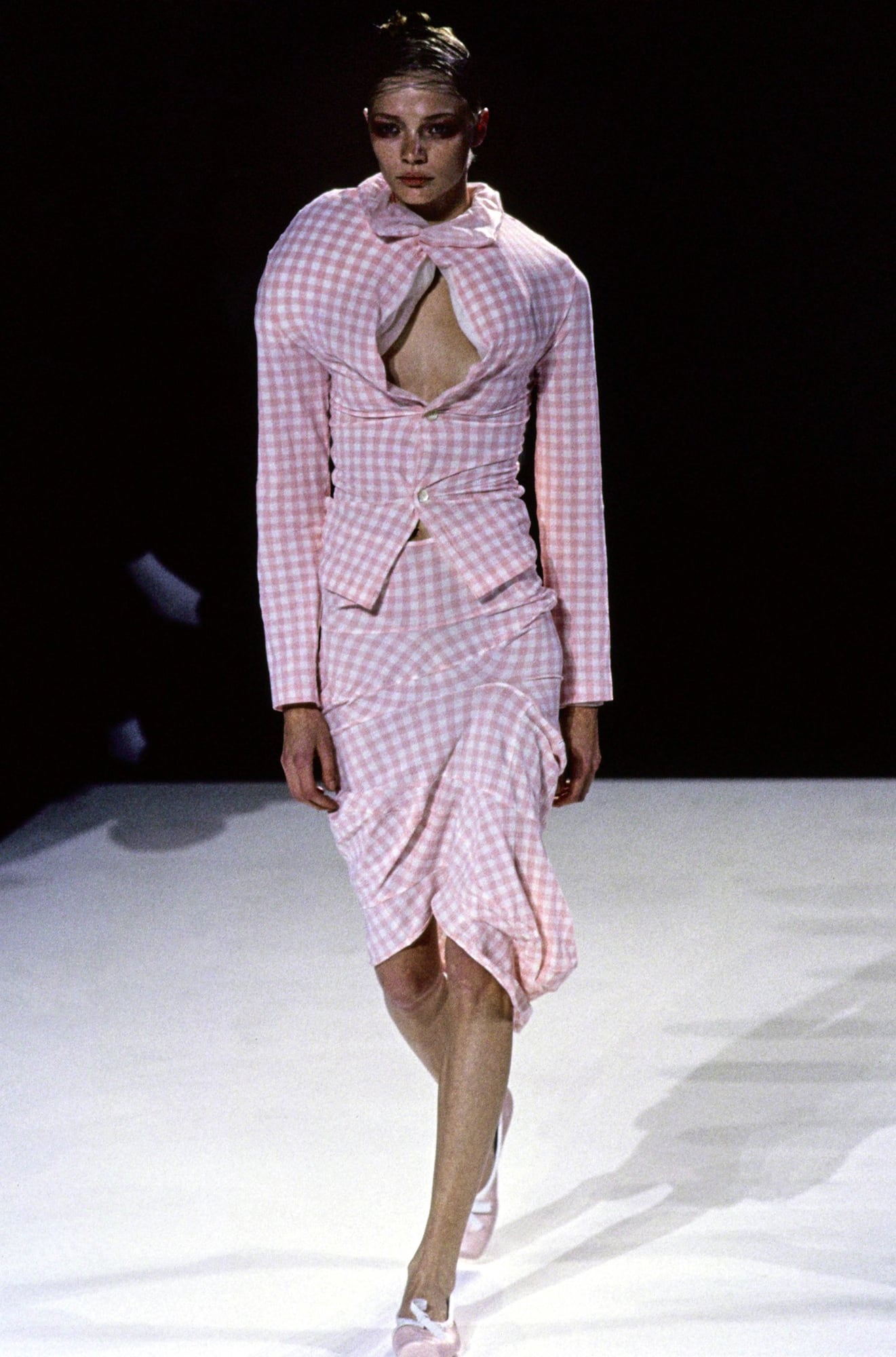
What looked unfinished was a method. Exposed seams, dropped stitches, asymmetry, and elimination of the usual finishing tricks were ways of keeping the garment in process, closer to a sketch than a sealed product. The spring/summer 1992 collection pushed that logic under the theme of the unfinished. By spring/summer 1997, with Body Meets Dress, Dress Meets Body, she stuffed kidney-shaped pads into gingham stretch dresses and moved the body's landmarks: hip where no hip should be, volume on the back, a silhouette that treated the figure as material to redesign rather than a shape to serve. "It's our job to question convention," she told Vogue. "If we don't take risks, then who will?"
In 2017 the Metropolitan Museum of Art gave her Art of the In-Between, the Costume Institute's first monographic show for a living designer since Yves Saint Laurent in 1983. Roughly 140 looks were arranged around dualities she refuses to pick between: fashion and antifashion, clothes and not-clothes, design and not-design. The museum finally had a vocabulary for a method she had been naming since the eighties.
Engineering of Movement
Miyake's laboratory started from a different question. Born in Hiroshima in 1938 and trained in graphic design at Tama Art University, he went to Paris in 1965 for the École de la Chambre Syndicale, assisted Guy Laroche and then Hubert de Givenchy, and spent a year in New York with Geoffrey Beene before coming home to open his Tokyo studio in 1970. He kept saying he was interested in design for living more than fashion as seasonal theater. The useful problem was the space between flat cloth and a moving body.
Pleats Please, launched in 1993, made that problem wearable. Garments are cut and sewn first, then heat-pressed into permanent pleats that hold their form, wash in a machine, pack into a suitcase, and still allow the wearer to walk, sit, and dance. The technique had already been stress-tested as costumes for William Forsythe's The Loss of Small Detail at the Frankfurt Ballet in 1991. Movement was the brief; the pleat was the engineering answer.
A-POC (A Piece of Cloth), developed from 1998 with Dai Fujiwara, pushed further into manufacturing. A computer-programmed industrial knitting or weaving machine turns a single thread into a tubular fabric already mapped with seams, openings, and finished pieces the wearer can cut free. MoMA holds an early A-POC piece in its permanent collection. The Kyoto Prize citation in 2006 called Miyake a designer who fused Eastern and Western cultures with cutting-edge technology; the plainer truth is that he treated fabric as a production system, not a surface to decorate.
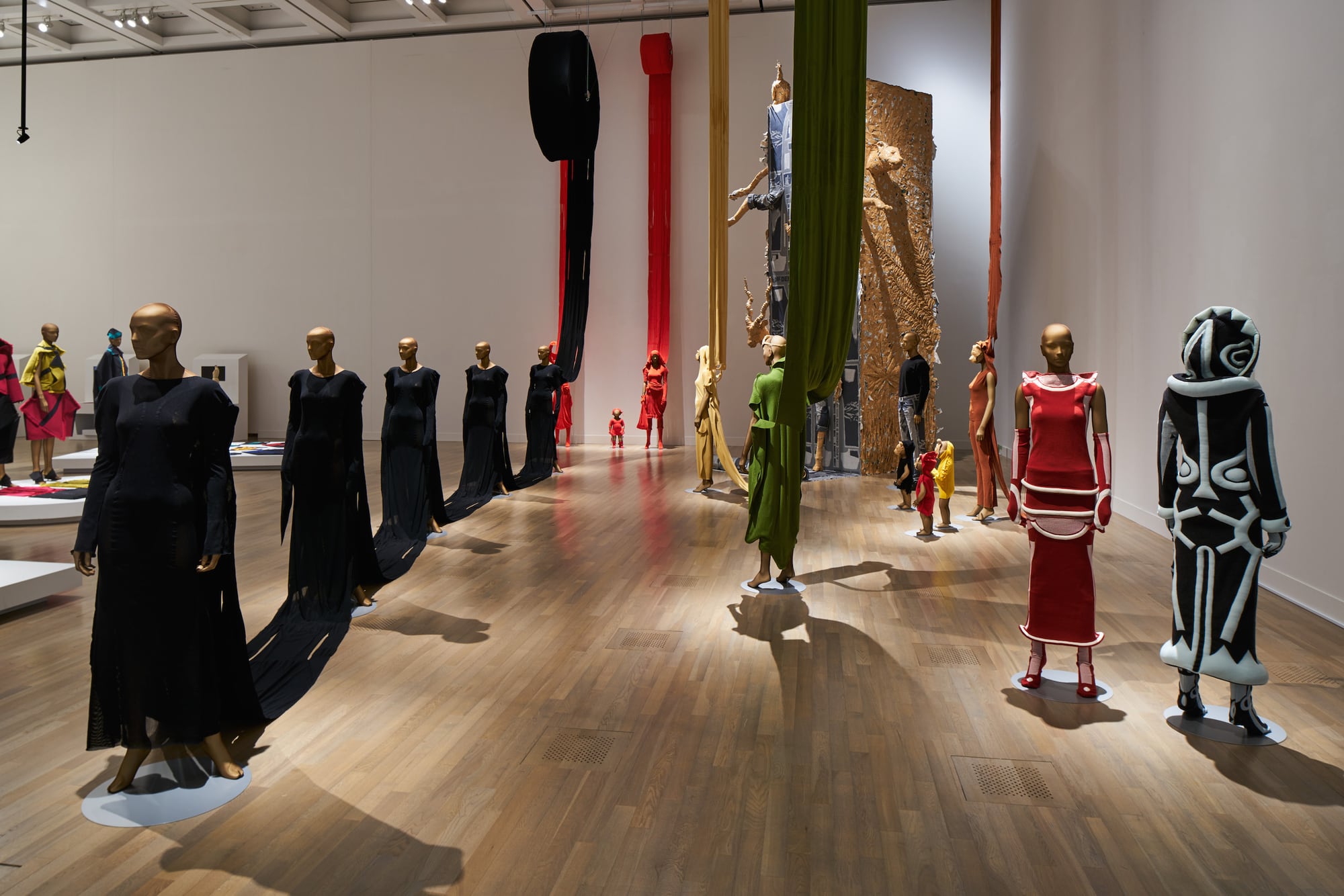
He died in Tokyo on 5 August 2022. The questions he left open still run the house lines, the Bao Bao bags that fold geometry into carryable structure, and 21_21 DESIGN SIGHT, the design museum he founded in Tokyo Midtown in 2007 with architecture by Tadao Ando. Its roof is a single sheet of folded steel, borrowed directly from the A-POC idea of one piece of cloth, with most of the galleries sunk underneath it. The building makes his argument before the exhibitions get a chance to.
Why Black Felt Revolutionary
Yohji Yamamoto arrived in Paris the same season as Kawakubo, and European editors paired them as a single shock. Carla Sozzani, an Italian fashion editor who would go on to open the Milan concept store 10 Corso Como, remembered the first encounter against a room still full of Mugler and Montana: big shoulders, heavy makeup, high heels. Yamamoto's clothes felt like a revolution, she said. Models walked in flats, without the usual paint, inside volumes the Tokyo press had already nicknamed the crow look.
Black was the instrument. In a 2000 interview with Suzy Menkes for the International Herald Tribune, Yamamoto called it modest and arrogant at the same time, lazy and easy but mysterious, able to swallow light or sharpen a silhouette. Above all, he said, black announces: I don't bother you, don't bother me. In a decade of color and power dressing, that refusal read as aggression. It also handed him a technical problem he has been working at ever since, which is how to keep reinventing black on a woman's body twice a year for Paris.
What Western critics heard as mourning or apocalypse was, for him, a quieter discipline. Perfection, he has said, is the devil. Asymmetry and organized imbalance keep the eye awake, and black makes a cut visible in a way color rarely does. The industry took the lesson so completely that fashion now wears black as its working uniform and rarely stops to ask where the habit came from.
Fabric as Technology
The Japanese laboratory never treated cloth as a given. Miyake's heat-set polyester and A-POC tubes are the clearest proof. So is the house culture that grew under Kawakubo's roof.
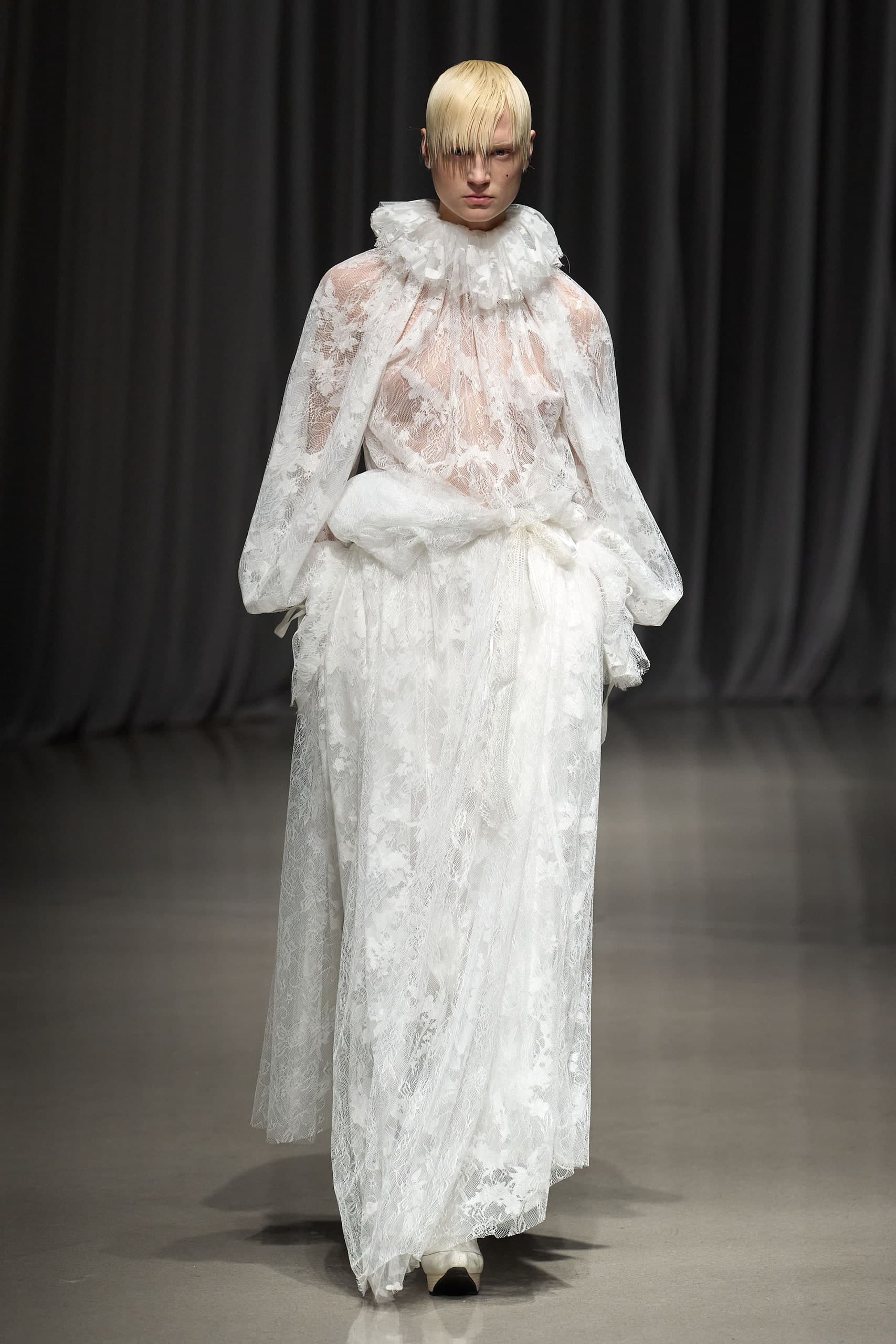
Junya Watanabe, who joined Comme des Garçons in 1984 after Bunka Fashion College and launched his namesake line under the CdG umbrella in 1992, pushed what critics later called techno-couture: synthetic materials engineered with couture patience. His autumn/winter 2000 collection sent out honeycomb ruffs in polyester chiffon that looked Rembrandt-adjacent until you learned they were hand-sewn yet folded flat into an envelope. Organic pattern, industrial fiber, traditional handwork: three technologies in one collar.
That habit of mind travels past the runway. Tokujin Yoshioka, who trained under Shiro Kuramata and Miyake before opening his own studio, designs store interiors, installations, and objects that treat light and structure the way Miyake treated pleats. Season posters that paired Miyake's clothes with Irving Penn photographs and Ikko Tanaka typography turned graphic design into part of the garment's public life. Eyewear, bags, lamps, museum roofs: the same insistence that an object should solve a problem of form, not merely carry a logo.
Read Japanese Indigo Starts in a Tokushima Vat when you want the dye-house end of that continuum. The laboratory thesis holds whether the tool is a vat, a heat press, or a knitting machine.
The Stores That Changed the Room
Clothes this argumentative needed rooms that did not behave like boutiques.
The Comme des Garçons flagship at 5-2-1 Minami-Aoyama still announces that before you touch a rack. In 1998–99, Future Systems (Jan Kaplický and Amanda Levete) wrapped the ground floor in curved glass that flared like funnels; a blue-dot film once veiled the interior, later peeled away, while the sculptural form remained. Shopping became an encounter with architecture first. Omotesando traffic still slows for it.
Dover Street Market, founded in London in September 2004 by Kawakubo and her husband and business partner Adrian Joffe, exported the same principle as curation. Kawakubo called the mix "beautiful chaos": Comme lines beside streetwear, art installations, and houses that would never share a floor in a conventional department store. Dover Street Market Ginza opened in March 2012 inside the old Ginza Komatsu West building, roughly twice the London footprint, a deliberate pioneer move in a conservative luxury district. Floors reset, collaborations turn over, and Rose Bakery upstairs keeps the stamina going. Go on a weekday morning if you want to read the merchandising rather than the crowd.
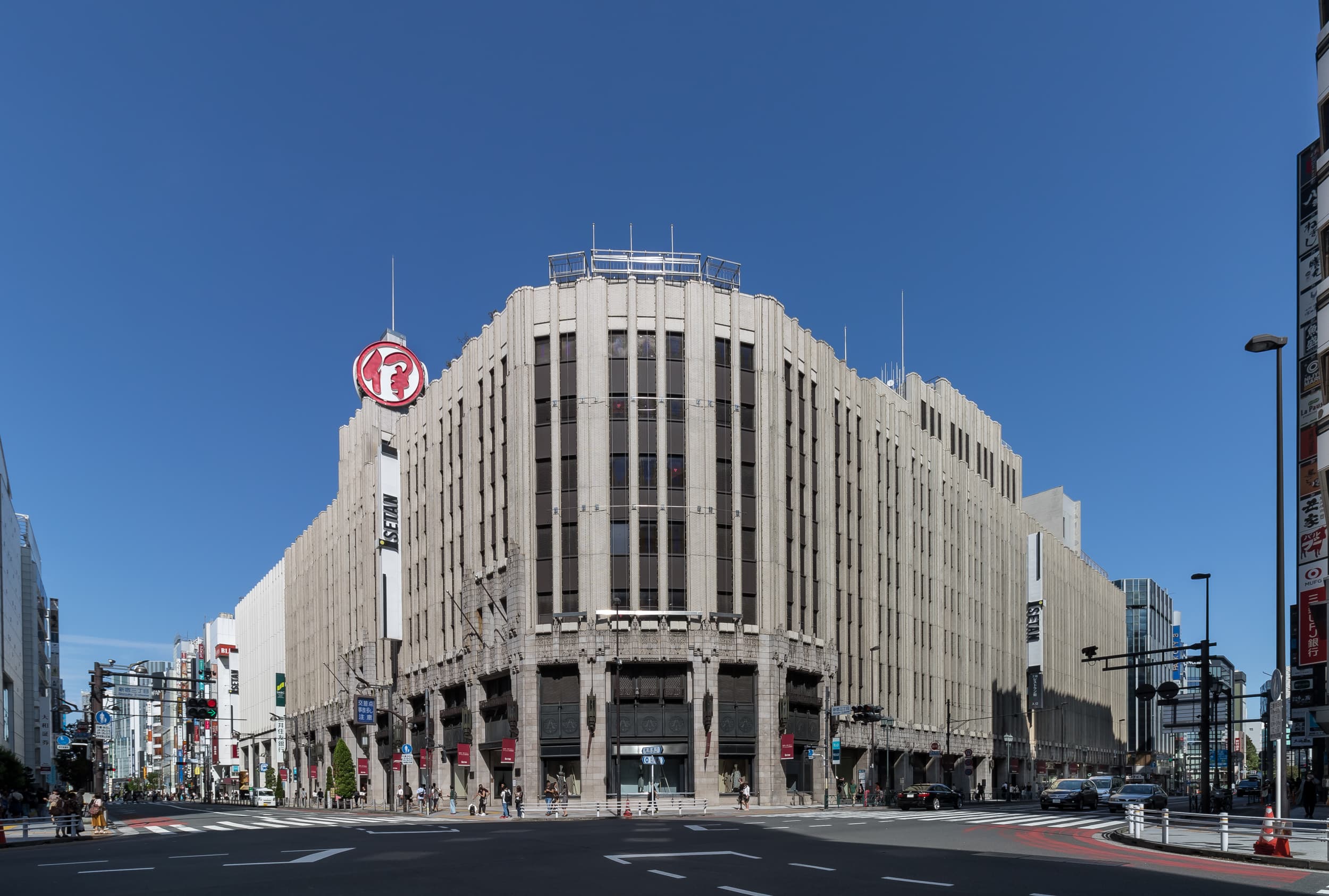
Department-store buyers did quieter laboratory work. Isetan in Shinjuku gave early floor space to Comme des Garçons, Sacai, and later names such as Thom Browne before those labels were global defaults. Read Tokyo Department Store Dressing for how those floors still teach proportion; the avant-garde and the depāto have been in conversation longer than the Instagram circuit admits.
Taking Clothes Apart
Chitose Abe is what the laboratory looks like when it graduates. She cut patterns at Comme des Garçons, then worked on Junya Watanabe's team, left in 1997 when she was expecting her daughter, and founded Sacai in 1999 from five hand-knitted pieces made with hobby-shop yarn. The method she kept from the Kawakubo school is literal: she begins by taking familiar garments apart (bomber, biker, knit, shirt) and rebuilding them so front and back, soft and hard, sport and tailoring occupy one piece. Hybrid, for her, is a patternmaker's dare.
Sacai showed in Paris from 2009 and put a runway under the clothes in 2011. Collaborations with Nike, The North Face, and Moncler proved the same splice could rewire icons the street already owned. Abe stays independent. The clothes still look as if two wardrobes collided and negotiated a truce you can wear to a meeting.
From Kawakubo's unfinished seams to Abe's spliced bomber, the through-line is permission to dismantle. Elsewhere deconstruction arrived as a critical label, picked up and dropped as the seasons required. Tokyo kept it as a working method, then built the stores, museums, and supply chains that could hold the results.
Keep the Laboratory Open
Radical form is easiest to miss when it has already won. Asymmetry is normal. Black is a default. Pleats travel. Concept stores copy "beautiful chaos" without the chaos. The useful Tokyo visit is the one that recovers the original stakes: a slow weekday that runs from the Aoyama glass, through every floor at Dover Street Market Ginza, across to 21_21 DESIGN SIGHT in Midtown, and ends at Isetan only after you have seen what the laboratory did to the idea of a finished garment.
The next time something in your closet does something odd at the shoulder, you know which laboratory to thank.
This is the Japan chapter of The Tastemakers. Next: Bangkok, where social heat still sets the dress code before the invitation does.