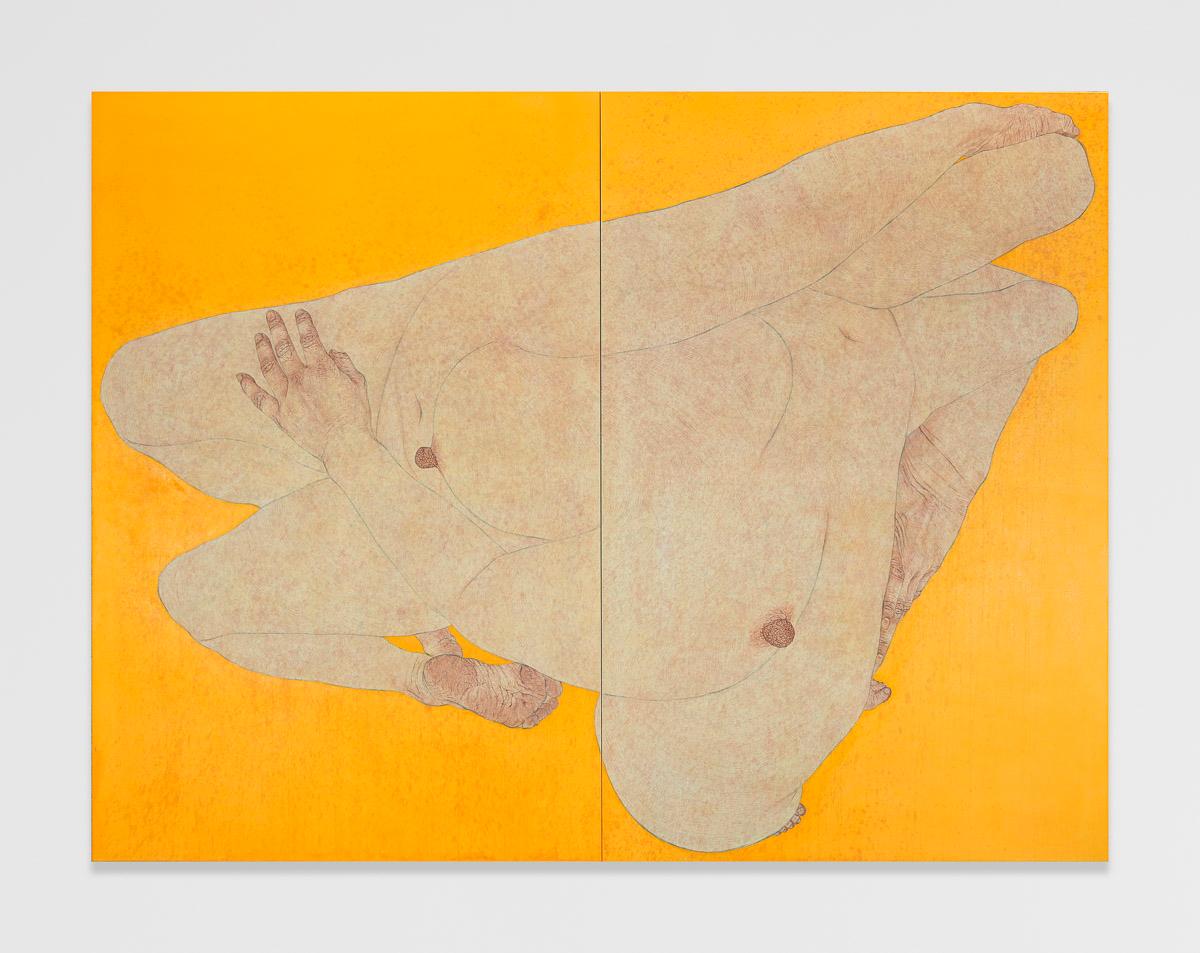
On a yellow ground the width of two doors, a pale body is cut by a vertical seam. Self Configuration: Indian Yellow Island 1 was built that way on purpose: two calico panels butted together so a torso can keep going after the first board ends. The painting is one of eleven new multi-panel works in Seung Ah Paik’s Floating Islands, which opened today at Gladstone’s Hannam-dong space and stays through 9 January 2027.
Paik was born in Seoul in 1979 and works in Pittsburgh. She photographs her own body from above, then layers limbs and torsos from different moments until a single pose no longer holds. Her face stays out of the picture because she cannot see it without a mirror; the right hand often drops out because it is holding the camera. The support is unprimed calico, a fabric she first used while draping at Central Saint Martins, with pigment soaked through charcoal underdrawing into the cloth. Against flat colour fields the assemblies look like islands. In Hannam you can finally see what the panel edges are doing.
Indian Yellow Island 1
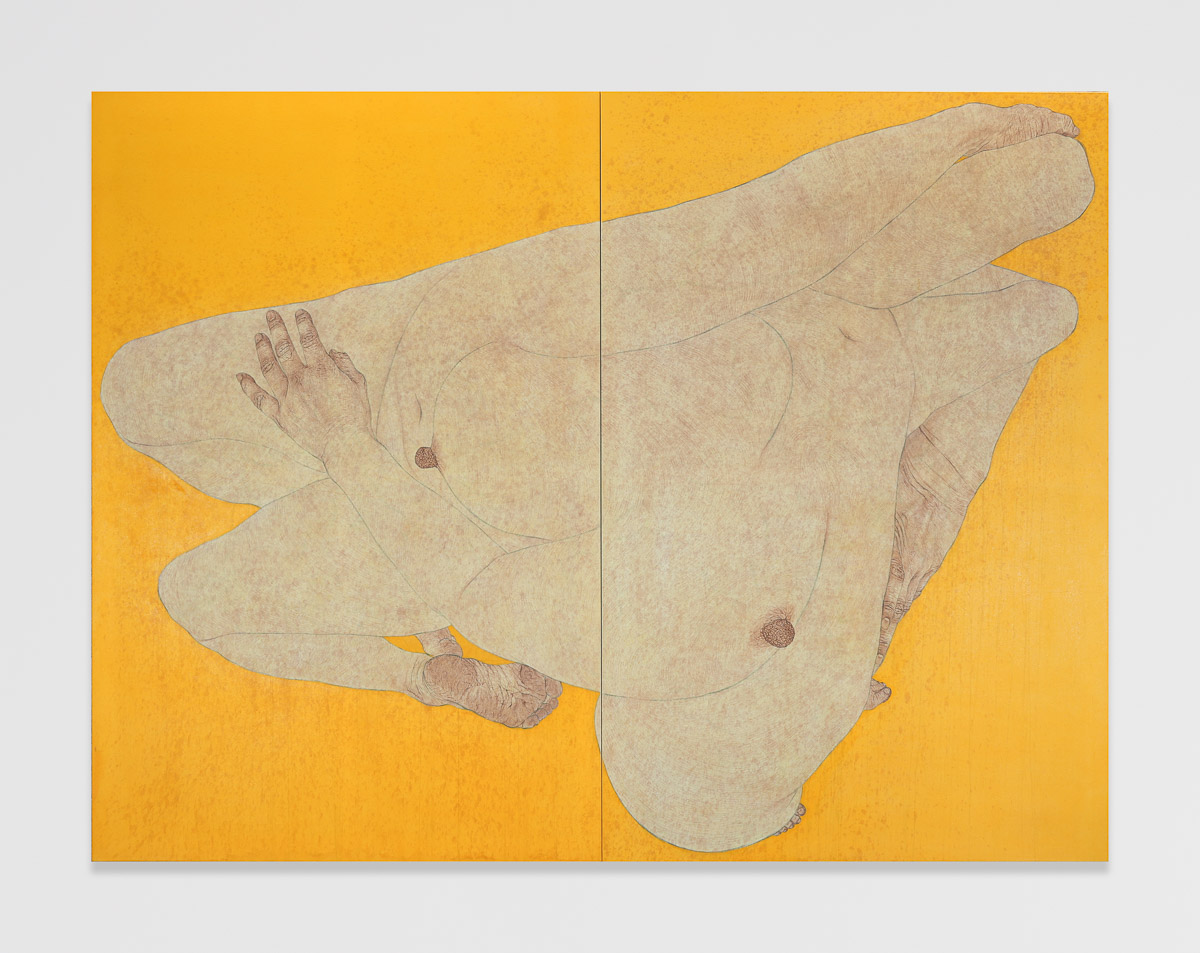
Indian Yellow Island 1 measures 200 by 260 centimetres across two panels of 200 by 130. Up close, the body seems continuous: a hand, a breast, a foot tucked under flesh that ignores the gap. From a few steps back, the join becomes a fold line, the kind mapmakers used when a coastline would not fit one sheet. The yellow behind it is saturated and blank. It does not stage a room or a landscape. It only keeps the body afloat so you can watch the seam do its work.
Cobalt Turquoise Island
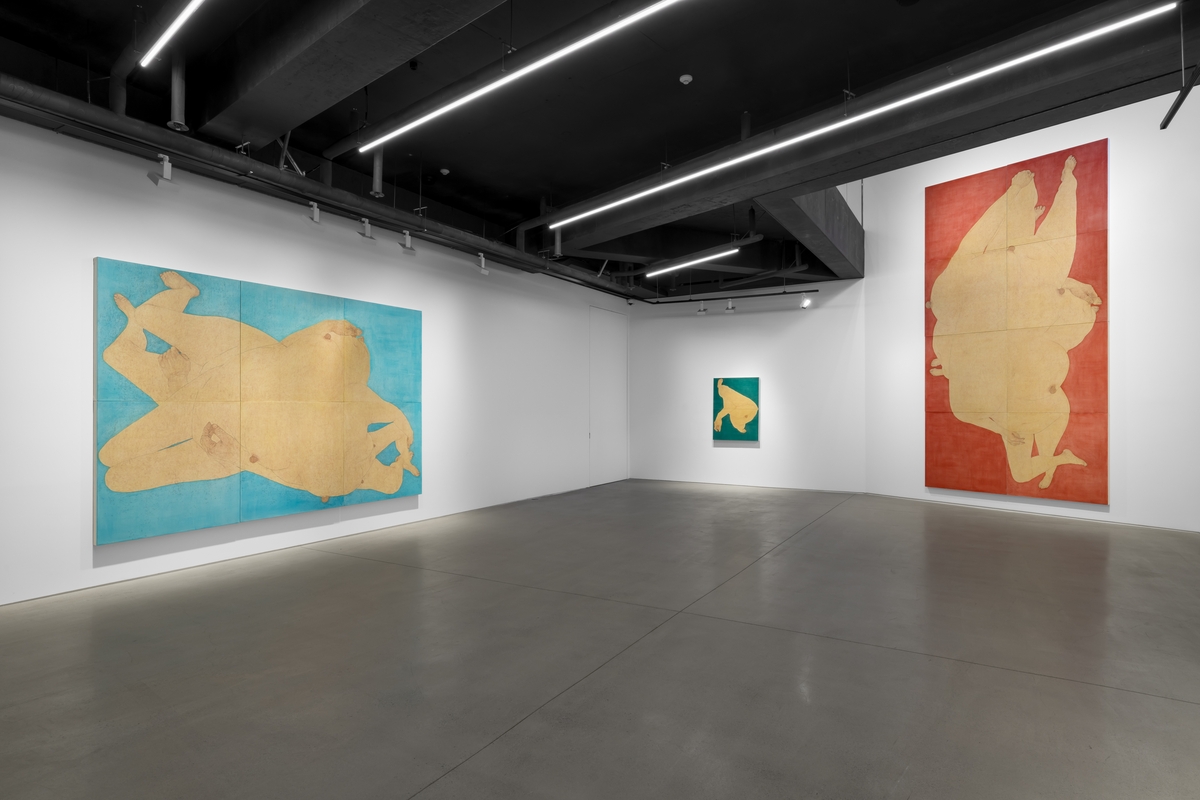
Self Configuration: Cobalt Turquoise Island spreads across six square panels into a turquoise field about 360 by 240 centimetres. In the Mass Studies room the work reads first as weather, then as anatomy: feet and hands recur across the seams, slightly rotated, slightly rescaled, as if the same glance had been taken again a second later. You start matching parts the way you match a motif in a textile. The figure does not march left to right. It replies to itself.
“Recently, they have begun to gather into denser, more singular forms, making the body harder to read and increasingly uncanny, even monstrous—like islands floating in fields of color.”
Seung Ah Paik, Gladstone press release, 2026
On the wall in Hannam, Cobalt is that gathering at a scale you can walk. The seams stay in plain sight; the figure keeps crossing them anyway.
Red Madder Lake Island
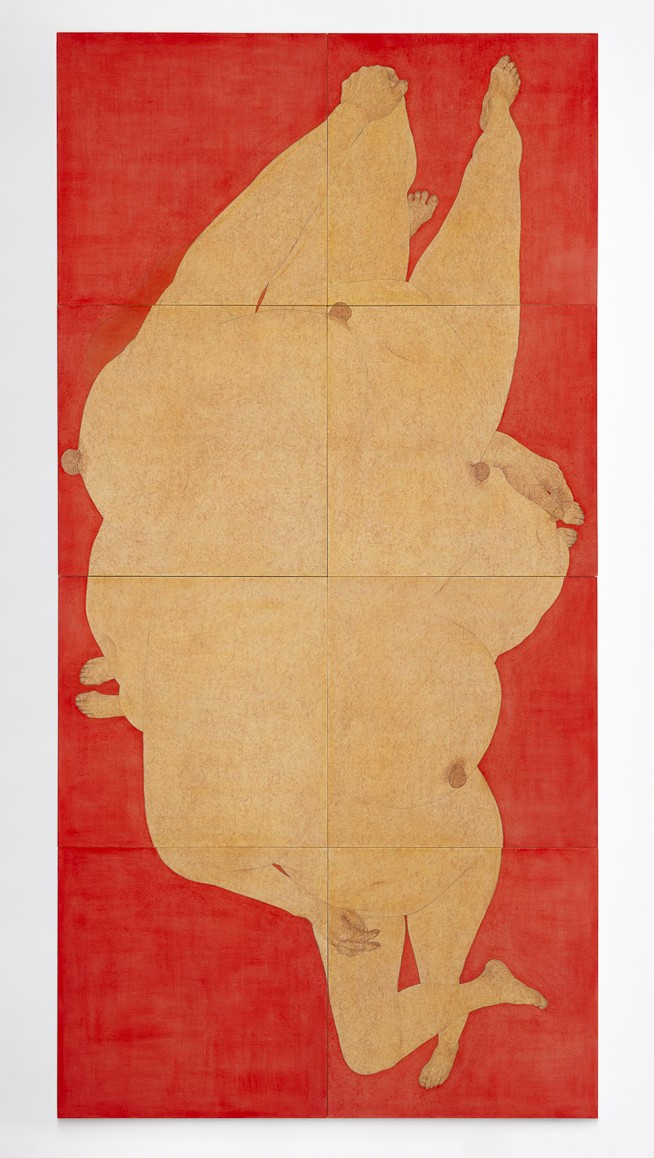
Self Configuration: Red Madder Lake Island goes further. Eight panels rise nearly five metres on a red ground 240 centimetres across. Paik has described the multi-panel method as a cousin of old map sheets taped into a wider world: each square holds a zone, and only the hang makes a territory. Here the seams chop without apology. A foot loses its torso; a hand belongs to a mass you have to rebuild by walking the height of the wall. Joseon portrait habit and the floating viewpoints of East Asian landscape painting sit somewhere behind that walk. In the room you mostly feel the panels come apart, then ask you to put the island back together.
Hannam until January
Floating Islands runs through 9 January 2027 at Gladstone Seoul, 1 Itaewon-ro 55ga-gil, Tuesday through Saturday from 10:00 to 18:00, closed Sunday and Monday. Admission is free. Hangangjin on Line 6 is the cleanest metro exit for Hannam. The gallery occupies two Mass Studies floors in the 739-28 Hannam Building, the larger Seoul outpost Gladstone opened this year after arriving in Korea in 2022. Keep Leeum Museum of Art for another half-day; the two are close enough that people try to do both before lunch and see neither properly. The Banquet Guide to Seoul still explains the river split; Why Frieze Seoul Owns September is the fair-week density of the same streets.
For a winter Seoul trip, put Gladstone on a midweek morning and start with Indian Yellow, Cobalt Turquoise, and Red Madder Lake. The other eight paintings will still be on the walls when you turn around.