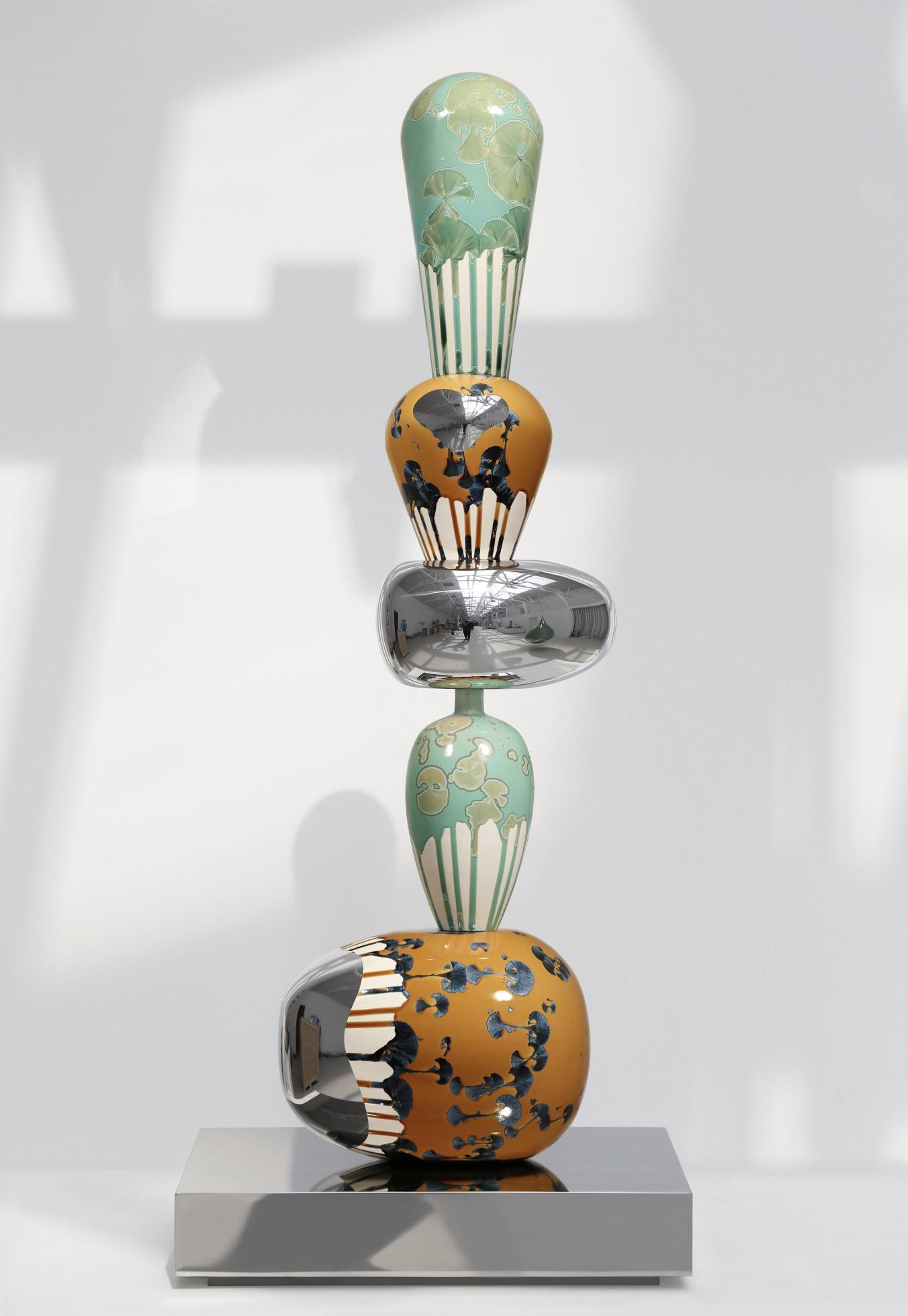
Li Hongwei’s Allegory of Balance-Streamline #4 looks as if it might tip. Five rounded volumes of fired porcelain and stainless steel rise about 150 centimetres from a rectangular steel base at Alisan Fine Arts on East 65th Street. An ochre bulb at the bottom leans one way. A mint-green teardrop and a mirrored steel form pull another. The top piece widens as it climbs, and the joins between the bulbs are thin enough that the whole stack reads as precarious. The gallery opened Finding the Balance, Li’s first New York solo, on 13 November; it runs through 23 December 2026.
Stacked Porcelain, Hidden Support
The useful question in the room is practical: where does the weight sit, and where does the silhouette put it? Li was born in Tangshan in 1980. He studied sculpture at the Central Academy of Fine Arts in Beijing, then took an MFA in ceramic art at Alfred University in 2007, and he now works between Princeton and Beijing. His crystalline glazes follow a Song-dynasty method he has discussed in interviews. He fires the porcelain hot, then drops and holds the temperature so zinc-rich glazes bloom into flower-like crystals; he has said he can control about eighty percent of a firing, and the rest arrives in the kiln. Stainless steel carries the rest of the construction. It reflects the room, adds density, and, in the Allegory of Balance series, helps conceal the supports that keep heavy components upright.
Streamline #4 (2026) measures about 150 by 65 by 45 centimetres. A horizontal steel form sits at mid-height; porcelain bulbs carry the color in ochre, mint, and crystalline blue. The stack looks like cairn stones balanced by eye alone. Museum notes on earlier Allegory works, including the Nelson-Atkins Museum of Art’s Allegory of Balance #18, record metal rods inside the components that hold the upright position. The same logic applies here even when the rods are not visible: the composition is engineered to look casual. Walk around Streamline #4 once and the steel middle mirrors the Upper East Side ceiling, pulling light into the stack so the porcelain looks lighter than it is. The off-balance effect is visual. The mass sits along an axis the silhouette does not advertise.
“The vessel exists through emptiness, and emptiness becomes visible through the vessel.”
Li Hongwei, on the Empty Vessel series, Alisan Fine Arts
A Bowl With Steel at the Center
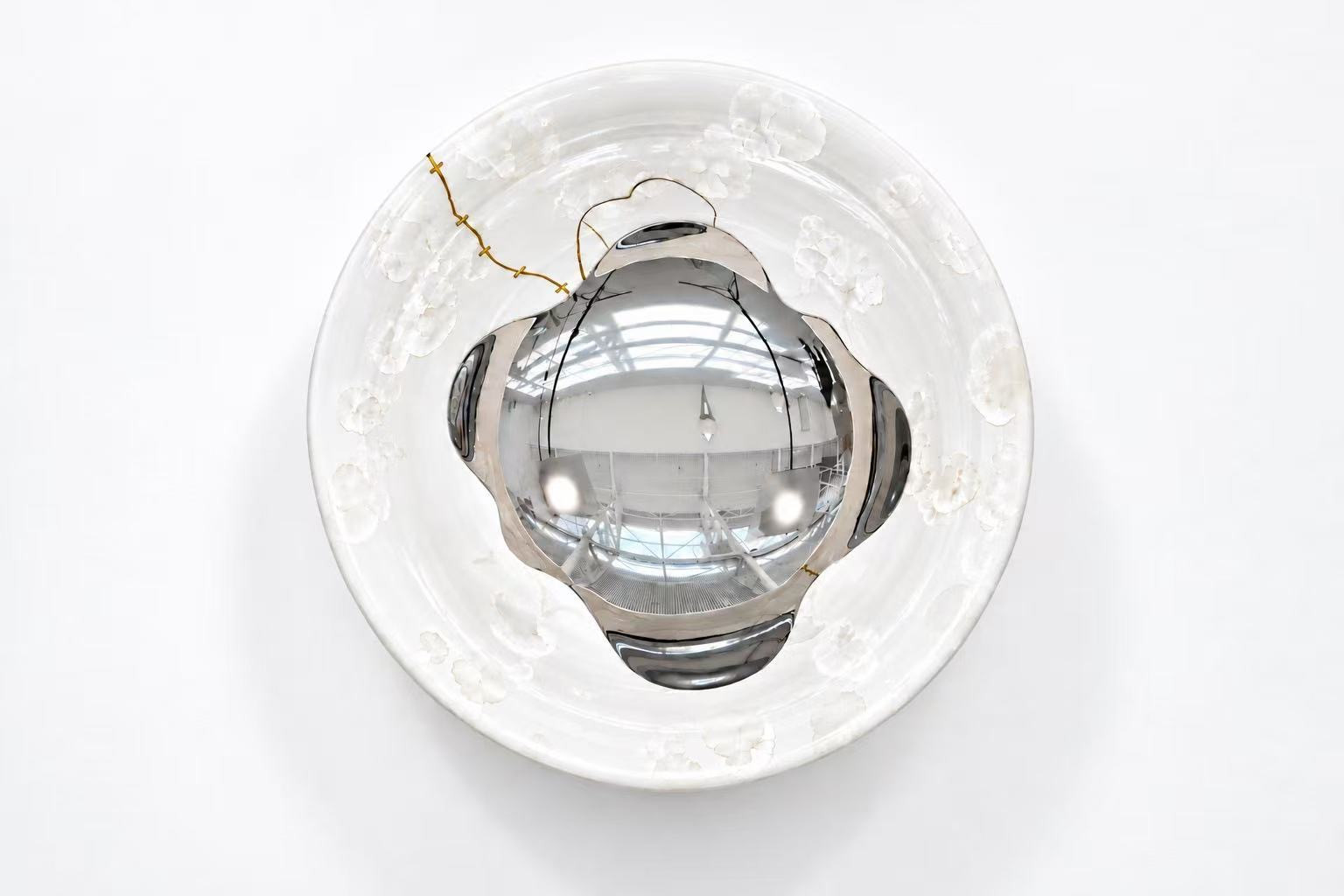
The Empty Vessel series, new for this exhibition, turns the same problem onto the wall. Empty Vessel #7 (2026) is about 43 by 43 by 19 centimetres: a shallow porcelain bowl with a white crystalline rim and a polished stainless-steel center shaped like a soft quatrefoil. The steel returns the gallery as a convex reflection, so the middle of the bowl looks open. A thin gold join runs through the porcelain and makes the steel feel inserted rather than painted on. Stand close enough to see your face bend across the metal, then step back until the center reads as a hole. The metal’s weight sits where the eye wants empty space.
A freestanding Allegory stack needs floor clearance and room to circle it. An Empty Vessel piece takes a wall the way a mirror would, then gives back a curved reflection instead of the flat shine of a decorative plate. Collectors who already buy Song-adjacent glaze will recognize the crystalline blooms; the steel keeps the object from reading as period revival. The British Museum, the Art Institute of Chicago, and the Princeton University Art Museum already hold earlier porcelain-and-steel works by Li, so the New York hang is less an introduction than a chance to see how the Allegory stacks and the new wall bowls argue the same point in different orientations. Alisan’s notes compare the Empty Vessel bowls to Anish Kapoor’s concave mirrors for the void effect, then point to the ceramic rim for warmth. In the gallery, that warmth is simply the glaze catching light at the edge of the bowl.
Alisan Fine Arts New York is at 120 East 65th Street, Tuesday to Saturday, 10:00 to 18:00. Call +1 646 360 3439 or write info@alisan.nyc if you want to confirm that Streamline #4 and an Empty Vessel work are on view that day. Take the 6 to 68th Street-Hunter College and walk south, or the F/Q to Lexington Avenue-63rd and walk east. Give the stack ten minutes before you move to the wall bowls. A separate group show, Ephemeral Ground, opens at the same address on 19 November and is not Li’s solo. For another Midtown Asian hang this season, Whanki, Chun, and Ha at the Korean Cultural Center is the Koreatown stop. On East 65th, find the weight first, then decide what the silhouette is doing.