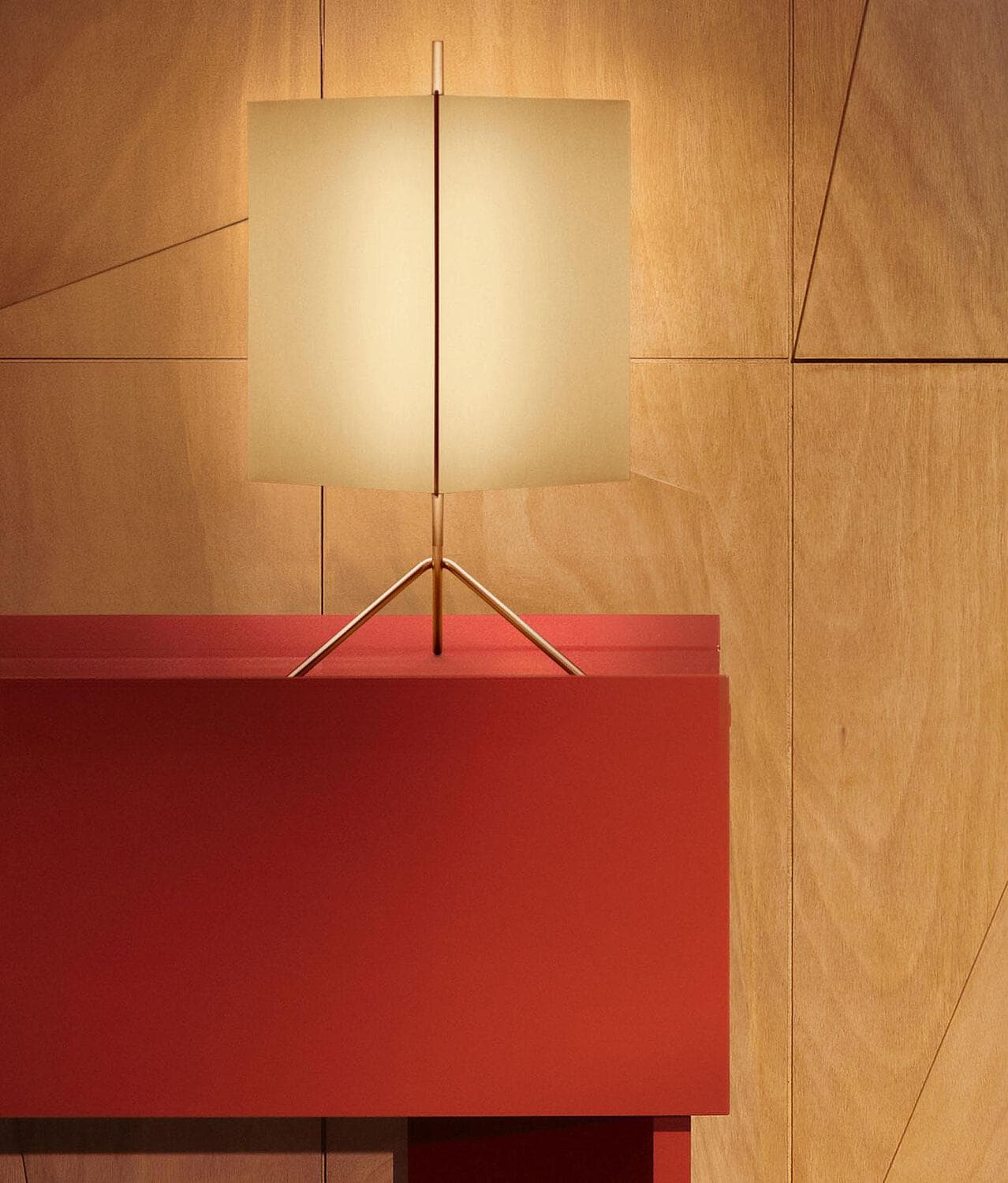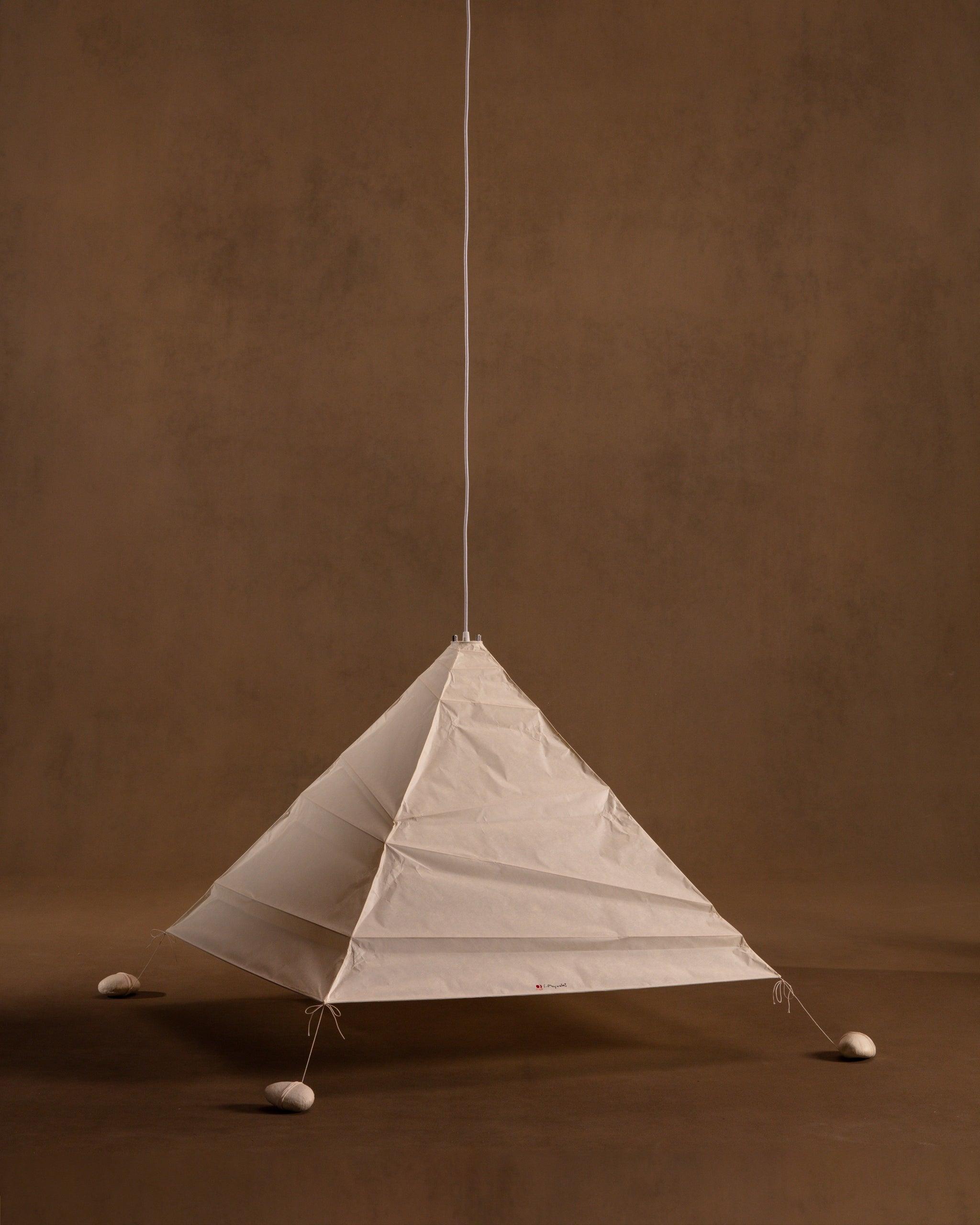
The Noguchi Museum Shop in Long Island City is selling two Akari that collectors could not buy until now. The VB1 and VB3 are pyramidal washi sculptures Isamu Noguchi designed for What is Sculpture?, his solo hang in the American Pavilion at the 1986 Venice Biennale. Ozeki & Co. in Gifu made them then and has only now put them back into production for retail. Noguchi added a run of “VB” models for that pavilion after being warned that paper lamps would look too commercial next to stone; the lamps stayed in the show anyway. The reissue coincides with Akari’s seventy-fifth year and with No Ordinary Light at the museum through 5 September 2027. Both models are listed in stock and ship in one to two weeks. What changes is how each one occupies a room.
The VB3 Holds the Floor With Four Stones
The VB3 is the wider of the two: a four-sided hanging pyramid in mulberry-bark washi with irregular, widely spaced bamboo ribbing (detarame higo). The shop lists it at 35.4 by 35.4 by 25.6 inches, or 90 by 90 by 65 centimetres, for $2,800. Four white cotton strings leave the corners and may be tied to four included washi-wrapped stones that Ozeki sources in Japan. In Venice, Noguchi showed this model with the stones attached, so the shade sat as a tethered volume on the floor plane.
That is still the more architectural hang. Give it a clear patch of floor under a high ceiling, hardwire or plug-in so the cord drops cleanly from the apex, and let the stones mark the footprint. In a living room that already holds a sofa and a low table, measure that 90-centimetre square before you order; the stones claim more plan than a usual pendant. The irregular ribs cast a stepped glow, and the weights keep the paper from drifting when a window is open. Use an E26 LED up to a 60-watt equivalent, ideally around 2700K or warmer. Hardwire kits run six or twenty feet of white cord with a five-inch canopy; the plug-in kit is eighteen feet with a rocker switch.
"Sculpture is more than the creation of objects of art. Sculpture is an experience that is wide and involves the total environment."
Isamu Noguchi, on What is Sculpture? at the 1986 Venice Biennale
The VB1 Floats as a Three-Sided Pyramid
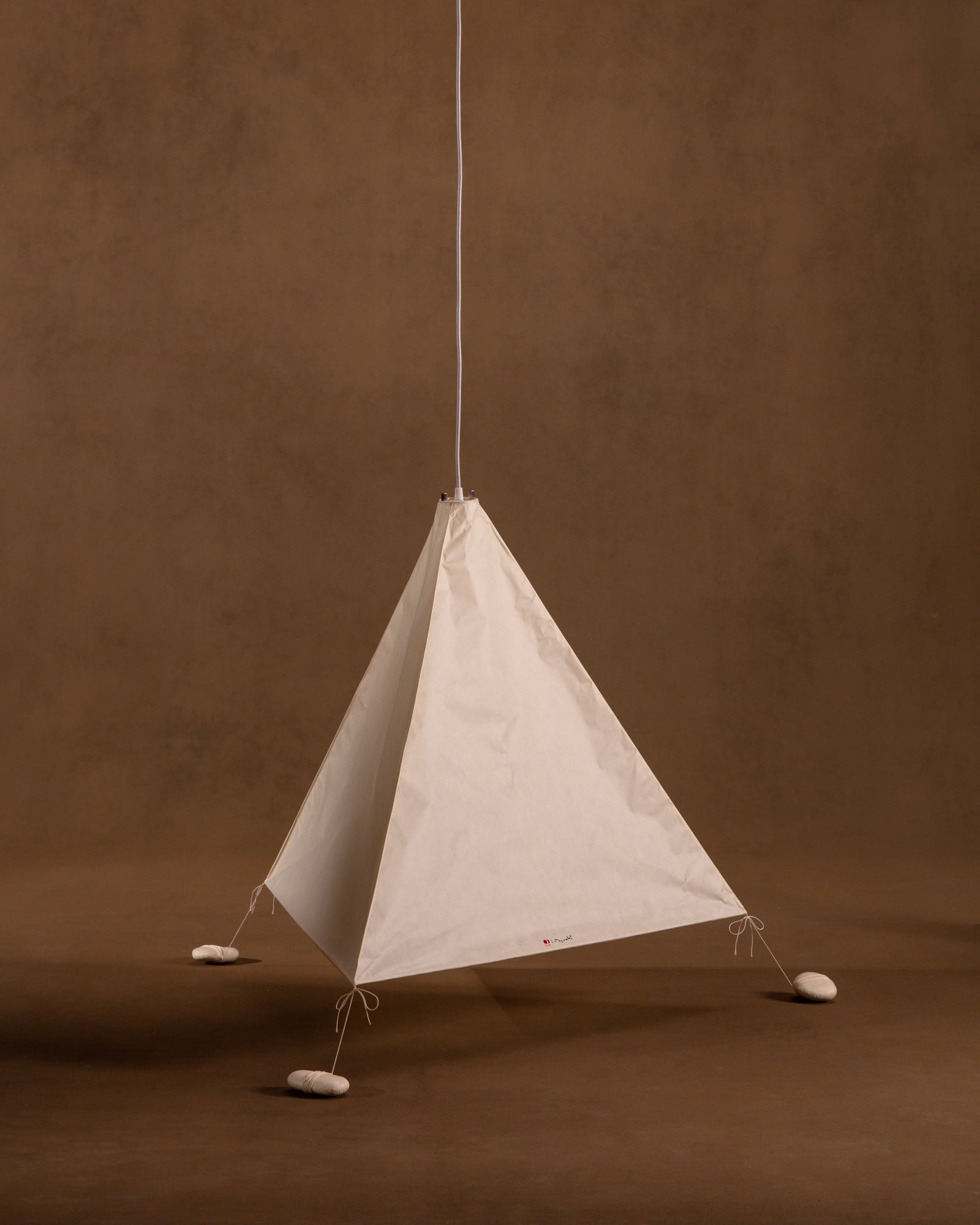
The VB1 is lighter in both structure and temperament. It is a three-sided pyramid, a tetrahedron, built without bamboo ribbing; the corners are cotton string alone. The shop lists it at 32.3 by 32.3 by 25.6 inches, or 82 by 82 by 65 centimetres, for $2,400. Three washi-wrapped stones come in the box and may be tied on, but in Venice Noguchi hung the VB1 without them, hovering just above the floor. Leave the stones off if you want the same soft volume that claims air more than floor.
It fits where four stones would crowd a sofa edge or a desk: a stair void, an open corner, a dining end that needs light without anchors underfoot. The unbroken paper face takes the glow without the ribbed steps of the VB3. Bulb and cord options match the VB3. Noguchi wrote that the triangle “seems to be nature’s way.” The paper-covered stones were Ozeki’s idea. “And, oh, what a beautiful thing!” he said of that detail.
North America is the sales territory for these models through The Noguchi Museum, online and at the Long Island City shop. Contiguous United States orders go UPS Ground. Within the five boroughs you can choose messenger delivery, arranged by email after checkout. Canada, Mexico, Alaska, Hawaii, and other outlying U.S. islands ship DHL, with tax and duty included in the shipping price where that rule applies. Signature is required on Akari over $700. The shop will not ship to P.O. boxes or freight forwarders. Returns are allowed within thirty days if the lamp is unused and undamaged; the buyer pays return shipping. Outside North America, write akari@noguchi.org before assuming Vitra can supply the same models. Vitra carries other Akari in Europe, Oceania, and the Middle East; these VB designs are museum exclusives here.
If you are already in Queens for No Ordinary Light, the shop is open Wednesday to Sunday, with last entry at 16:30. For how Akari already changes a diaspora living room, read Noguchi and Asawa Changed How an American Room Can Feel.