At fair booths and evening sales, Korean modern art often arrives in New York as one surface: muted fields, hemp weave, paint treated as labor. Dansaekhwa earned the attention. Joan Kee's 2014 survey From All Sides at Blum & Poe in Los Angeles helped name the method for North American collectors, and Ha Chong-hyun's Conjunction canvases still move at Frieze. The trouble is what that success edits out. Too many hangings treat monochrome process as the whole of Korean modernism.
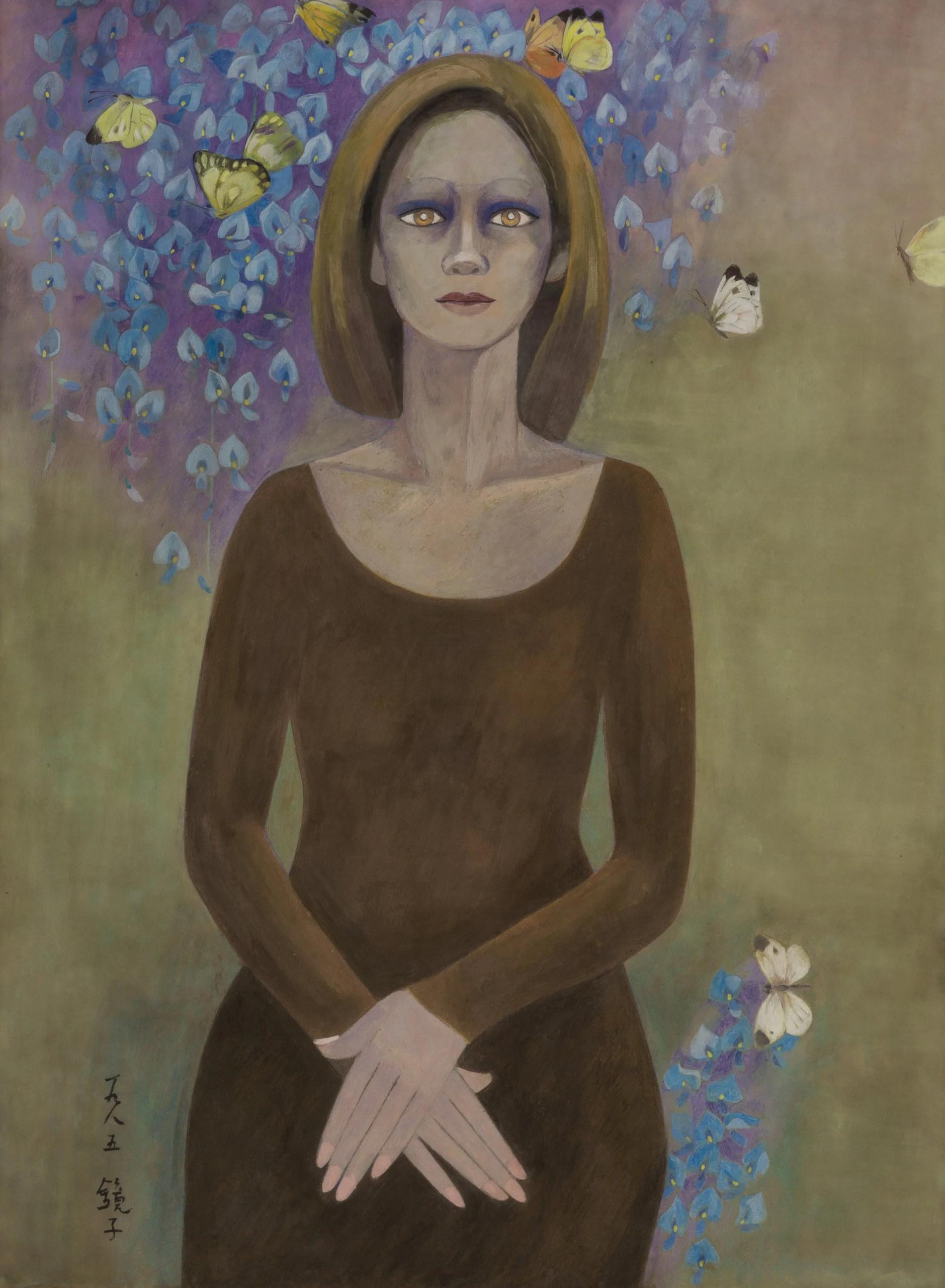
The Present Tense opened 19 November at the Korean Cultural Center New York and runs through 18 December. Organized with the National Academy of Arts of the Republic of Korea, Gallery 2F at 122 East 32nd Street holds twenty-five works across painting, sculpture, crafts, calligraphy, and architecture: twenty living academy members and five late masters, including Suh Se-ok, Lee Jong-sang, and Chung Sang-hwa. The opening reception was the evening of 18 November. Three canvases are enough to see what a Dansaekhwa-first hang usually leaves out: Chun Kyung-ja's Woman with Butterflies from 1985, Ha Chong-hyun's Conjunction 24-11 from 2024, and Kim Whanki's Untitled from 1968.
Chun's Butterflies Still Hold the Center
Chun Kyung-ja's Woman with Butterflies stops the monochrome story cold. A woman in a dark dress stands against an olive ground; blue flowers and yellow butterflies gather at her head while her hands cross at the waist. Born in Goheung in 1924 and trained in Oriental painting in Tokyo, she taught for decades at Hongik University, built pigment in layers until the surface thickened, and kept the figure when abstraction took the prestige rooms. She later lived in New York and died there in 2015. In Korea she became a painter people recognized on sight. Export taste has been cooler to that saturated figurative line than to quiet fields.
Walk from her canvas into the rest of the academy hang and the same range keeps opening. Suh Se-ok's ink People from 2000, Park Kwang-jin's landscape, Jeun Loi-jin's stone family sit nearby without borrowing Ha's method. Chun puts autobiography and color back where export taste has been slowest to look.
Ha's Conjunction Is the Chapter Everyone Already Knows
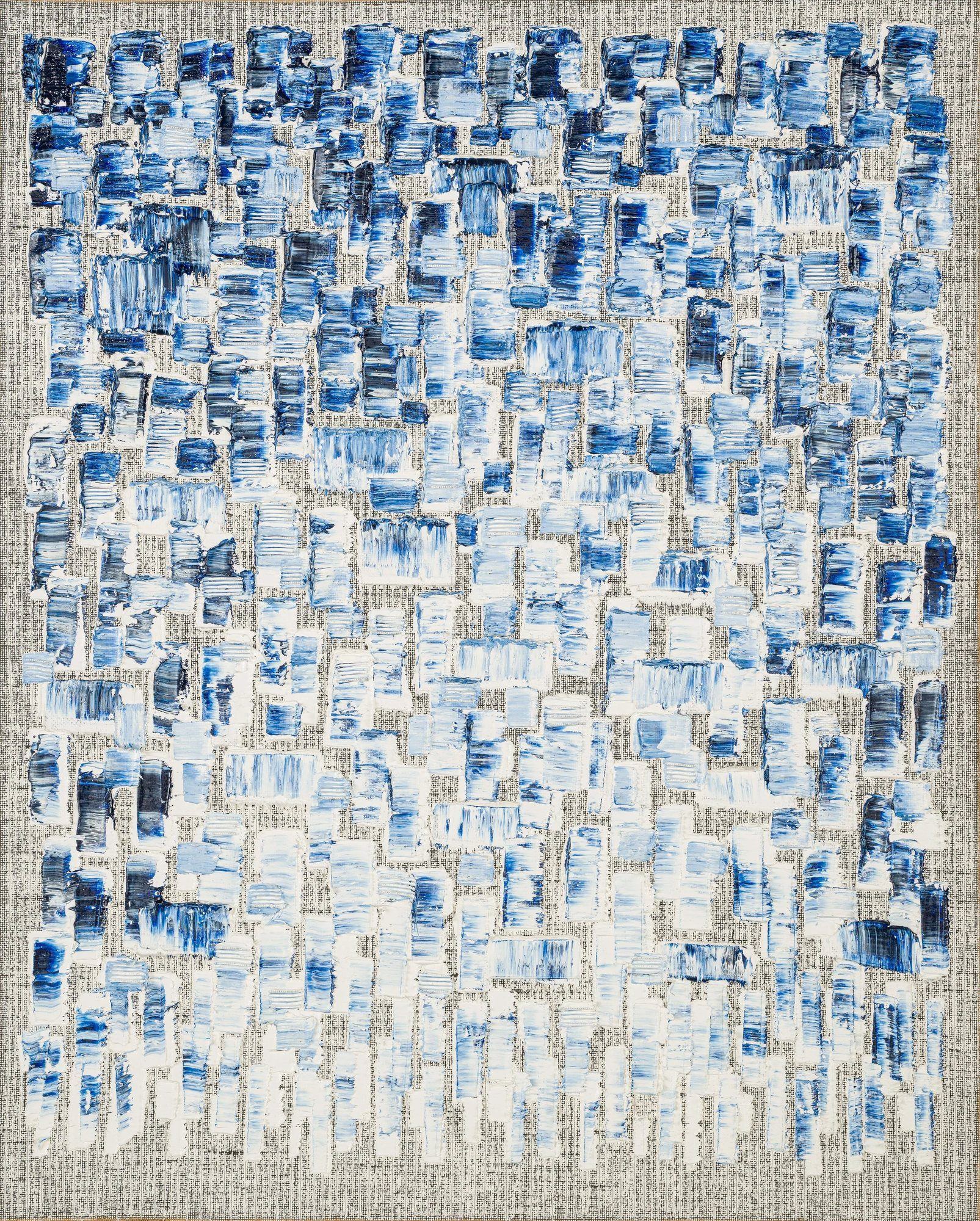
Ha Chong-hyun's Conjunction 24-11 is the familiar face of the export story. Since 1974 he has pushed oil through the back of coarse hemp in the baeapbeop, or back-pressure, method that became a signature of first-generation Dansaekhwa. Weave and paint meet as one object. Early works used wartime and reconstruction materials; recent Conjunction pictures keep the same physical argument while the color can run hotter. The 2024 canvas on East 32nd continues a practice now fifty years old.
Putting him beside Chun is the useful move. Dansaekhwa is a real chapter of method, material, and making under authoritarian years, and Korean painting keeps going past that chapter. Start Art Basel Paris at Booth O.A2 already tracked a later Conjunction on a fair floor this autumn. Here the same practice sits inside an academy survey that still has room for ink, craft, and figurative color. Ha belongs on this wall as one practice among others.
Whanki's 1968 Untitled Belongs to New York
Kim Whanki's Untitled from 1968 is the New York picture in the room. After representing Korea at the São Paulo Biennale in 1963, he settled here and worked in the city until his death in 1974. The late-sixties pictures come before the famous all-over blue dot paintings of the early seventies. Mountains, moons, and islands thin into dots, lines, and planes. His journal for 23 January 1968 records the experiment he was running that winter.
"Trying with flying dots and dots gathered to symbolize shapes."
Kim Whanki, journal, 23 January 1968
Auction fame later fixed Whanki as deep blue fields sold at evening prices. The Present Tense returns him to the messier New York year, in Midtown Koreatown, a short walk from Herald Square. Anyone who knows the late dots mainly from catalogues rarely sees that 1968 laboratory hung in the city where he made it. Pair the visit with Seventy Years of Asia Society, Still on Park Avenue if you want an Upper East Side museum day; keep Why Frieze Seoul Owns September for the fair-week map. On 32nd Street the case is shorter. Dansaekhwa sold well. Chun's butterflies, Ha's hemp, and Whanki's 1968 dots show how much larger Korean modern painting looks when one room holds more than one surface.
Gallery hours run Tuesday to Friday, 10:00 to 18:00, and Saturday, 11:00 to 17:00, closed Sunday and Monday. The second-floor gallery is open to the public; confirm current access on koreanculture.org before a Saturday. The hang stays up through 18 December.