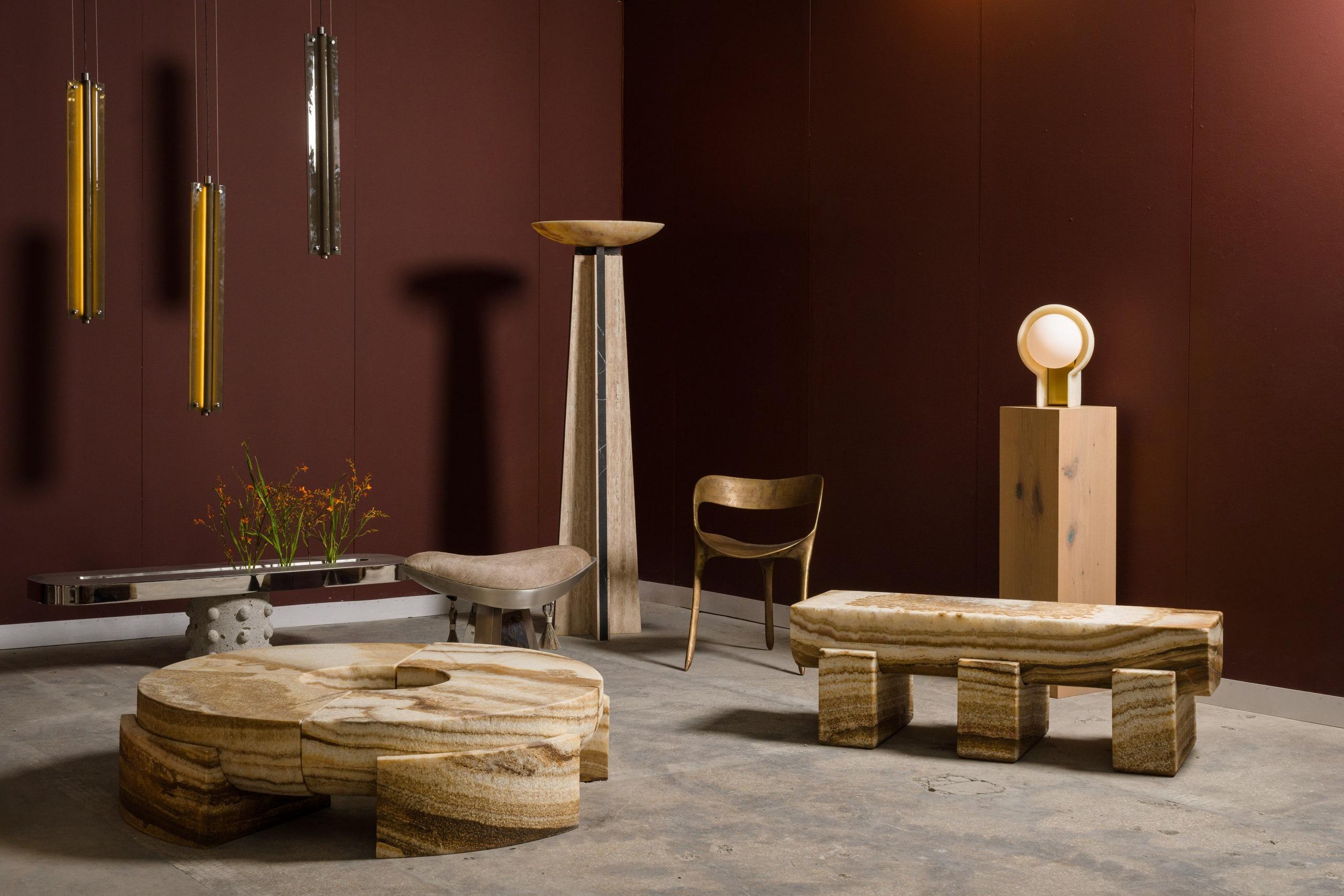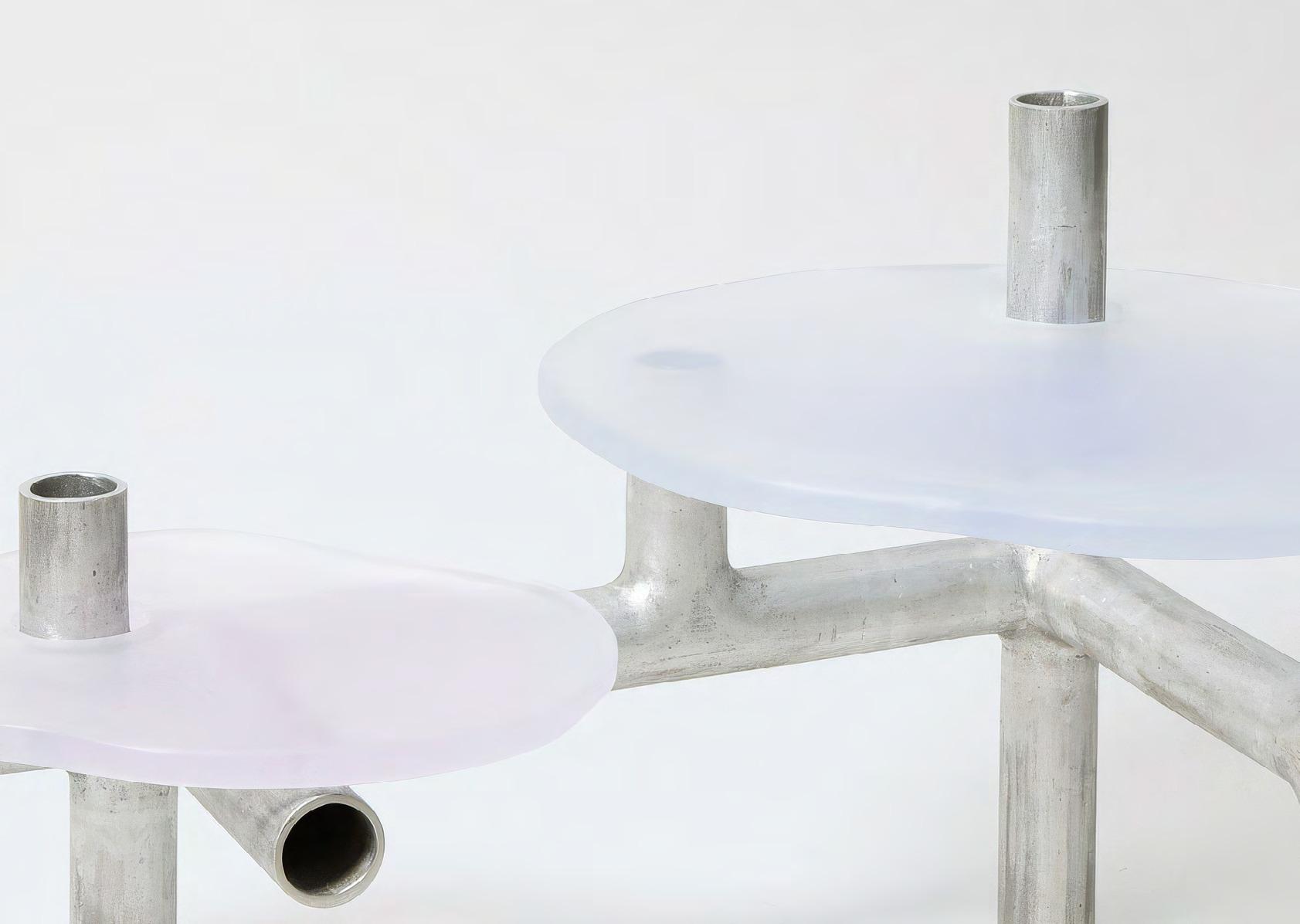
On Jeonghwa Seo’s JS-013 coffee table, the hollow tubes that hold the frosted acrylic still show ridges and knots that belong to wood, even though the piece is cast aluminum. Carwan Gallery has opened Precise Play in Wong Chuk Hang through 20 February 2027: Seo’s first Hong Kong solo, and the inauguration of the gallery’s Asian space after Beirut and Athens. Cylinder Series furniture and lighting share the hang with Material Container stools and a few new commissions.
Sand Cast, Still Timber to the Eye
JS-013 belongs to the Cylinder Series: sand-cast aluminum tubes, edition of twelve plus two artist’s proofs, made in Seoul factories Seo has used for both metal and acrylic. The low acrylic top sits about 38 centimetres high; a second tier rises to about 50. Catalogue notes put the plan near 130 by 90 centimetres. Lilac and white frosted slabs sit on the frame so the metal shows through faintly. Put a hand on the tube and the read changes. It is cold, and the grain does not give the way timber does.
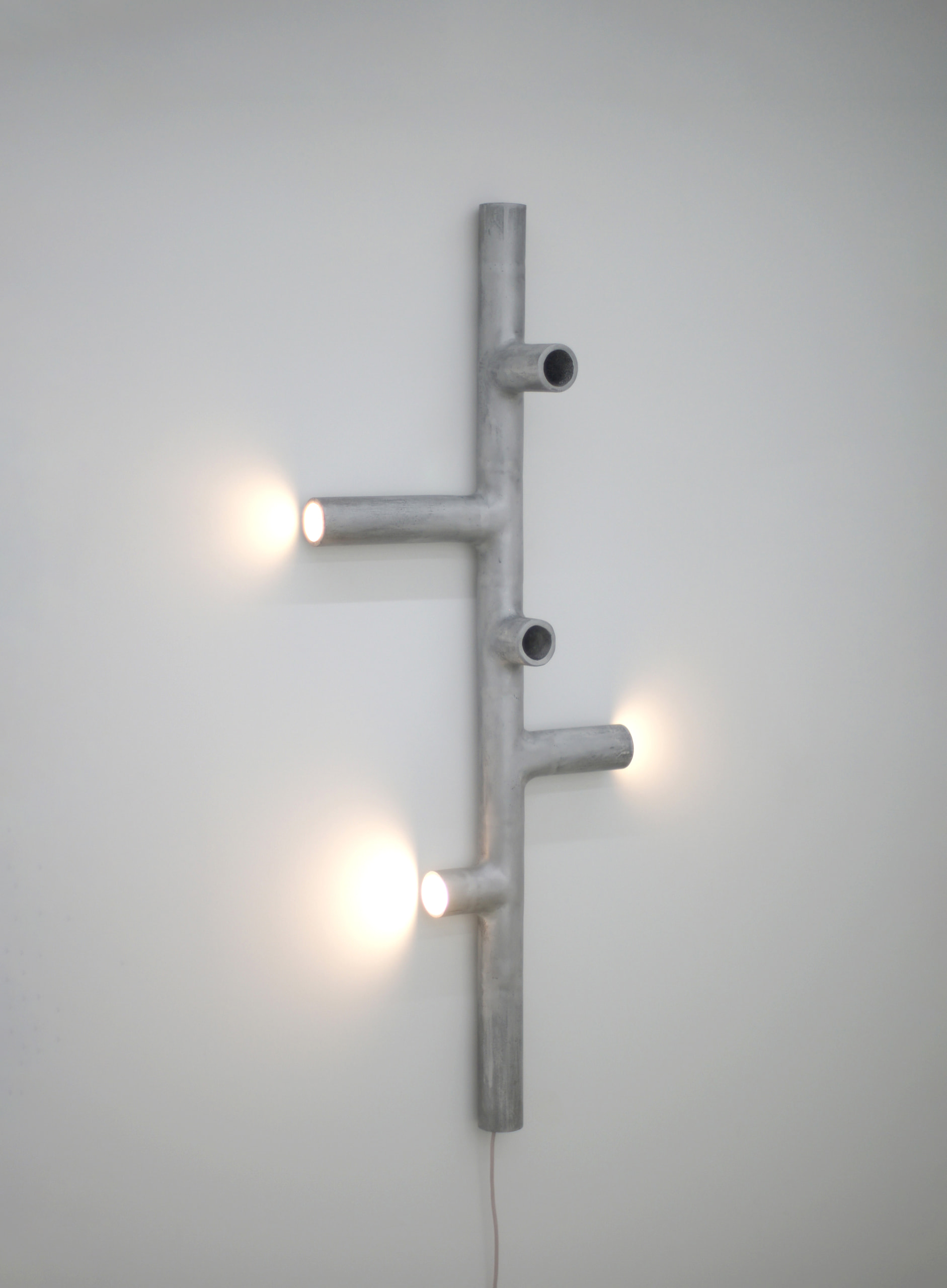
Seo gets that grain through aluminum sand casting. Wood’s surface and growth marks go into the mold; the metal keeps the imprint. The process is industrial enough for edition furniture and precise enough that a knot can survive as a ridge under a palm. On a wall light from the same series, the bark lines run along every branch of pipe before the warm circles hit the plaster. The furniture is quieter about the same fact: an industrial cylinder that still looks like timber until touch corrects the eye. Catalogue copy for the Hong Kong hang calls the frames raw silver-grey and the acrylic hand-sanded into soft lilac, amber, and white, so the translucent tops keep catching the light against the cast.
“The Cylinder collection was created by focusing on the overlapping effect seen under the acrylic plate.”
Jeonghwa Seo, on the series, to Dezeen (2024)
When the Hand Corrects the Eye
Once the eye has filed the piece as wood, temperature and weight correct it. The hard rim of a cast opening will not dent like a softwood rail. Seo, born in 1982 and trained in metal art at Hongik University before Eindhoven and a 2024 design Ph.D. at Seoul National University, has spent years pairing materials so density and surface disagree. Material Container stools on the same hang nest basalt, rosewood, brass, cork, and sand-cast aluminum in conical bases; the Victoria & Albert Museum holds a brass-and-Jeju-basalt example from that line. Cylinder Series tightens the same idea into one material that looks organic and behaves industrial.
In a Hong Kong flat, that matters. Seo’s aluminum keeps the grain as a visual cue while the structure stays hard enough for daily use. The acrylic tops soften the silhouette without the maintenance of a veneer. He has described the series to Dezeen as softness against brutality; in the room, the tree stays visible and a glass can still sit on metal that will not mark. Consoles, daybeds, and totem shelves nearby repeat the tube language at different scales, so the grain reading does not live on one coffee table alone. Collectors who buy Korean woodwork for joinery will find a different craft here: the work is in the mold and the cast, not in a half-tuck you can name from a Joseon shelf.
Carwan lists the Wong Chuk Hang address as Unit A, 9/F, E Tat Factory Building, 4 Heung Yip Road, with hours Tuesday to Saturday, 11:00 to 19:00. Take the South Island Line to Wong Chuk Hang and walk Heung Yip; call +852 3008 5615 before a first visit if the building lobby confuses you. Download the exhibition catalogue on carwangallery.com, then give JS-013 enough time for the eye and the hand to disagree. For another Korean furniture lesson on the island this season, What Teo Yang Kept From Traditional Korean Furniture in His New Hong Kong Show is the Central parallel at NUOVO.