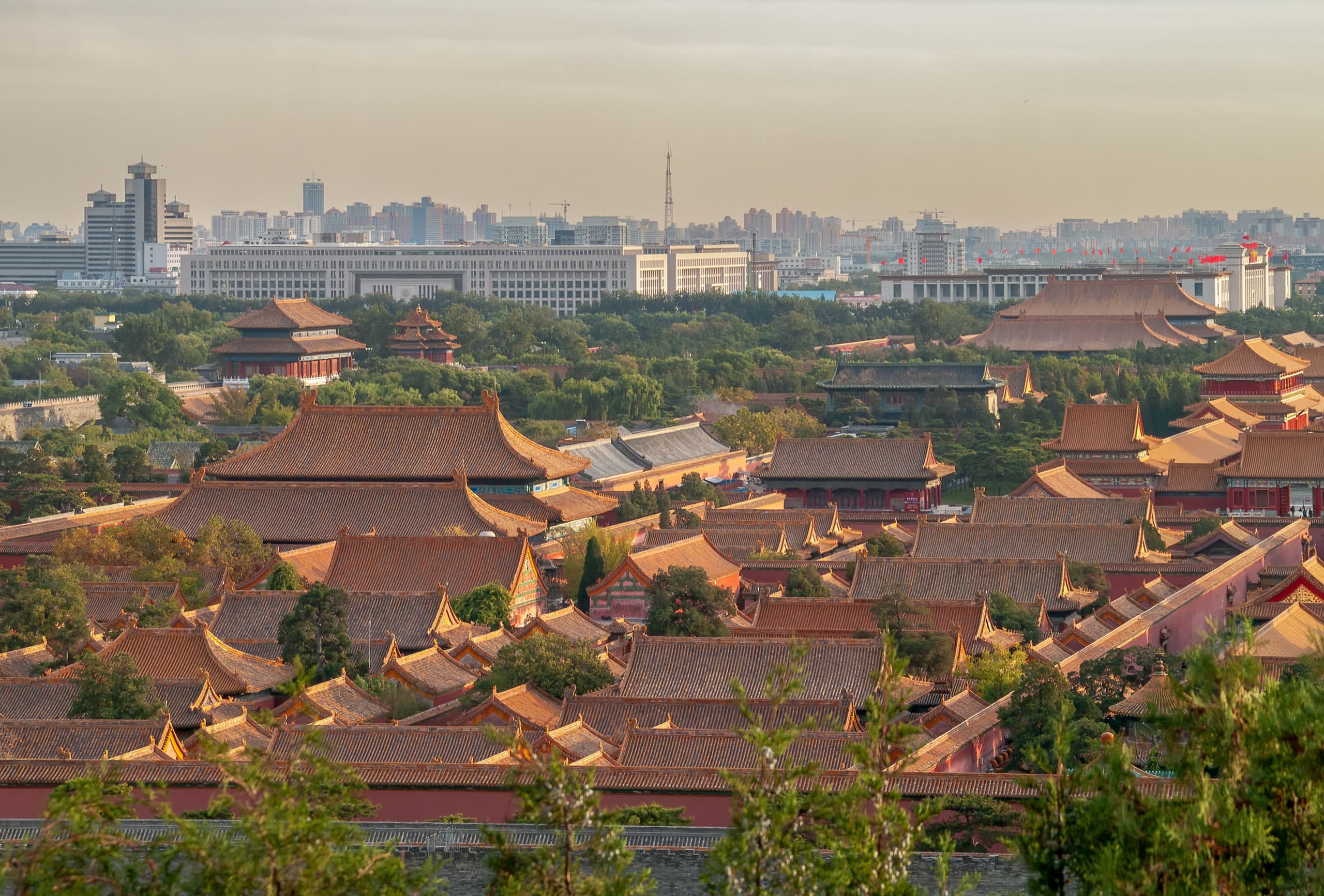
The Forbidden City from Jingshan Park, Beijing: yellow roofs running south, the modern skyline beyond the trees. Photograph by Reinhold Möller.
Walk Taikoo Li Sanlitun North this spring and the capital looks like a luxury boom. Hermès opened its fourth Beijing store there on 2 April 2026, a five-storey glass box wrapped in rose-pink ceramic. House of Dior Beijing, a petal-and-gold building by the Pritzker laureate Christian de Portzamparc, had opened in December 2025, with a Monsieur Dior restaurant on the garden level. Louis Vuitton landed on the same rebuild that month. Tiffany cut the ribbon in March.
Then look at the ledger. Bain & Company, which has the closest thing the trade has to a census, put mainland personal luxury down about 17 to 19 percent in 2024 and another 3 to 5 percent in 2025. The houses are still building. The market they are building for is smaller, pickier, and less willing to be photographed.
The political weather for that split arrived on 17 August 2021, when Xi Jinping put gongtong fuyu, common prosperity, at the center of the tenth meeting of the Central Financial and Economic Affairs Commission. The authorized write-up came two months later, in Qiushi, the Party journal, on 15 October. China, it said, had finished the work of letting some people get rich first. The next stage was an olive-shaped income structure, a larger middle, and a tighter hand on what the top took home.
Paris and Milan heard a simpler sentence. If the best client in the industry was being told to look less rich, the decade they had just lived through was over.
Five years later, the useful story is how that speech, a property slump, and a more cautious Asian buyer arrived at the same counter. Common prosperity is the climate. It is one reason the numbers moved. The property market, the price hikes, and a sour household mood did the daily arithmetic.
What the document actually said
Start with the text, because the trading floor did not.
Common prosperity is Party vocabulary with a long shelf life. Mao used the phrase. Deng turned it into “let some get rich first.” Xi put it back at the center after the poverty-alleviation campaign and the 2020 claim of a moderately prosperous society.
The August speech, in the authorized English on Qiushi’s site, is specific about time. By the end of the 14th Five-Year Plan in 2025, solid progress. By 2035, “more notable and substantive progress,” with basic public services equalized. By mid-century, common prosperity “basically achieved,” with income and consumption gaps in a reasonable range. Luxury desks close the books every three months. The Party wrote a thirty-year clock.
The tools listed were taxes, social insurance, transfers, a property-tax trial, and a look at widening consumption taxes that already sit on things like high-end watches, jewellery, golf, and yachts. Zhejiang was named the demonstration province. A Central Committee and State Council opinion dated 20 May 2021, published in June, told Hangzhou to show the rest of the country how it is done by 2025, and to come close to the full goal by 2035.
The text names polarization, illegal income, monopoly pay, and “lying flat.” Louis Vuitton goes unmentioned. The luxury effect was downstream: a signal about display, tax, and which kinds of wealth were safe to photograph.
“We will regulate excessively high income in a reasonable manner, improve the personal income tax system, and standardize the management of capital gains.”
Xi Jinping, “Making Solid Progress Toward Common Prosperity,” Qiushi, from the 17 August 2021 speech
That is a tax sentence. The industry heard a taste sentence. Both readings have been true, in different rooms.
The week the shares moved
In the days after the August meeting, Kering and LVMH lost as much as 14 percent in a week, Reuters Breakingviews reported on 23 August 2021. The fear was simple. Euromonitor had Chinese shoppers at about 40 percent of global luxury demand that year. A political turn against conspicuous wealth looked, from a trading floor, like a demand shock.
It was also a donation week. Tencent had already put 100 billion yuan into social-value and charity pots that officials folded into the common-prosperity story. On 2 September, Alibaba said it would invest another 100 billion yuan by 2025 in ten programs: small firms, rural digitalization, gig workers, healthcare in poorer places. Reuters called it $15.5 billion. The companies were answering a political cue, not a product brief.
Then the tax bureau did the visible work. On 20 December 2021, Hangzhou fined Huang Wei, the livestreamer known as Viya, 1.34 billion yuan for hiding income. Her accounts came down the same day. She had made a living selling almost anything on Taobao Live, and looking rich while she did it. The fine was about tax. The audience was everyone who had built a career on a phone.
The Party already had entertainment rules, tax notices, and a public example. Those were enough.
The numbers, after the slogan
If you stop the story in 2021, you miss the part that actually hit the boutiques.
Mainland personal luxury, on Bain’s January 2026 reading, fell about 17 to 19 percent in 2024, then another 3 to 5 percent in 2025, with the second half of last year finally looking less ugly. Beauty was the durable category, up roughly 4 to 7 percent. Leather dropped about 8 to 11 percent. Watches were worse, down something like 14 to 17 percent. Fashion sat in between, down 5 to 8 percent. Secondhand grew 15 to 20 percent, and still accounts for less than a tenth of the primary market. The buyer still wants the object. The full retail story, and the full logo, are easier to skip.
We’ll be blunt: those ranges are a consultant’s way of saying the floor moved and nobody wants to pretend they know the last decimal. What you can use is the shape. Entry leather got harder to defend. A jar of cream did not. A pre-owned Kelly became a reasonable conversation.
Chinese shoppers have always been a traveling client as well as a mainland floor. In 2023, Bain put their share of world personal luxury at about 22 to 24 percent, with a long-range path back toward 35 to 40 percent by 2030 if confidence returned. In 2024, about 40 percent of what they spent went overseas. Japan, on a cheap yen, was the windfall: some tickets ran as much as 30 percent under mainland prices. Asia-Pacific receipts from Chinese tourists ran around 120 percent of 2019. Europe was still at about half.
In 2025 that tide turned. Bain’s January 2026 note put 65 percent of Chinese luxury spending back on the mainland and 35 percent abroad. A weaker renminbi closed some of the gap. Mall promotions did the rest. The houses that had staffed up in Ginza for a permanent arbitrage had to relearn the domestic floor.
Bruno Lannes, Bain’s senior partner on the China report, called 2025 a recalibration, not a rebound. Very Important Clients still held a large share. Younger aspirational buyers delayed entry. That split matters more than a single growth rate. The top of the pyramid can still clear a Kelly. The middle of the pyramid, the part common prosperity said it wanted to enlarge, is slower to put a bag on a payment plan.
China’s property slump took household wealth with it. Price increases after 2022 made entry leather harder to explain at dinner. Youth unemployment and a sour consumer-confidence print did more daily work than a Qiushi essay. Common prosperity told a rich person, in public, that looking careless was a risk. The other facts collected the bill.
“The government has been pushing for common prosperity, and they have been discouraging any sort of money worshiping.”
Kenneth Chow, principal at Oliver Wyman, speaking to CNBC in July 2024
How a rich person is supposed to look
The cultural half of the policy showed up on the feed.
On 23 April 2024, the Cyberspace Administration opened another Qinglang, or “clear and bright,” campaign against influencers who built traffic by flaunting wealth. Accounts associated with Wang Hongquanxing, sometimes billed as China’s Kardashian, and Bo Gongzi, who posted cars and Hermès, ran into the usual disappearance. State media talked about money worship and “toxic traffic.” Viya’s fine had been a tax case. These takedowns were a taste case: who was allowed to look rich on a phone.
Consultants reached for “luxury shame” the same summer. Claudia D’Arpizio, Bain’s global head of fashion and luxury, told CNBC the posture in government had a psychological effect. Some wealthy households moved money. More of them stopped performing wealth for strangers. She compared it, carefully, to the United States after 2008, when people who could still buy chose not to look as if they were.
Lisa Wan, a professor at the Chinese University of Hong Kong’s School of Hotel and Tourism Management, still warns against a tidy East-West split. Speaking with Channel NewsAsia Luxury in 2025, she put the share of Chinese luxury consumers who still associate visible logos with wealth at more than half. Quiet luxury is a real shift among people who already know the codes. Plenty of buyers still want the logo to do the talking.
What changed is the audience. A bag that used to face the escalator now faces the owner. Appointment salons, private rooms, and objects that read as craft rather than billboard became the safer grammar. That is the same move we tracked in The New Asian Luxury Buyer Doesn’t Need You to Recognize the Brand, and the same money that slid from entry leather to a jar in China’s Luxury Consumer Is Trading the Handbag for the Beauty Counter. Common prosperity made public luxury more expensive in a currency the tax office does not collect: attention. Private rooms and quieter objects were already in the culture. The policy made them look like the adult choice.
Diaspora buyers felt it even when they were not under the CAC. A Hong Kong or Vancouver household that still shops in Paris now thinks twice about posting the receipt. Relatives on the mainland scroll the same apps. The family WhatsApp is a more careful room than it was in 2019. Spend has not vanished. The performance of spend has thinned.
Korea, for now, is the offset. South Korea Is Luxury’s Bright Spot While the Market Hesitates is the other Asian ledger: a won story, a tourist story, and a department-store story that does not run on the same political clock.
The houses that stayed, and the ones that shrank
The share-price panic of August 2021 priced an exit. The houses stayed. The China they kept was smaller and pickier.
LVMH’s Asia business excluding Japan was 35 percent of group revenue in 2021. By 2024 the filings put that weight at 28 percent. Kering’s Asia-Pacific share, excluding Japan, slipped from 38 percent in 2021 to 30 percent for the full year 2024. Mid-tier logo houses took the worse bruising. Hermès, which sells scarcity to people who already have the appointment, kept looking sturdier. That is a client mix.
And the capital kept landing in Beijing. Swire finished a deep rebuild of Taikoo Li Sanlitun North in early 2026 and said footfall had risen since the December openings. Those buildings are bets that the remaining client, the one who still buys, wants a quieter room and a longer visit. A five-storey Dior with Anne-Sophie Pic, the French chef, cooking on the garden level is a different wager from a mall in-line that lives or dies on weekend traffic.
Nicolas Hieronimus, L’Oréal’s chief executive, told analysts as early as October 2021 that redistributing wealth would likely enlarge China’s middle class and help his business. The official theory of common prosperity agrees with him on paper: grow the middle, keep legal riches. The last five years showed the gap between that theory and a household that watched property prices fall and livestreamers get fined. Beauty held up. Leather did not. He was right about the category. He was early about the mood.
Zhejiang, the demonstration province, reported a 2024 GDP of 9.01 trillion yuan. The Party study texts of 2025 called that substantial progress. You can believe the provincial numbers and still notice that a Hangzhou livestreamer was the example the rest of the country remembered.
The long clock
Common prosperity is written through 2035 and the middle of the century. Luxury houses report every three months. That mismatch is now the operating condition.
Beijing needed people to believe that looking careless with money had a cost. Once that belief set, the property slump, the Japan price gap, and a tired middle class did the arithmetic. Global luxury is living with a Chinese client who still matters, who still travels, and who is less willing to be the industry’s growth engine on camera.
The roofs from Jingshan have not moved. The permission to look like you own the view has.
Confirm current house figures in the next earnings season. The policy will still be there. The quarter will not.