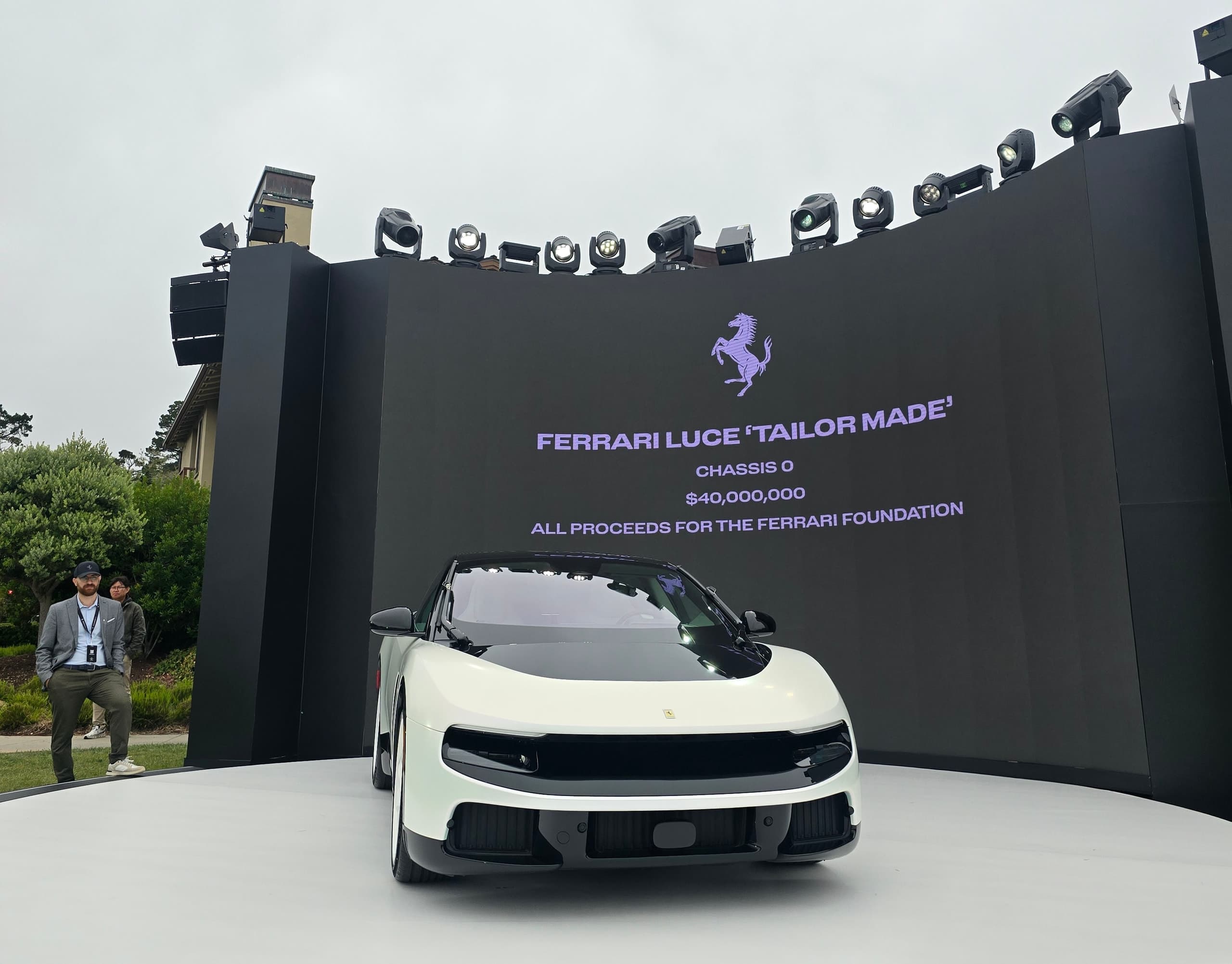
On the Monterey lawn last week, Chassis 0 sat under a curved wall that did the talking for it: Ferrari Luce Tailor Made, forty million dollars, all proceeds for the Ferrari Foundation. RM Sotheby’s had estimated the lot north of a million. The hammer stopped at $40 million on 15 August, buyer’s premium waived, every dollar for education through the foundation. Delivery waits until early 2027, after Maranello finishes the car.
Read the figure as charity theater first. The useful question is the one Monterey staged in public: whose taste is Ferrari designing for now?
“Real innovation is not democratic. Breakthrough ideas rarely emerge from immediate consensus.”
Ferrari CEO Benedetto Vigna, LinkedIn, May 2026
The Car the Forums Hated Cleared Its Book
Ferrari introduced the Luce in Rome in May as its first series-production battery-electric model and its first five-seater, shaped with Jony Ive and Marc Newson of LoveFrom, the San Francisco studio known for Apple-era product restraint. List price sits around €550,000 before taxes. The silhouette is cab-forward, glass-heavy, and short on the visual grammar that makes a classic Ferrari photograph well on a forum. Shares fell hard the next session. Former chairman Luca di Montezemolo, who ran Ferrari for two decades until 2014, hoped aloud that the prancing horse might come off the car. Italy’s deputy prime minister and transport minister, Matteo Salvini, piled on online. Classic owners did what classic owners do when a house invents a new client: they took it personally.
Maranello took the abuse and kept selling. People familiar with the company told the Financial Times that the planned 2026 allocation of just under 500 Luces was spoken for within roughly two months, before customer deliveries. Demand ran especially strong in China. Feedback from technology entrepreneurs in hubs such as Silicon Valley was described as positive. Dealers, per the same reporting, were told not to lean on traditional petrol collectors to take one. Ferrari opened a second client book. It left the first one alone.
That is the chagrin, compressed. The Luce courts buyers who already live with electric cars, new wealth, and a different idea of what a Ferrari should do in a driveway. Plenty of those buyers are Asian, Asian diaspora, or sitting in the same tech corridors where diaspora capital already moves first. Chassis 0 did not need the forums to like it. It needed a room that understood firsts.
Early Adopters Do Not Wait for Permission
The diaspora piece of this story started years before Monterey, in ordinary registration data.
In the United States, Asian buyers have long punched above their population share in battery-electric sales. A 2022 Mobility Global registration cut, the kind of industry dashboard dealers actually read, found that 16 percent of Asian new-vehicle registrations were electric, against roughly 3 percent for Black and Hispanic buyers in the same window, with Tesla taking nearly four-fifths of Asian EV registrations. We’ll be blunt: that is early-adopter behavior with a checkbook. S&P Global Mobility’s more recent cuts still show the pattern. Through the first quarter of 2025, Asian households were about 7 percent of all new registrations yet roughly 27 percent of new Teslas. Through mid-2025, they accounted for about 19 percent of battery-electric volume. Prefer premium and tech-forward nameplates, and the same households show up again in Mercedes and BMW electric SUVs.
North of the border, Environics Analytics’ EVTrends work flagged culturally diverse families, predominantly of Chinese and South Asian descent, among the cohorts whose EV and plug-in growth was outrunning the Canadian average. Automakers noticed. Kia’s Canadian EV marketing went straight at Chinese and South Asian newcomer households. Asian households remain a mix at the charger, of course. When a new powertrain needed early believers with income, education, and urban density, those communities were already in the queue.
Put Ferrari’s bet against that map and the Luce looks less like a provocation and more like homework. China already treats EV literacy as ambient. Silicon Valley, where Asian American and Asian Canadian professionals have spent a decade normalizing six-figure electrics as garage furniture, already did the social proof. The classic Ferrari fan who still wants a V12 soundtrack was never going to lead that transition. The people who already charged overnight were.
Taste Moves Before the Badge Catches Up
Cars are only the loudest chapter. The same early-adopter posture shows up wherever scarcity and craft meet a buyer who does not need European permission to feel current.
Watch collectors know the feeling. The Next Collectible Watch May Come From Asia, Not Switzerland follows limited runs from Singapore, Hong Kong, Tokyo, and Kuala Lumpur bought for finishing and proportion. Soft goods tell a parallel story: South Korea Is Luxury’s Bright Spot While the Market Hesitates watches Seoul keep spending when other capitals pause. Fashion’s Asian American experiments, from CFGNY outward, treat ambiguity as material. Across categories, the diaspora reader often arrives first, then watches the house rewrite its deck to look intentional.
Luxury houses already design around that consumer’s phone research, celebrity map, and useful skepticism. Ferrari’s version is louder because the badge still carries a combustion myth. The Luce forces the house to decide whether the myth still picks the client. Monterey put a foundation plaque and a forty-million-dollar line item on the answer.
What the Hammer Actually Bought
Be precise about Chassis 0. It is a one-of-one Tailor Made first: Madreperla paint that shifts with the light, a plaque that freezes production order at zero, charity paperwork that makes the bid a gift as much as a purchase. Reports named Dr. Herbert Wertheim, the Florida optics-and-investment billionaire who also paid $26 million for a Tailor Made Daytona SP3 at Monterey the year before. Call it relationship philanthropy at auction volume. Do not confuse the bidder with the client book the Luce was built to open.
Ferrari still used Car Week, among the most photographed stops on the collector calendar, to put a public figure on the opening chassis of its electric program. Classic culture got to hate the silhouette in peace. The order book filled anyway. China and the tech hubs did the quiet commercial work. Diaspora EV early adoption had already made the quieter cultural case: electric can read as prestige before it reads as nostalgia.
That client’s habits were rehearsed in Tesla driveways and Chinese showrooms, and on Canadian suburban charging cords, long before LoveFrom drew a flying-bridge C-pillar. The forums can keep the V12 romance. Maranello is pricing the next chapter for the people who show up first.