The old room still has the oil portraits. The new room has the glass wall, the jade counter, and the auction paddle.
Canada's establishment taste was, for a long time, exactly what it looked like on paper: Anglo and French, clubby, inherited, comfortable with pastoral oils and a whisky at the Vancouver Club or Montreal's Mount Royal Club. That room still exists. It has simply stopped being the only room that matters. In Vancouver and Toronto, taste now forms as a composite of European inheritance, North American money, Indigenous craft, and an Asia-connected eye that treats art, architecture, seafood, jewelry, and dress as one continuous register.
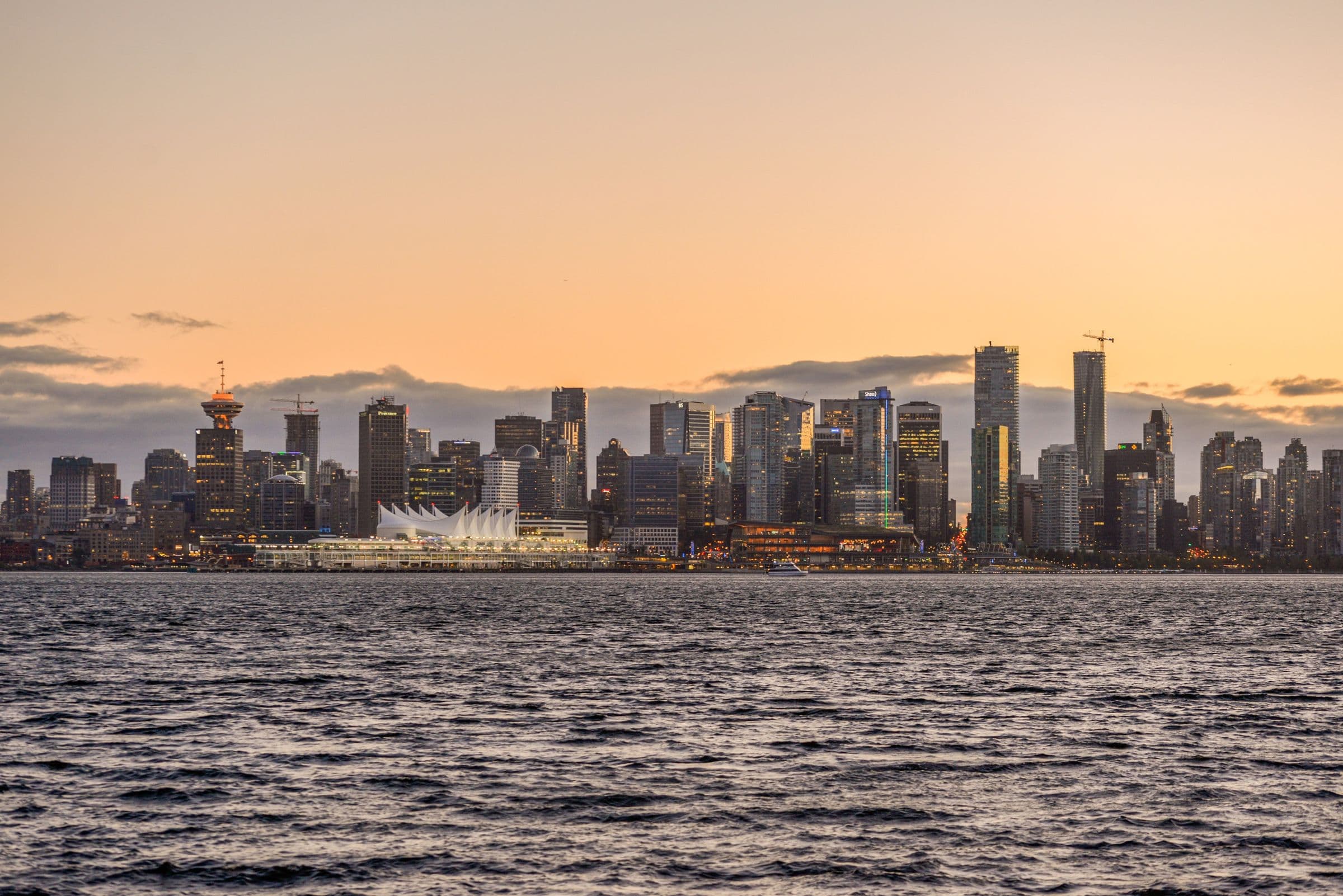
Skip "Canadian fashion" as a runway category. Ask who sets the register in two cities where Pacific Rim wealth and multilingual retail floors have been rewriting the default for a generation. Much of the answer sits on museum boards and gala committees rather than backstage.
"This is just as much about leaning into our heritage as it is about design excellence."
Deborah Lau-Yu, founder of Fête Chinoise, on the Signature Event's design brief, 2024
The Inherited Room
Start with what taste used to mean here, because the contrast is still standing on Hastings Street. The Vancouver Club, founded in 1889 and modelled on London gentlemen's clubs, kept British portraiture on its walls well into the late twentieth century. Women were admitted in 1993. The collection has since shifted toward contemporary work, but the building's Edwardian façade still signals the old grammar: inherited membership, Anglo comfort, the assumption that culture arrives from Europe and is installed here. Montreal's Mount Royal Club, designed by McKim, Mead & White and once the social spine of the Golden Square Mile, tells a similar story in French and English: Protestant business families, club dinners, a commercial capital that briefly thought it ran the country.
That establishment lost its monopoly without disappearing. Writing in the Literary Review of Canada in 2012, John Ibbitson put the arithmetic bluntly: Canada is importing a new Toronto every decade, and the old New York, Toronto, and London triangle carries little resonance for arrivals whose families are bound to the Pacific by language and kin. The Vancouver Club's own evolution shows how the transfer worked in practice. In the 1970s, Charles Merritt, a Victoria Cross recipient from the Dieppe raid and later a member of Parliament, sponsored Tong Louie into the club, a moment the club's own history treats as the opening toward a more diverse membership. Louie had turned his father Hok Yat's 1903 Chinatown grocery into a retail empire spanning IGA and London Drugs. He understood the code exactly: assimilate, prove you belong, then buy the pharmacy chain.
His son Brandt Louie sits on bank boards and university chairs today, prefers to be "nondescript," and runs one of British Columbia's largest private companies. The Louies are establishment now. They simply arrived through a different door.
Glass, Cedar, and the Mountain View
If the inherited room is portrait and paneling, the West Coast room is glass, cedar, and whatever the weather is doing outside.
Arthur Erickson, whom Philip Johnson rated by far the greatest architect in Canada and possibly the greatest on the continent, built the country's most persuasive case for taste as environmental grammar. After a 1961 trip to Japan, he translated teahouse material restraint into Pacific Northwest light: post-and-beam, concrete, floor-to-ceiling glass, houses that spiral through courtyards and forest. The Smith House in West Vancouver, built in 1965 for artists Gordon and Marion Smith, won the Royal Architectural Institute of Canada's Prix du XXe siècle in 2007. It is still the template: art, architecture, and landscape held in one continuous promenade.
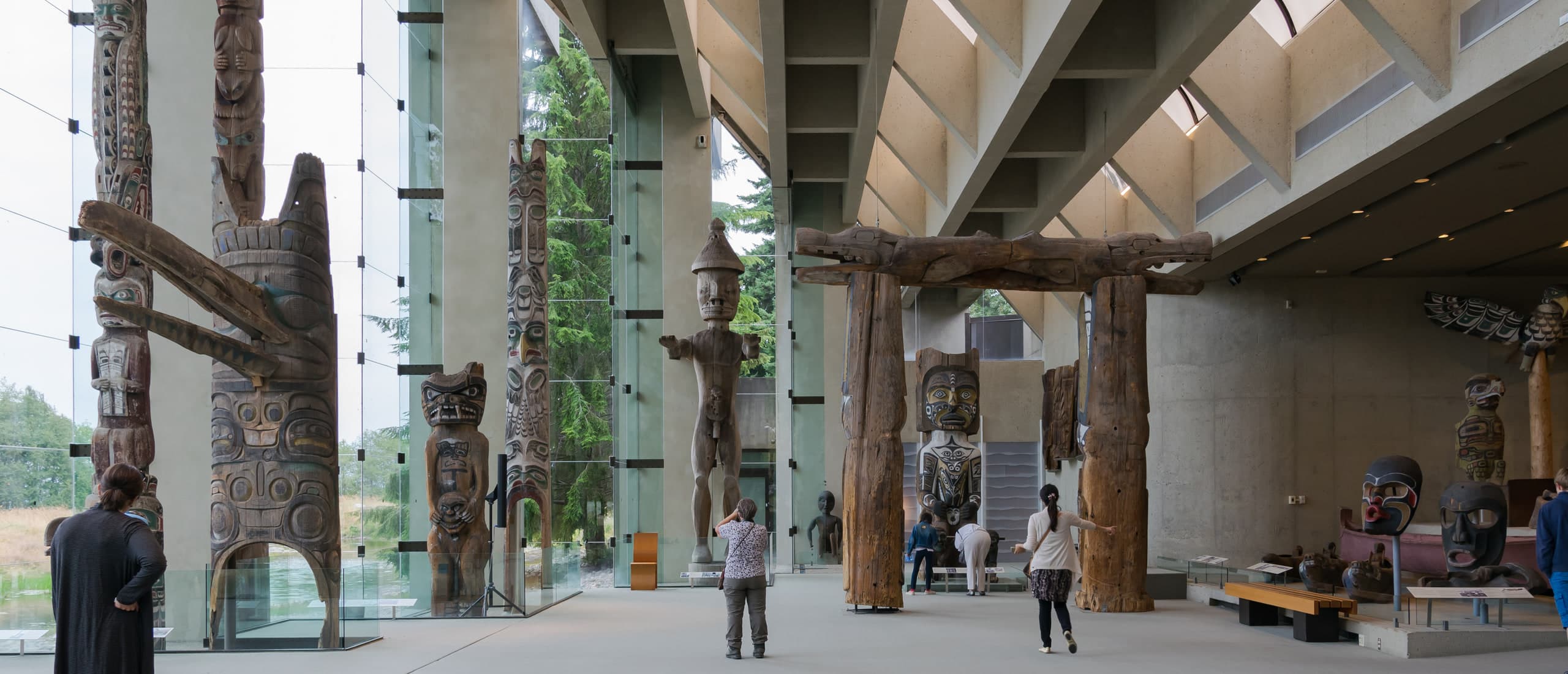
Erickson's masterwork is the Museum of Anthropology at the University of British Columbia, completed in 1976 on Musqueam unceded territory. The Great Hall's fifteen-metre glass walls frame Northwest Coast poles and house posts against the North Shore mountains and the inlet beyond. The building borrows from Haida longhouse typology and Japanese spatial sequencing alike, and it puts Indigenous carving where the structure is. Stand in that room on an overcast afternoon and the argument is visible in one frame.
Vancouver taste has always been an adaptation of somewhere else, and it has never been embarrassed about it. When Richard Neutra came up to lecture local architects in 1946, his Californian gospel of glass, light, and landscape took hold immediately at Thompson, Berwick & Pratt, the firm that trained Erickson, Ron Thom, Barry Downs, and Fred Hollingsworth. The result, a decade later, was houses like the Lakeberg Residence, finished in 1957 on a cul-de-sac where Kerrisdale meets the Southlands, complete with breezeway, kidney-shaped pool, and Roman brick, all modelled on Frank Sinatra's Palm Springs house.
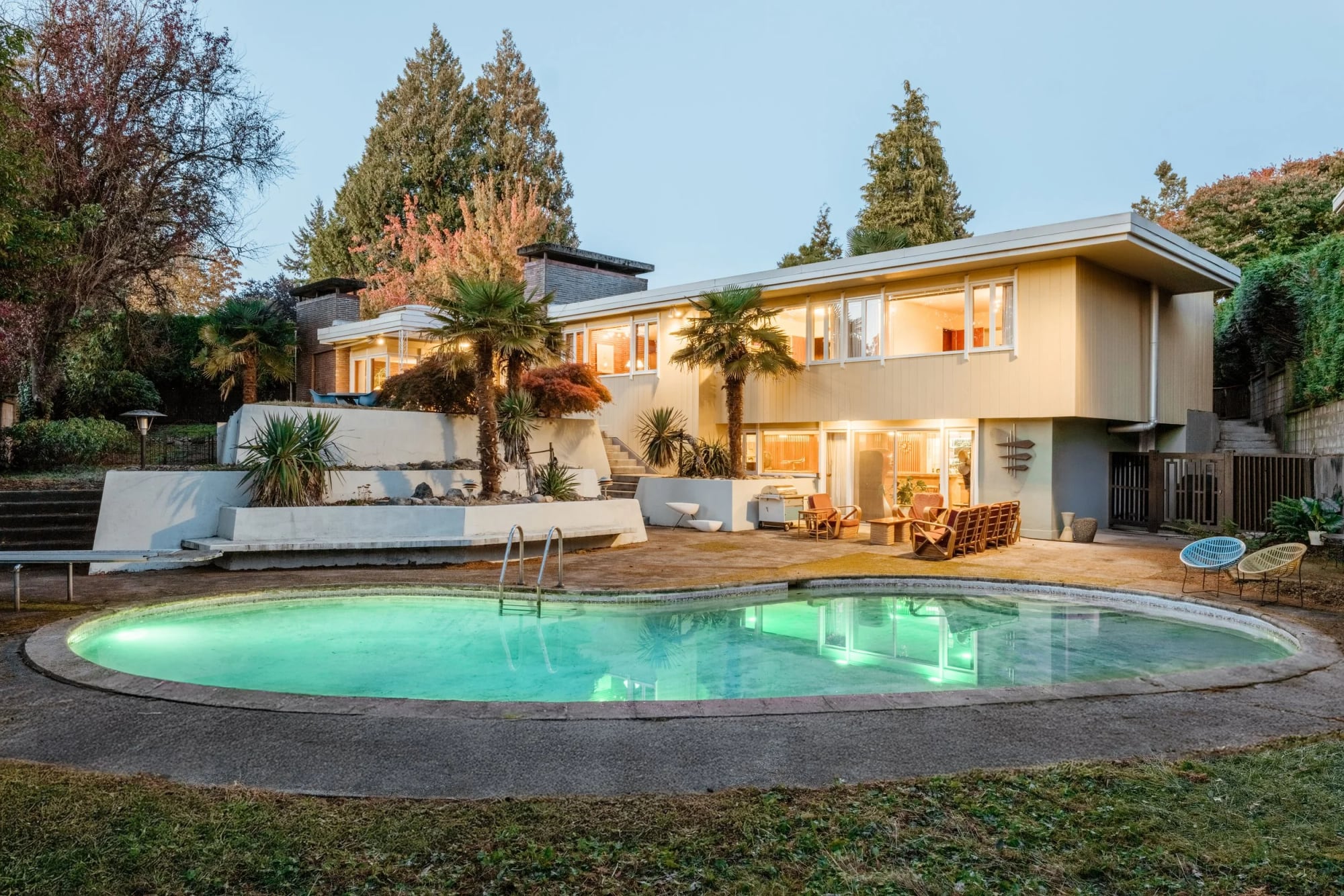
Seven decades on, the source has moved. Nagomi House, completed in Kerrisdale in 2025 by BLA Design Group, was built for clients who had lived in Japan: a lowered tiled genkan at the entry, a path past board-formed concrete and raked stone, cedar soffits, and a concealed prep kitchen for the heavy cooking the open plan is not meant to show. Same neighbourhood, same appetite for an imported grammar. California in 1957, Japan in 2025.
Vancouver exports a dress code of its own too. Lululemon, Arc'teryx, Aritzia, Herschel, and Native Shoes built global businesses on performance, proportion, and fabric discipline drawn from mountains, seawall runs, and a city that treats the body as a design problem. Function leads. That is still taste, and it now ships worldwide.
Vancouver's Pacific Registers
Walk the city in the right order and the composite becomes legible. Begin at the Vancouver Art Gallery on Hornby Street, still housed in Erickson's courthouse renovation while a new building takes shape at Larwill Park. In November 2024 the Gallery renamed its Institute of Asian Art the Centre for Global Asias and seeded a C$1.6 million fund from Chinese Canadian donors including the art historian Roger Lee, Shawn He and Sylvia Zhang, and the artist Henry Wang with the Chen family. Lee, Vancouver-born and Canada's first Chinese Canadian art history professor, began collecting Yixing teapots in the 1980s after a 1975 trip to China with his parents rearranged how he saw his own inheritance. Melissa Karmen Lee, who runs the Chinese Canadian Museum, describes his method precisely: a Western-trained scholarly eye brought to objects his Chinese heritage had already claimed. That double vision is the whole chapter in one collector.
His teapots now anchor the inaugural Collector's Corner series at the Chinese Canadian Museum in Chinatown and a dedicated gallery at the Art Gallery of Greater Victoria. The museum itself is worth the detour for the building alone: it opened on 1 July 2023 inside the Wing Sang Building at 51 East Pender, the oldest structure in Vancouver's Chinatown, built in 1889 by the merchant Yip Sang.
The Centre also expects the archive of Zheng Shengtian, the artist, curator, and Yishu journal co-founder who opened one of the first galleries anywhere outside China devoted to contemporary Chinese art, in Vancouver, in the early 1990s. Think about the timing. That was years before the mainland art market became a fixture of the international calendar, in a city most of the trade still filed as a regional stop. The bet has aged well: in December 2025 an anonymous Hong Kong donor gave the Gallery 131 works by 78 artists, the largest gift of Hong Kong art in its history, as we covered in Hong Kong's Collection Lands in Vancouver.
The social calendar does the same work in an evening. Deborah Lau-Yu, the Toronto designer and publisher who founded Fête Chinoise in 2015, brought her black-tie Lunar New Year gala west for the first time in February 2024, filling the Shangri-La with roughly two hundred guests, the actress and singer Linda Chung, the Malaysian calligrapher Jameson Yap working live, and a silent auction whose lots opened at C$1,000. The Chinese Canadian Museum, the beneficiary that night, wheeled in a wooden dragon head close to a century old and parked it on the red carpet for photographs.
That is the register in miniature: a heritage object out of a Chinatown collection doing the job of a step-and-repeat, with the dressing, the artwork, and the philanthropy arranged around it. Nobody in the room treats those as separate interests.
Commerce completes the circuit at Oakridge Park, the Cambie Street redevelopment that has become the clearest read on how the trade now rates this city. Chow Tai Fook opened a redesigned boutique there in June 2026 with a Canada-exclusive run of maple-leaf pendants and earrings, the Hong Kong house doing to the national symbol what it usually does to auspicious motifs. Bvlgari took its first standalone Vancouver store in the same development, Rolex built its largest boutique in North America, and Chaumet its largest on the continent as well. Holt Renfrew's Vancouver room runs QIXI exclusives from Messika and Qeelin on the lunar calendar rather than the Western one.
Watch the buyer who books Mott 32 for live seafood, checks a Heffel Asian art sale online between courses, and stops at Oakridge on the way home. Those look like three different appetites and behave like one. For the dining half of that circuit, see The New Banquet: Canada.
Brian Jungen, of Swiss and Dane-zaa descent and an Emily Carr graduate, supplies the necessary critique from inside that universe. His Prototype for New Understanding series cuts Nike Air Jordans into forms that read as Northwest Coast masks, turning sacred merchandise into merchandise about the sacred. He made twenty-three, the number Jordan wore, and Jordan's own representatives came asking for one. Jungen took the Audain Prize for the Visual Arts in 2025. Keep him in the frame when the jade counter starts to feel frictionless, because his work asks what a Pacific luxury culture is entitled to borrow, and from whom.
The Gallery's next home makes the point institutional. In September 2025 it selected Formline Architecture's Alfred Waugh, an Indigenous architect, and Toronto's KPMB to design the Larwill Park building: lower, more grounded, and explicitly plural where Herzog & de Meuron's cancelled tower was spectacle. Taste in Canada now has to hold Erickson's glass, Waugh's land-based design, and a Hong Kong collection in the same civic sentence.
Toronto's Corridor
Toronto plays the same game with different furniture, starting with Yorkville. For QIXI in 2024, Holt Renfrew's Bloor Street room held a global exclusive from Oscar Heyman, a radiant-cut orangy-pink diamond ring listed at C$2.9 million, alongside a John Hardy love-knot bracelet flagged "only at Holts." A department store does not build a lunar-calendar exclusive around a three-million-dollar stone unless it knows exactly who is walking in that fortnight.
The design names on the same few blocks are smaller and no less serious. Beaufille, founded by the sisters Chloé and Parris Gordon, took Womenswear Designer of the Year at the Canadian Arts and Fashion Awards in October 2024 and has since moved to four collections a year on its own direct-to-consumer rhythm rather than the show calendar. Sid Neigum, an earlier CAFA winner and Chloé Gordon's partner, works a near-mathematical approach to proportion and has shown in London, Paris, and New York while keeping the studio in Toronto. Neither label is chasing volume. Both are being watched by the buyers who decide what Canadian design means abroad.
Auction houses stitch the two cities together. Heffel, Canada's national fine art auctioneer with galleries on Hazelton Avenue in Yorkville and Granville Street in Vancouver, runs dedicated Asian art sales alongside its Group of Seven blockbusters. The April 2024 Asian art auction realized just over C$585,000 across 125 lots with bidding from Hong Kong, Taiwan, and South Korea. The strongest material came from the estate of Wang Yiling, a banker and collector with business ties across Beijing, Tianjin, Hankou, and Hong Kong: fourteen works bequeathed to a descendant in Vancouver and kept out of public view for more than fifty years. A Zhang Daqian landscape painted in 1949 and dedicated to Wang himself took C$79,250 against a C$40,000 estimate. That is the corridor in one consignment, a Republican-era collection sitting quietly in a Vancouver house until a Canadian saleroom put it back into circulation and Asia bid it up.
Fête Chinoise runs its Toronto Signature Event a few blocks from those windows, at the Park Hyatt for its tenth anniversary in January 2025 and the Ritz-Carlton in February 2026. Note who fed the room in 2025: Mott 32, the same Hong Kong house whose Vancouver dining room anchors the Cantonese circuit out west. Two cities, one supplier list.
For years Sing Tao has also published eliteGen, a bilingual luxury magazine aimed squarely at affluent Chinese Canadian households in both cities, mixing supercars, interior design, jewellery, and destination restaurants in a single issue. Read that table of contents as a schedule rather than a grab bag and it describes an ordinary weekend: a Yorkville fitting, a Richmond seafood lunch, an evening where the silent auction opens at four figures.
One Closet, Many Inheritances
Transpacific taste is easiest to spot when the categories collapse. Consider the collector who studies Yixing clay on Pender Street, stops in front of a Jungen at the AGO, commissions a genkan for a Kerrisdale house, orders the duck forty-eight hours ahead, and picks up a maple-leaf pendant at Oakridge on the way to the airport. Call that eclectic and you have misread it. It is one grammar applied across object, room, meal, and dress, and the question it keeps answering is who belongs to the Canada currently being built.
Alex S. Yu says the personal version out loud. Born in Taipei, raised in Vancouver, trained at Blanche Macdonald and the London College of Fashion, he launched his label at Vancouver Fashion Week in 2014 and now shows in London and New York while making the clothes in a Vancouver studio. "To my friends and family back home in Taiwan, I was always considered 'the foreigner' or 'whitewashed,'" he told the Georgia Straight in 2025. "But to my friends here, I was always considered 'FOB.'" His conclusion is the useful part: "There are so many first- and second-generation immigrants who don't fully belong to one culture, but I think we're a whole new breed." His whimsical, technically fussy womenswear could not be further from a seawall legging, which is rather the point. The city has more than one export story.
None of this replaced the inherited room so much as outgrew it. Brandt Louie sits on the bank and university boards that once defined the establishment; the Vancouver Club still serves dinner, now under contemporary work rather than royal portraits. What moved is the default. In Canada's affluent Pacific cities, taste is assembled from several inheritances at once, and the transpacific one increasingly sets the pace.
So if you are visiting, walk Hornby before you walk the mall, and save the Museum of Anthropology for a grey afternoon when Erickson's glass turns the North Shore into the exhibition. Book the banquet table before the auction preview. And when someone points at an oil portrait, ask who sponsored whom into the club, then ask who is designing the gallery going up on Georgia Street. The second answer tells you more.
This is the Canada chapter of The Tastemakers. Next: Tokyo, where department-store grammar still teaches proportion better than any influencer brief.