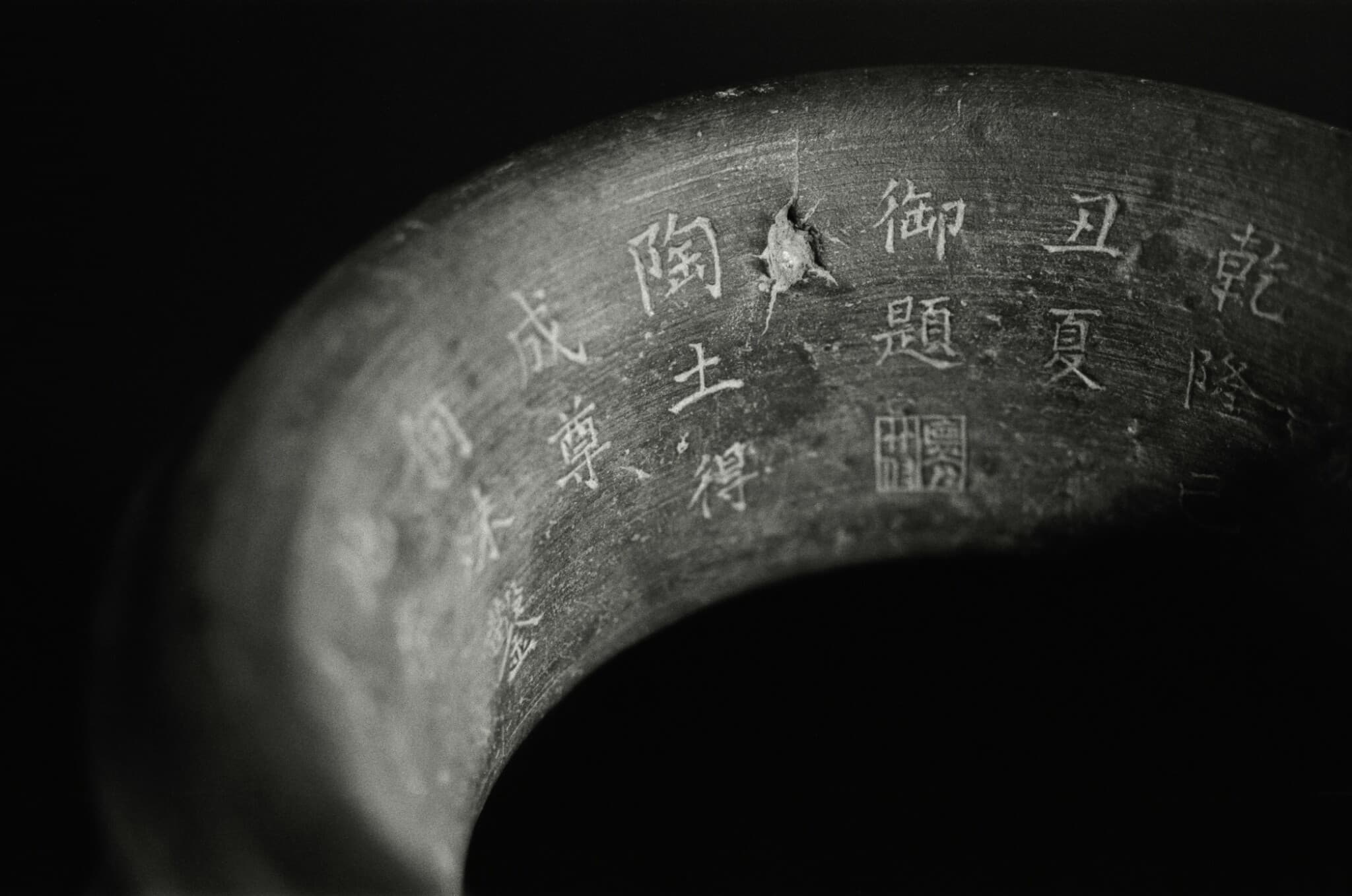
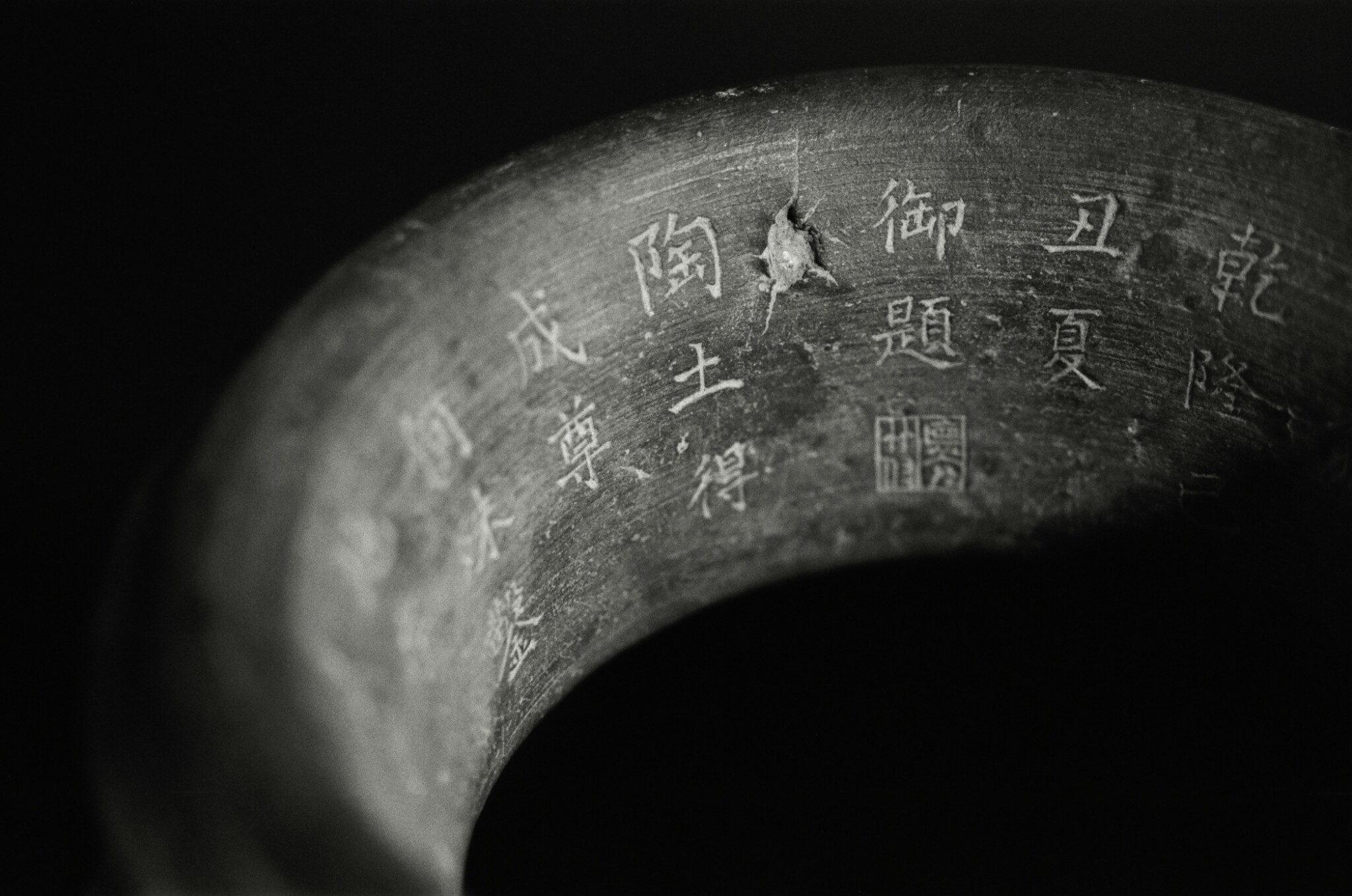
The loss sits in the writing. Qianlong had a poem cut into the rim of a Zhou pottery jar, and a chip breaks the characters. The poem is his "Ode to a Pottery Zun," dated to the summer of 1769. He used it to correct the name of an earthen jar, and he set two famous bronzes beneath it. Sir Percival David, the British collector whose Chinese ceramics are at the British Museum, owned the jar later. Sotheby's estimates it at 6 to 12 million Hong Kong dollars on the morning of 30 October. I would spend longer on the chip than on that range. You can want the poem and still refuse the damage.
Duanfang wrote the label himself. He was viceroy of Zhili at the end of the Qing, and he collected under the studio name Taozhai. The cong in the same morning sale is about 10 centimetres high. On the lid he calls it a Zhou zucong, notes that half the carved pattern is already worn away, and still writes that the lines left are as fine as a hair. Sotheby's dates the jade to the middle of the Liangzhu culture, about 2800 to 2400 BCE, the Neolithic tradition named for a village near Hangzhou, and estimates it at 10 to 20 million. The Zhou dynasty on that lid begins more than a thousand years after the dates the catalogue gives the jade. I would keep the note about the worn carving. I would ask someone else for the date.
Yamanaka & Co. showed it in Osaka in 1923, still as a Zhou jade from his collection, and a Tokyo catalogue repeated the attribution in 1932. It was back at Sotheby's Hong Kong in April 2019. A long provenance can carry a wrong dynasty the whole way.
The lot is also marked as guaranteed property, and as carrying an irrevocable bid. The house has promised the seller a minimum, so it has its own money in the result, and a third party has already committed to a bid that will make the lot sell. Both marks are explained in Sotheby's symbol key. Read them before you treat the printed range as a suggestion made in private.
Sam Shum, a senior specialist in Chinese works of art at the Hong Kong house, told China Daily what he looks at on a Qianlong falangcai bowl in the 2:15 sale. Falangcai is enamel on porcelain, with the pigment prepared in a Western way. Shum dates that technique on porcelain to the Kangxi reign, when Jesuit craftsmen and palace artisans worked on it together. The dragons, he said, echo the spacing of the floral bowls made under Kangxi, which he reads as Qianlong's fondness for the legacy of that reign. Kangxi was his grandfather. The spacing is why the bowl is worth a condition report. The 20 to 40 million beside it is the house guessing at a hammer.
"Originally made for a single lifetime's enjoyment, it laughs at how much collectors have paid for it ever since."
The Qianlong Emperor, on a Zhou jade disc, 1776, as translated by Sotheby's
That line was cut in 1776 into a different object in the morning sale, a Zhou white jade disc set in a zitan screen from the palace workshops. He had spent 1769 correcting a jar's name. Seven years later he was laughing at the money. If you bid on the jar, know whether you are buying the poem or betting on the room.
The galleries at Sotheby's Maison, Landmark Chater, 8 Connaught Road Central, were open from 24 to 29 October, 11 to 6. They are shut. Possessing the Past starts at 10 on the 30th. If you are bidding from the catalogue, ask for the condition report, and then ask what it leaves out. The house sells the lots as they are. It counts the online photographs as part of that report, and it says a silence in the catalogue is not evidence that a flaw is missing. The chip on this rim is the one you can see. A hairline under a porcelain glaze usually is not.
If the jar hammers at 6 million, the low end of its range, the Hong Kong buyer's premium Sotheby's published in September is 28 percent. That is 1.68 million, so the bill starts at 7.68 million, before whatever tax follows the crate to the country where you live. Between 15 and 60 million the rate is 22 percent, and above 60 million it is 15 percent. The glossary also describes a 1 percent overhead premium in its salerooms. Check the conditions for this sale before you add it. A Hong Kong invoice will not tell you whether the mainland, or your own customs, will admit the jar. Ask that before you bid.
If you would rather look than bid, the imperial workshops are on view at the Hong Kong Palace Museum through 18 September 2028. Asia Week Still Opens on Madison is the same kind of looking, in March, with the objects still in the room. I would still start with the chip. You can check that one without a specialist.