On 18 November you can take the lift to the sixth floor of The Henderson, at 2 Murray Road, and look at more than twenty pictures from a collection that has barely been shown. Christie's is calling the hang its first exhibition in Asia of modern South Asian art, and one of the first times the Dabriwala family has let a public in. It is free through 29 November. I would put those twelve days on the calendar for a plainer reason than the anniversary language. The room is real. The checklist is not up yet.
India by the Bay is why the dates are generous rather than tidy. The festival is in its eleventh year, produced with Teamwork Arts, the Delhi company behind it, and it runs 26 to 29 November at Asia Society Hong Kong Center, 9 Justice Drive, in the old explosives magazine above Admiralty. The pictures are already on the wall for eight days before anyone has to choose between a dance ticket and a dinner reservation. They come down on the festival's last afternoon.
That afternoon is also when you can stop guessing. From 3:00 to 4:00 on 29 November, Surbhit Dabriwala, who grew the collection after his father Rajendra began it, talks with Damian Vesey, the London specialist who looks after this category for Christie's. Rishika Assomull, a senior director at Villepin, moderates. An hour, filed by the house as part of the festival, under the title South Asia in the Global Pantheon. If you have ever tried to reconstruct a private collection from auction records and press adjectives, an hour with the person who grew up around the pictures is the better use of the Sunday.
A Bombay syllabus, then a wider map
Rajendra started buying more than forty years ago in the order a serious Indian collector of that generation often did. Bengal first, Ganesh Pyne among the names Christie's gives, and then the Bombay modernists who still dominate the evening sales: Sayed Haider Raza, Francis Newton Souza, M. F. Husain, Ram Kumar, Tyeb Mehta, Akbar Padamsee. If you know the field, that list is close to a syllabus. If you do not, these are the painters whose canvases now set the price of Indian modernism. Christie's has published them as the history of the collection. It has not published them as the list on the wall at Murray Road. I looked on 16 October. The highlights module on the event page was empty. Come anyway, and ask the desk which of these actually traveled.
What I would cross the harbour for is the part Surbhit added. He kept his father's core, then bought Cheong Soo Pieng, the Singapore painter, the Indonesian painters Hendra Gunawan and Affandi, and a younger room that includes Arpita Singh and Salman Toor, who was born in Lahore and works in New York. A family that began with Indian modernism is willing to hang a Singaporean and two Indonesians under the same name, in a saleroom in Central, and still introduce the whole thing as South Asian art. That argument usually lives in a catalogue essay. Here it gets a room you can walk into.
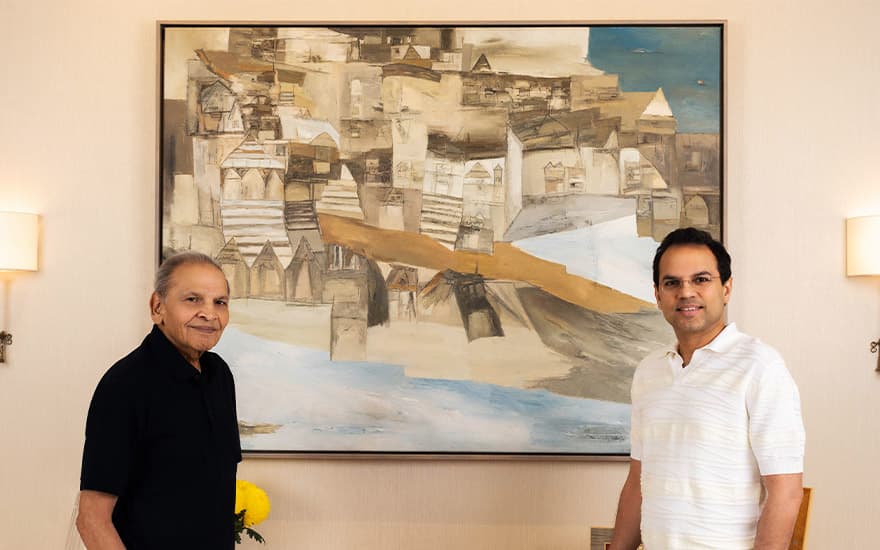
The photograph announcing all this is the family at home, not the sixth floor. Rajendra is on the left, Surbhit on the right, and behind them is a city of ochre roofs and a blue band of water that Christie's identifies as a work by Ram Kumar. A yellow flower sits in the foreground. The sconces could belong to a hotel. This is the family with a picture they kept. Treat the Ram Kumar as theirs until the desk tells you it is one of the works that traveled.
"What inspired me most was the realisation of how much of this work is religious and spiritual in the oldest sense. These artists were engaging with questions of tradition, belief and identity through a modern visual vocabulary, each following a distinct path through Indian modernism."
Surbhit Dabriwala, on the collection, to Christie's, 6 October 2026.
Set that next to the rest of the announcement, which is grateful, global, and interchangeable with any category having a good year. This is the sentence that says what he thinks the pictures are for. The family runs the Dabriwala Foundation for the Arts so that some of the scholarship stays public, which makes an open door in Central feel like a continuation rather than a Hong Kong special. Nishad Avari, who runs South Asian modern and contemporary art for Christie's from New York, will call the hang an overview of a century. Surbhit's sentence is the one that tells you what kind of century he means.
Ask the desk for the lift
Christie's has been in The Henderson since 20 September 2024, floors six through nine of the Zaha Hadid tower, and the Dabriwala hang is on six. The way in will waste twenty minutes if you learn it from a security guard. Central Station Exit J2 is a covered two minutes to the first-floor footbridge. Admiralty Exit B is about three minutes to the same bridge. Escalator to the third floor, then the Christie's desk, which is the desk that calls the lift. The Henderson lobby is a different conversation. Guest parking is down on B2 to B5, if a car is really how you want to do Central.
House hours are Monday to Friday, 9:30 to 18:00, and the desk closes on public holidays. Separate hours for this exhibition have not been posted, which is the gap. The panel forces 29 November open at least from 3:00, because that is a Sunday and they have invited an audience. The Saturday in the middle of the run is the day to telephone +852 2760 1766, or write infoasia@christies.com, before you leave the hotel and discover a locked floor.
If you want a sense of the other bill that week, Sakhi, the Sunday dance in the Jockey Club Hall at Asia Society, is listed at HK$350 for members, students, and friends of the festival, and HK$380 if you are none of those. Read the rest of the programme before you assume every evening costs the same. The pictures cost nothing. See them on a Wednesday if you can, while Justice Drive is still quiet, and keep the Sunday for the panel if you want Surbhit in the room rather than on the wall text. The Banquet Guide to Hong Kong covers the rest of the stay, including the evening if it belongs on the Island after all.