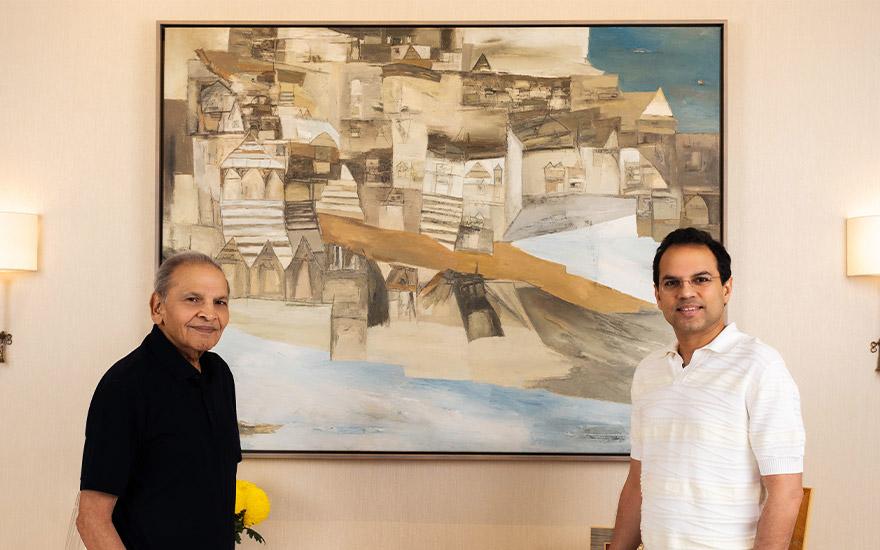
November at Christie's Hong Kong usually means an appointment card. From 18 November, Luxury Week puts wines, Hermès, jewels, and watches under glass on the sixth floor of The Henderson, 2 Murray Road, before live sales that run through 26 November. The same floor is also hanging something you do not need a paddle for. Masterpieces of Modern South Asian Art: Highlights from the Dabriwala Collection is free from 18 to 29 November, one of the first public looks at a collection Rajendra Dabriwala began more than forty years ago and that his son Surbhit has kept expanding. If you are already in the building for auction week, you can see named modern canvases while the luxury lots next door still require a booking.
More than twenty works are up. Three of them map the family's Bombay-modern core: Tyeb Mehta's Untitled (Woman on Rickshaw), S. H. Raza's Jodhpur, and Akbar Padamsee's Metascape. They sit inside the Progressive Artists' Group circle that still dominates how Indian modernism is bought and sold. The rest of the hang opens onto Bengal, Baroda, and the Southeast Asian names Surbhit added later. For hours, the India by the Bay weekend, and the Sunday panel with Surbhit, Over Twenty Dabriwala Works at The Henderson has the practical notes.
Mehta Puts the Viewer in the Yoke
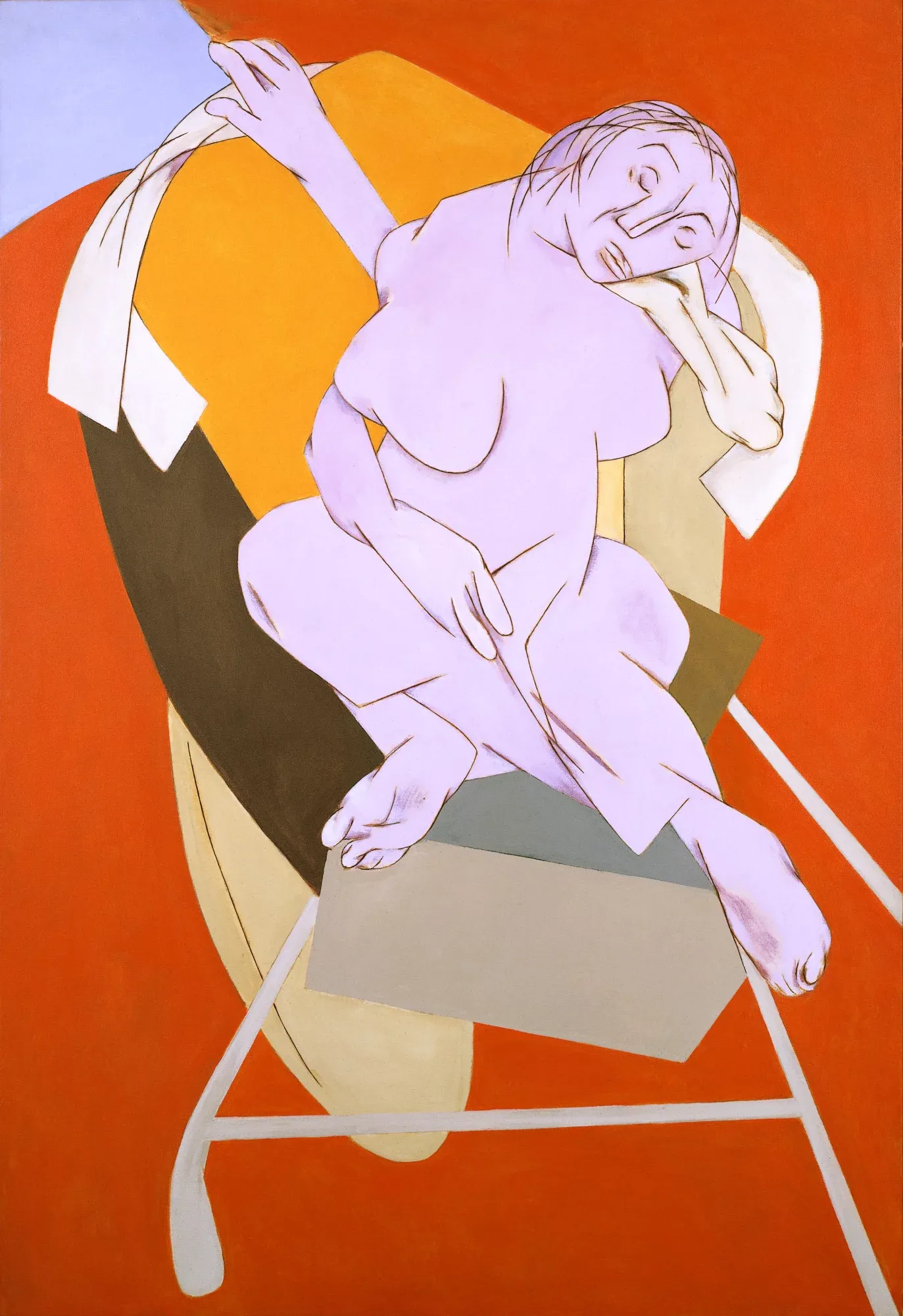
Tyeb Mehta's Untitled (Woman on Rickshaw), from 1991, measures 175.3 by 119.4 centimetres in oil and is the largest of the three. A lavender figure sits inside a rickshaw drawn as sharp planes of orange, brown, and white against a flat red field. The puller is cropped out. Mehta spent 1983 to 1985 as artist-in-residence at Visva-Bharati in Santiniketan, where hand-pulled rickshaws still worked the lanes, and the motif hardened there into what the critic Nissim Ezekiel called a sign of bondage rather than transport. The diagonal that organises his later canvases had already arrived around 1969, after he flung a streak of paint across a stuck surface and found a way to hold colour in place. By the 1990s the figure is almost a diagram: flat planes locked together, the body held between containment and freedom.
Mehta belonged to the Bombay Progressive Artists' Group circle that formed around Independence, alongside founders including F. N. Souza, M. F. Husain, and S. H. Raza, with Padamsee close to the same rooms. Where Souza left for London and Raza for Paris, Mehta stayed closer to Bombay and kept returning to Partition memory, bulls, and labour. A different Woman on Rickshaw from 1994 later set a Christie's London record; this larger 1991 canvas is the one on the Dabriwala wall. Stand in front of it long enough and the missing puller registers. The viewer stands where the labourer should be.
"The rickshaw is not a simple means of transport but a sign of bondage."
Nissim Ezekiel, on Tyeb Mehta, Kunika-Chemould exhibition catalogue, New Delhi, 1970
Raza Turns Jodhpur Into Colour
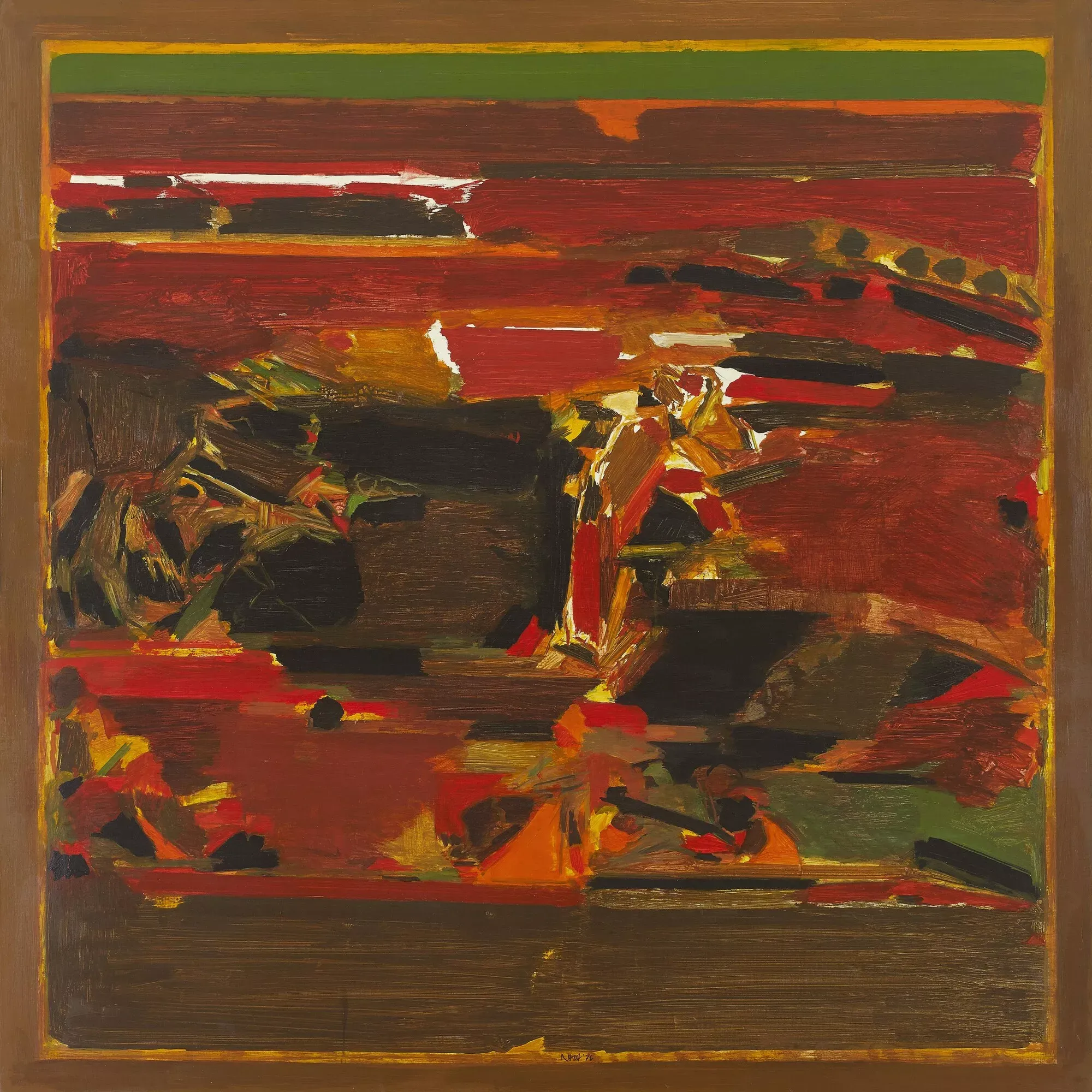
Raza's Jodhpur is a square metre of acrylic from 1976: a thick painted border, a green band at the top, and a field of reds, ochres, and blacks that feel closer to heat and stone than to a postcard of the Blue City. He was a Progressive founder who made his life in France, then spent the 1970s pulling Indian colour, miniature framing, and Rajasthan travel back into the work. City titles from that decade sit just before the black bindu becomes the centre of his geometry later on. Jodhpur is still a place turned into temperature, not yet the clean circles of the 1980s.
That path matters for how the Dabriwalas collected. Rajendra moved from Bengal modernists such as Ganesh Pyne into the Progressive roster, Raza among them. A painter living in Paris and naming an Indian city in acrylic is exactly the kind of picture the family kept buying: modern means, older questions of belonging. On the wall in Central, the square sits between landscape and mantra. Anyone who knows Raza mainly from late bindu images will see here how he got there.
Padamsee Paints Time Without an Address
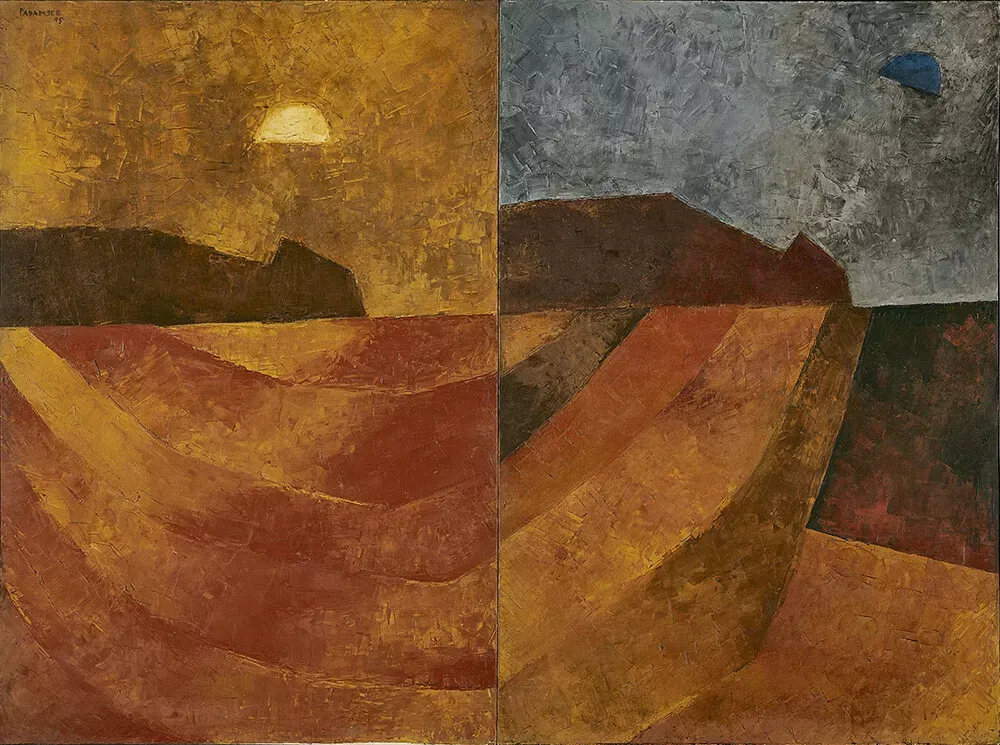
Padamsee's 1995 Metascape stretches to nearly two metres across. Sun and moon sit over knife-laid planes of earth and sky; the left half burns warmer, the right cools. He said the pairing came from reading the opening of Kalidasa's Abhijnanashakuntalam, where the poet names the sun and moon as the two controllers of time without spelling the words. From the 1970s he used those elements as a metaphysical landscape: water, earth, fire, and sky without a tourist viewpoint. Once the Progressives had set aside academic realism and Bengal revivalism, he could treat landscape as structure and colour as thought.
He was the Sanskrit-minded voice in a circle that also included Mehta and Raza, individualist enough that critics still argue over how tightly to fold him into the Group. After the rickshaw's human burden and Raza's named city turning into colour, Padamsee answers with sun, moon, and ground. The three together show a collector who wanted the Progressive generation's range, not a single favourite. Elsewhere on the same walls sit N. S. Bendre's Untitled from 1988, plus Husain, Jamini Roy, Ram Kumar, and Jagdish Swaminathan, along with Surbhit's later Southeast Asian and diaspora purchases. These three are enough to find the family's centre of gravity.
The hang stays up through 29 November. Christie's Luxury Week ends a few days earlier, so the pictures outlast the paddles. The free visit is on the calendar; call +852 2760 1766 before a Saturday. Sunday at 15:00 brings Surbhit into the room after the rickshaw, the square of Rajasthan heat, and the sun-and-moon landscape.