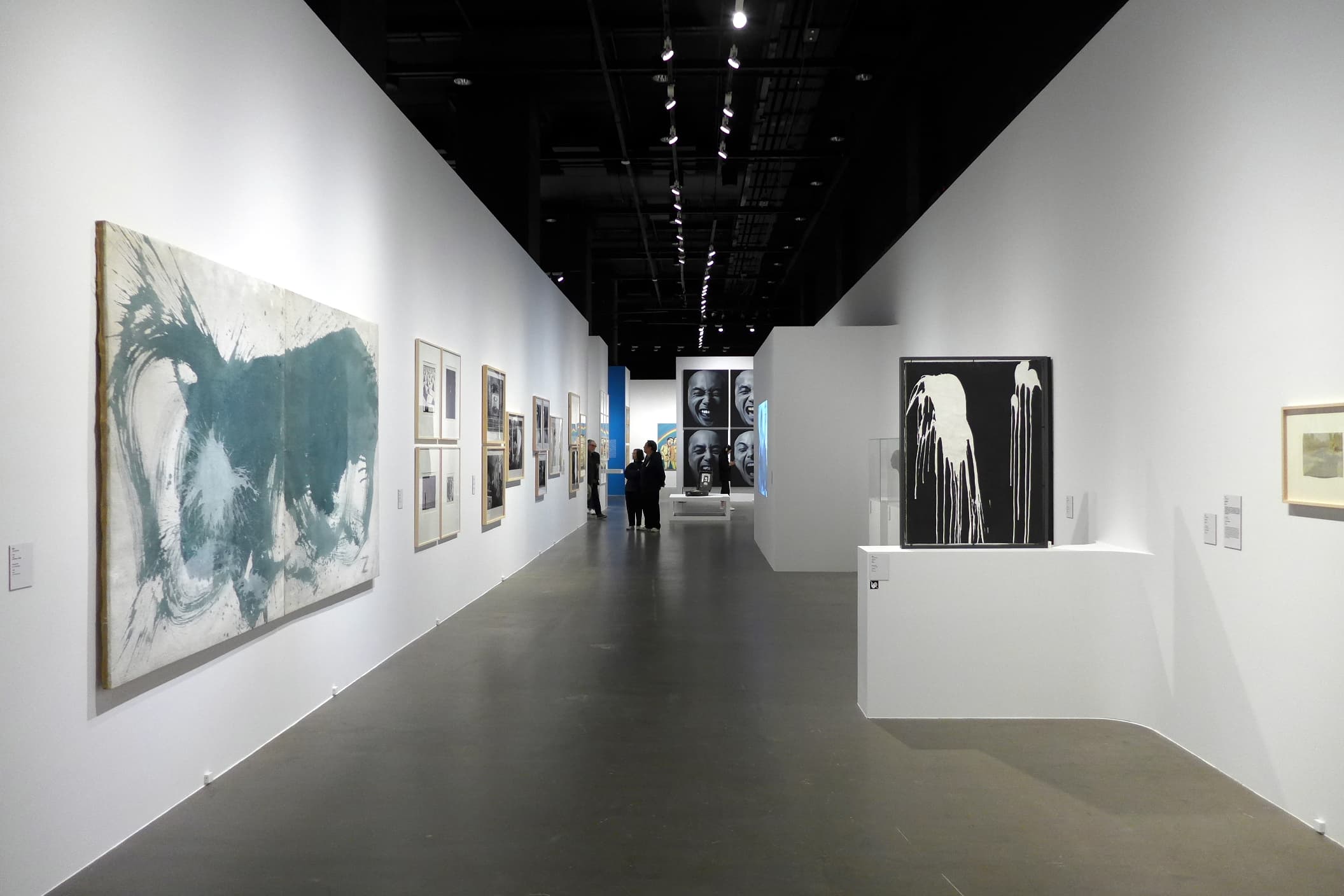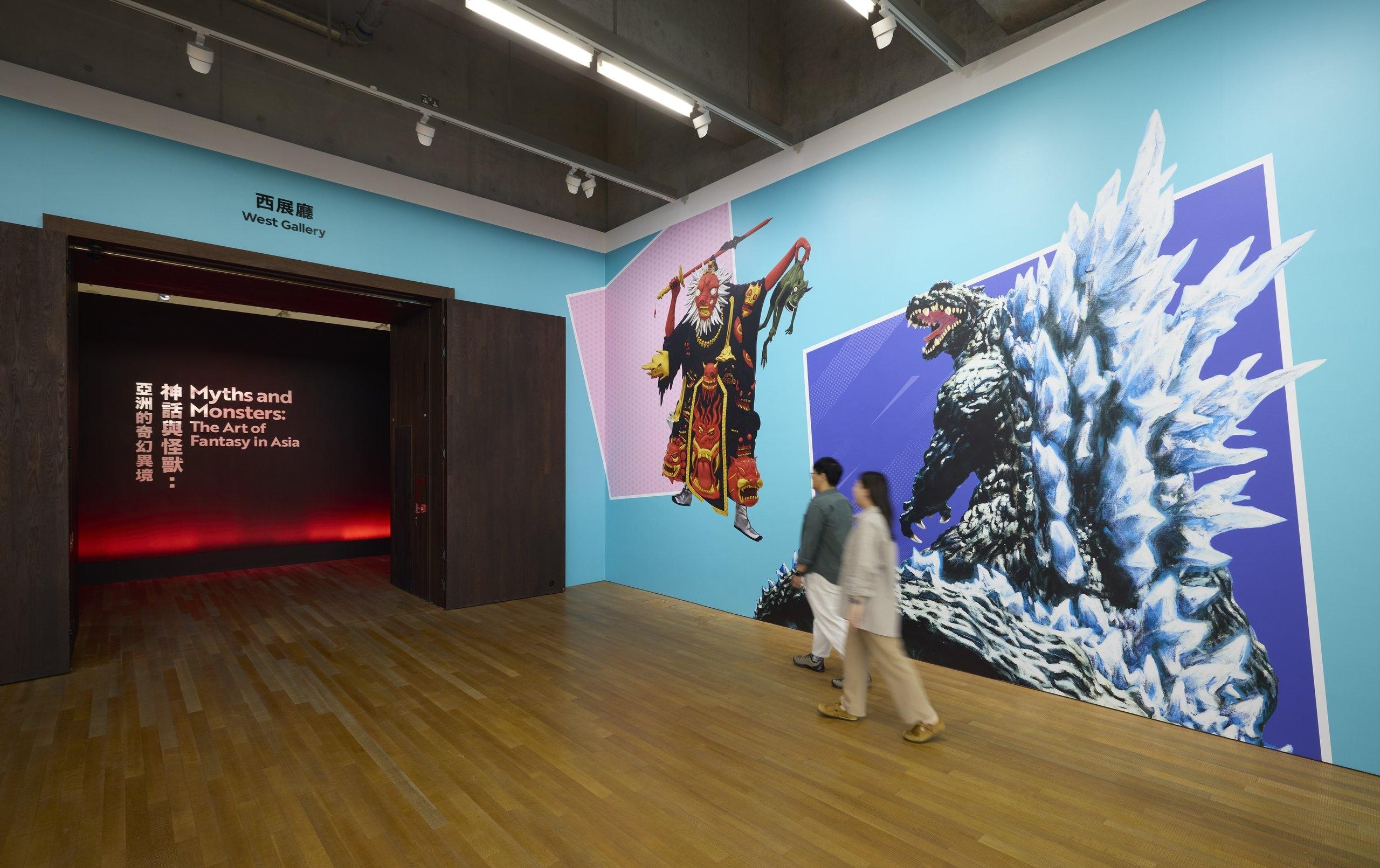
West Gallery entrance at M+ for Myths and Monsters: The Art of Fantasy in Asia, with a Godzilla mural on the approach wall. Photo: Lok Cheng. Image courtesy of M+, Hong Kong.
Godzilla hangs beside a Chinese shadow puppet, and Takashi Murakami closes the walk with a guardian dragon. Myths and Monsters: The Art of Fantasy in Asia opened at M+ on 17 October and stays in the West Gallery on Level 2 through 4 April 2027. More than 400 works run from nineteenth-century folklore and religious imagery through Surrealism into manga, anime, games, and contemporary art. Co-curators Ulanda Blair and Isabella Tam treat fantasy as a tool artists reach for when the subject is too heavy to say straight: war, grief, technology, identity.
Fantasy Opens at M+ Before the Paris Fairs was the booking note for autumn fair week. This is the hang: five works that make the two-century argument readable in one afternoon.
From lamp light to Blue Dragon
In Spirits Among Us, the lights drop. Chinese shadow puppets sit with Japanese ukiyo-e and Tibetan Buddhist thangkas in a deliberately dark room. Before film and television, supernatural stories arrived as cut leather, lamp light, and moving silhouettes. The puppets already do the work Godzilla will later do in public: give fear, protection, and taboo a figure you can face together.
A few paces on, Utagawa Kuniyoshi’s 1852 woodblock Nue makes that folklore concrete. The chimera has a monkey’s face, a raccoon-dog’s body, tiger limbs, and a snake’s tail, diving through storm clouds above a palace roof. On loan from the Yumoto Koichi Memorial Japan Yokai Museum in Hiroshima, it shows how Edo printmakers hung unspeakable anxiety on a wall. The same chapter also holds Unkei’s Edo-period Night Parade of One Hundred Demons handscroll and a nineteenth-century Tibetan Raudrantaka Mahakala thangka. One named monster is enough to carry into the brighter rooms.
Those rooms open into From Godzilla to Ghost in the Shell. Toho’s Godzilla (1954) turns postwar nuclear dread into a creature the whole city can argue with. Tezuka Osamu’s Astro Boy (1952) hangs nearby as the hopeful twin, a machine that might protect rather than erase. The monster and the robot ask the same chapter’s question twice.
Animation and games press the question further. Background paintings from Mamoru Oshii’s Ghost in the Shell (1995) ask what remains of a self when the body is no longer entirely human. Yoshitaka Amano’s Final Fantasy concept work pulls the game screen into the museum line. Catastrophe, hope, and inventions that outrun their makers become public pictures, not private nostalgia.
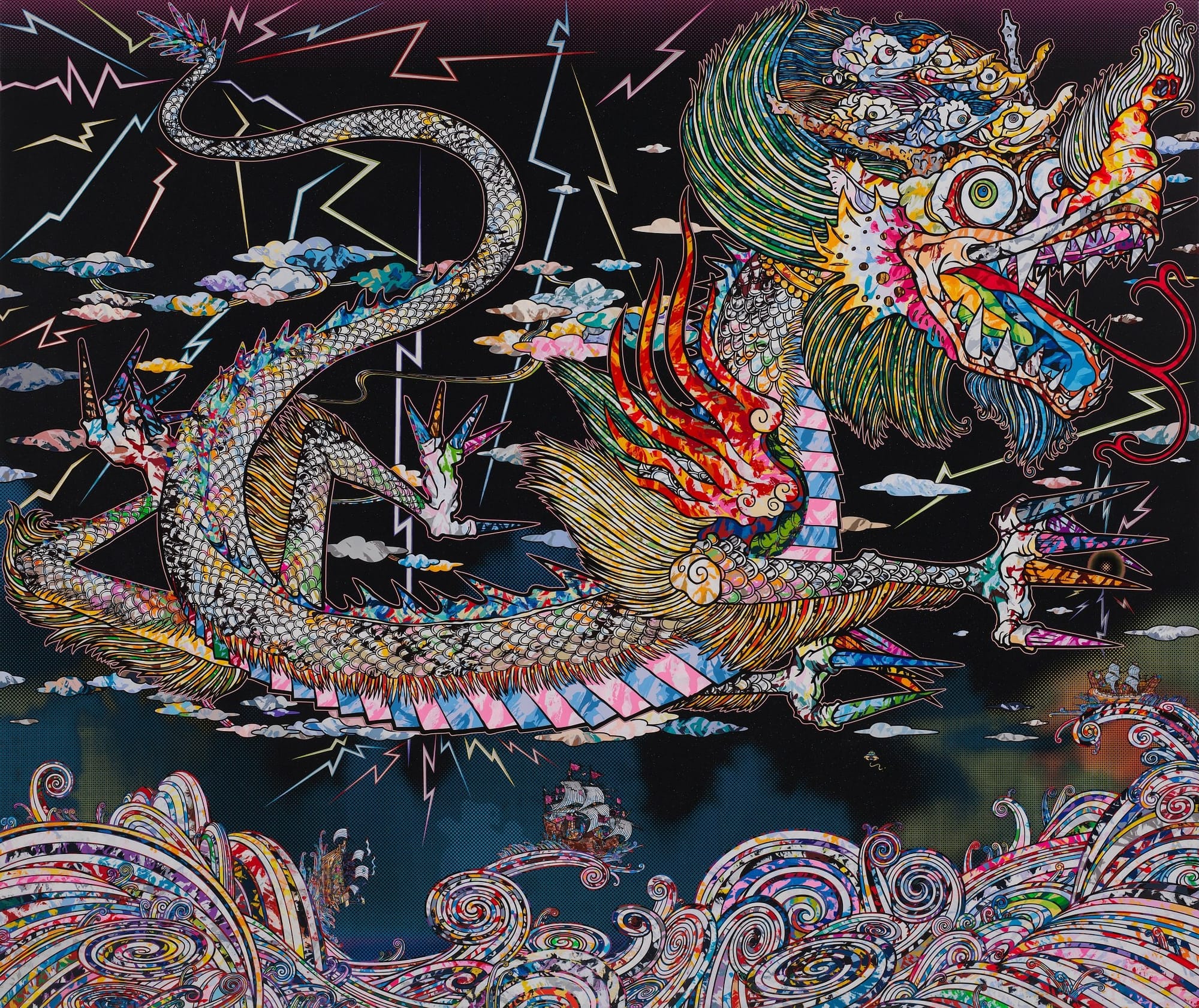
New Mythologies returns the guardian beasts to the wall. Murakami’s 2024 quartet, Flaming Vermilion Bird, Blue Dragon Soars Through the Universe, Black Tortoise and Arhats, and White Tiger and Family, restages the Four Symbols of East Asian cosmology in acrylic, glitter, and gold leaf, with manga faces and AI-assisted passages. The Blue Dragon of the East is the clearest close: a directional guardian redrawn in the visual grammar of anime. Between the shadow puppets and this canvas, fantasy keeps the temple’s job and changes the medium.
At the door, Oscar Chan Yik Long’s site-specific mural Fear Catcher (2026) draws on Zhong Kui, the King of Ghosts. Chan, a Hong Kong artist based in Helsinki, turns the deity into a figure for naming a fear and releasing it. He is the local hinge between the puppet room and Murakami’s dragons.
How to see it
M+ is at 38 Museum Drive, West Kowloon Cultural District. One timed ticket covers the galleries, including this Special Exhibition: HKD 190 standard, HKD 100 concession. Closed Mondays. Fridays run to 22:00; mornings are quieter. Last admission is thirty minutes before close. Members and Patrons walk unlimited. Buy the session online before a weekend harbour day.
Give the West Gallery a full afternoon and leave the Hong Kong Palace Museum for another visit. Inside the galleries, Fantastical Planet lets visitors build a creature of their own; it is a pause between chapters, not the reason to come. The companion volume Myths, Monsters, and Manga is in the M+ Shop. For the building’s collecting argument, How the Sigg Collection Built M+ still holds; for March, Art Basel Hong Kong remains the fair hinge.
Leave with the lineage intact: lamp light, a named yokai, Godzilla, the anime screen, then Murakami’s Blue Dragon.