Audemars Piguet's newest Code 11.59 Selfwinding watches are 38 millimetres across, the same compact case the collection has used since 2023. The dials are the news. One is gold obsidian in yellow gold, reference 77410BA.OO.A604CR.01. The other is mirror-polished black onyx in pink gold, reference 77410OR.OO.A001CR.01. The choice is between two blacks, finished two different ways, before anyone argues about diameter.
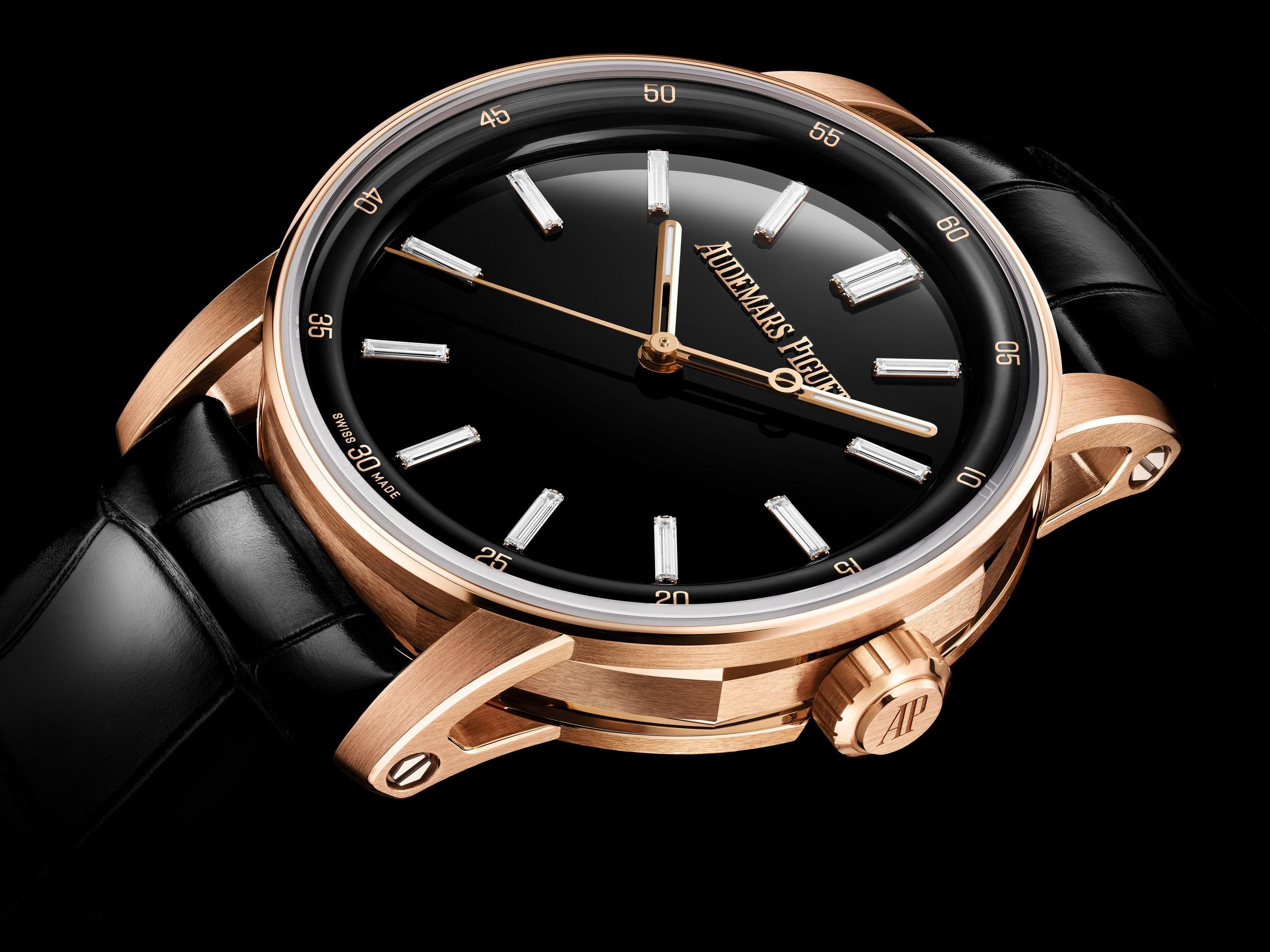
Both references were announced in early November with the same bones. Each case is 9.6 millimetres thick, with the Code's octagonal middle sandwiched between an extra-thin bezel and a round caseback, openworked lugs, and alternating brushed and polished surfaces. That architecture is easy to miss in a front-on photograph and clearer from the side, where the octagon and the floating lugs do the work. Double-curved, glareproofed sapphire covers the dial and the caseback; the crystal's dome and vertical curve push light across a stone surface in a way a flat glass would not. Water resistance is 30 metres. The automatic Calibre 5909, a date-less sibling of the 5900 that powers the ordinary 38mm Selfwinding, is produced by Vaucher to Audemars Piguet specifications. It measures 26.2 by 3.9 millimetres, runs at 28,800 vibrations an hour, and offers a 60-hour reserve for hours, minutes, and central seconds. Dropping the date is the mechanical way of saying the dial comes first: no aperture cutting into the stone, no window competing with inclusions or baguettes.
Two blacks, two finishes
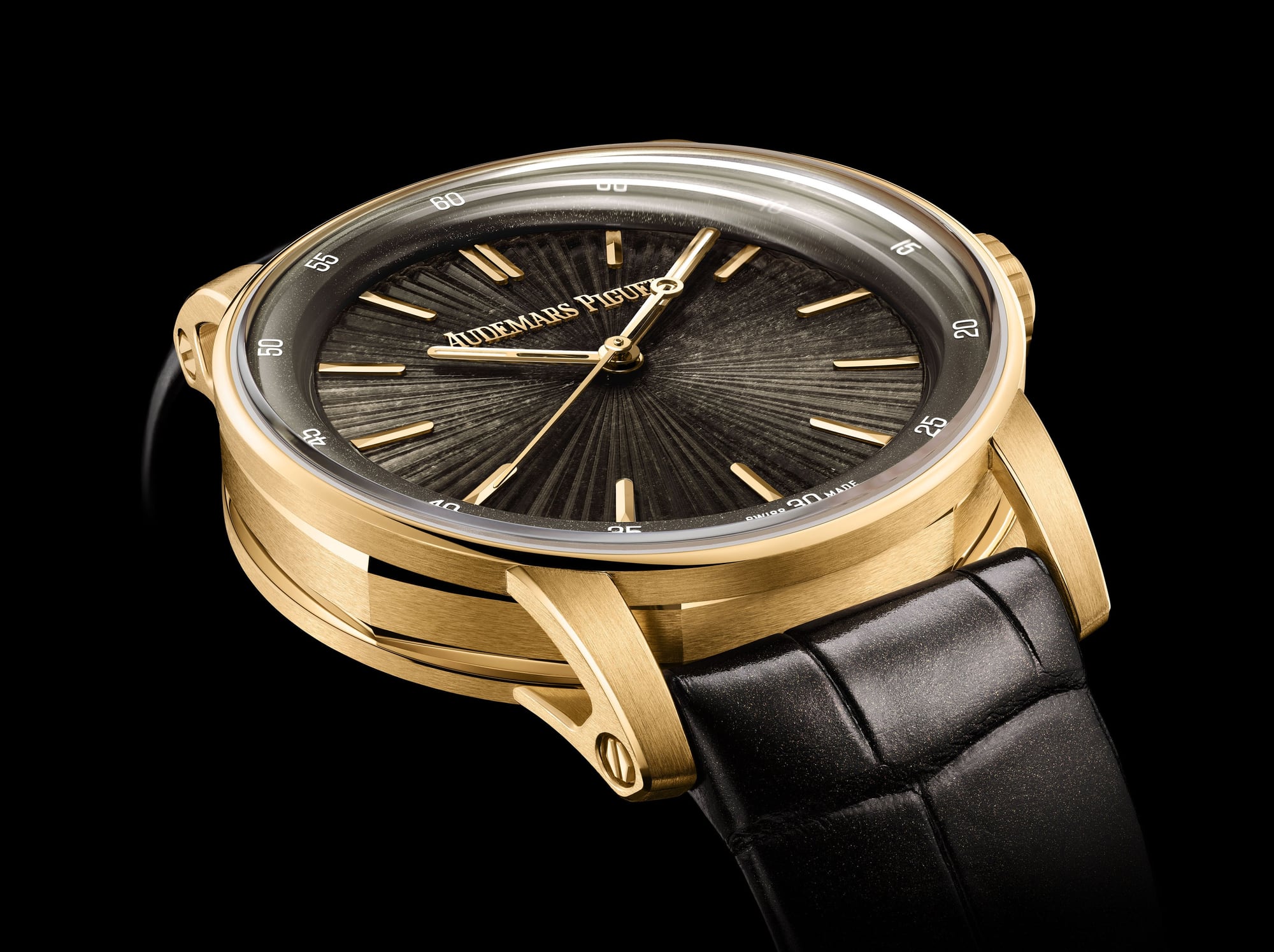
Gold obsidian is volcanic glass. Rapid cooling leaves a reflective surface and, in this variety, gold-toned mineral inclusions that catch light as the wrist turns. Audemars Piguet cuts a sunburst motif into that surface so the inclusions read as texture rather than accidents. Reference 77410BA.OO.A604CR.01 sets the dial in an 18-carat yellow gold case, with pink-gold hour markers, yellow-gold hands filled with luminescent material, and a shimmering brown inner bezel that softens the step from stone to metal. The black alligator strap picks up a subtle sheen. Swiss launch pricing is CHF 45,500. United States listings put the same watch at $57,500.
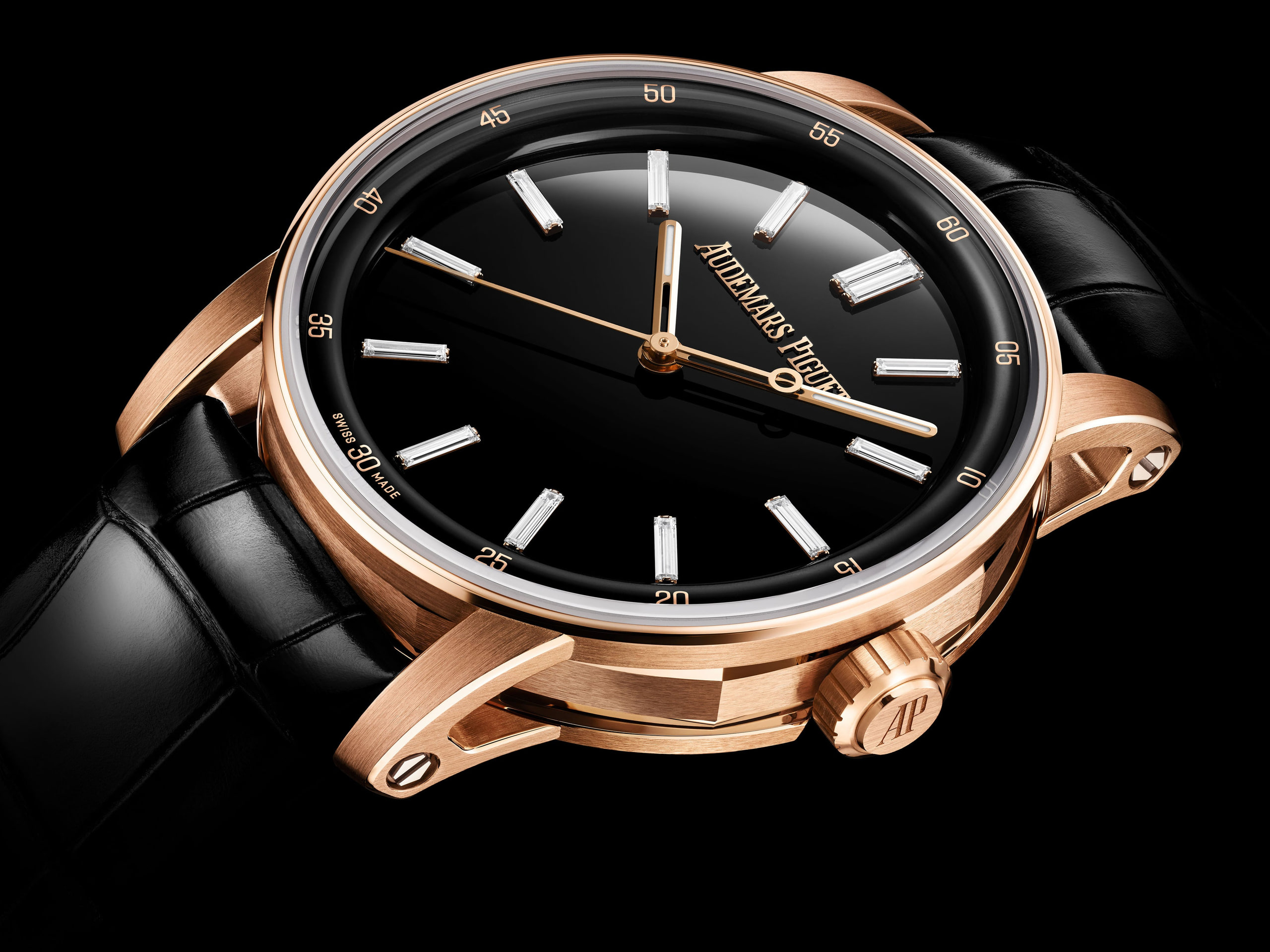
The onyx watch is the evening answer. Reference 77410OR.OO.A001CR.01 uses an 18-carat pink gold case and a black onyx dial polished to a mirror, deep and nearly uniform, closer to enamel than to grain. Thirteen baguette-cut diamonds, about 0.37 carats in total, with a double marker at twelve, sit on that plane. Pink-gold hands carry the lume. A black inner bezel lets the dial run almost to the crystal. The strap is glossy black alligator with a pink-gold pin buckle. Swiss pricing is CHF 54,100. The official United States listing is $68,500.
That gap is not only metal. The onyx reference is paying for baguette diamonds and a stone that has to take a perfect polish without showing seams. The obsidian reference is paying for inclusions and a sunburst that has to be cut into glass without cracking the dial. Both start as rock: cut, thinned, ground, polished, then drilled for the hands. No two gold-obsidian surfaces match. Onyx, once mirrored, asks to look identical from watch to watch, which is a different kind of difficulty.
The finishing argument continues past the dial. Yellow gold against flecked volcanic glass reads warm, especially with the brown flange and the subtly shimmering strap. Pink gold against mirror onyx and baguettes reads more formal: black strap, diamonds as the bright interruption. In both cases the stone does more identifying work than the date window ever did on the stamped-dial Codes.
Proportion does the rest
Thirty-eight millimetres matters because the stone gets a dress-watch frame instead of a sports-watch billboard. The Code's architecture, with the octagon visible mainly from the side and the lugs welded to the bezel so the middle stays clean, keeps the case optically quiet. That quiet is useful when the dial is the event. Turn the wrist on the obsidian and the inclusions shift. Hold the onyx still and the baguettes do the work. Those are two different ways of wearing black.
Earlier in 2026 the house already put turquoise on a 38mm white-gold Code, and baguette markers on larger stone dials for Japan. These two blacks are the quieter continuation: one volcanic and flecked, one mineral and mirrored. For a collector who already owns a Royal Oak and wants something that reads under a cuff rather than across a table, the stone-dial 38mm Code is the sharper Audemars Piguet option in this release than another sports-watch colourway.
The stamped ripple dials with a date remain in the catalogue. These references are a different buy. Confirm the current United States price at an authorised salon; listings move. The case size is settled. The stone is not.