The Cantor Arts Center’s Asian American Art Initiative has been buying and accepting Asian American art since 2018, when Stanford art history professor Marci Kwon and associate curator Aleesa Pitchamarn Alexander founded it. The holdings have grown from roughly thirty works to more than eight hundred. In Focus: Asian American Art from the Collection, now in the Ruth Levison Halperin Gallery through 22 February 2027, puts twenty-one of the recent acquisitions on the wall. Many have not been shown publicly before. The show does not offer one definition of Asian American art. Three works show what that means in practice: Pacita Abad’s 1993 lithograph, Rupy C. Tut’s 2024 painting, and Masami Teraoka’s 2018 woodblock.
“We are honoring the individual, because we Asian Americans are not a monolith and because each of these artists has had very particular experiences and perspectives.”
Aleesa Pitchamarn Alexander, Robert M. and Ruth L. Halperin Associate Curator of Modern and Contemporary Art, on the AAAI’s approach to artists’ practices
Pacita Abad’s American Dream on handmade paper
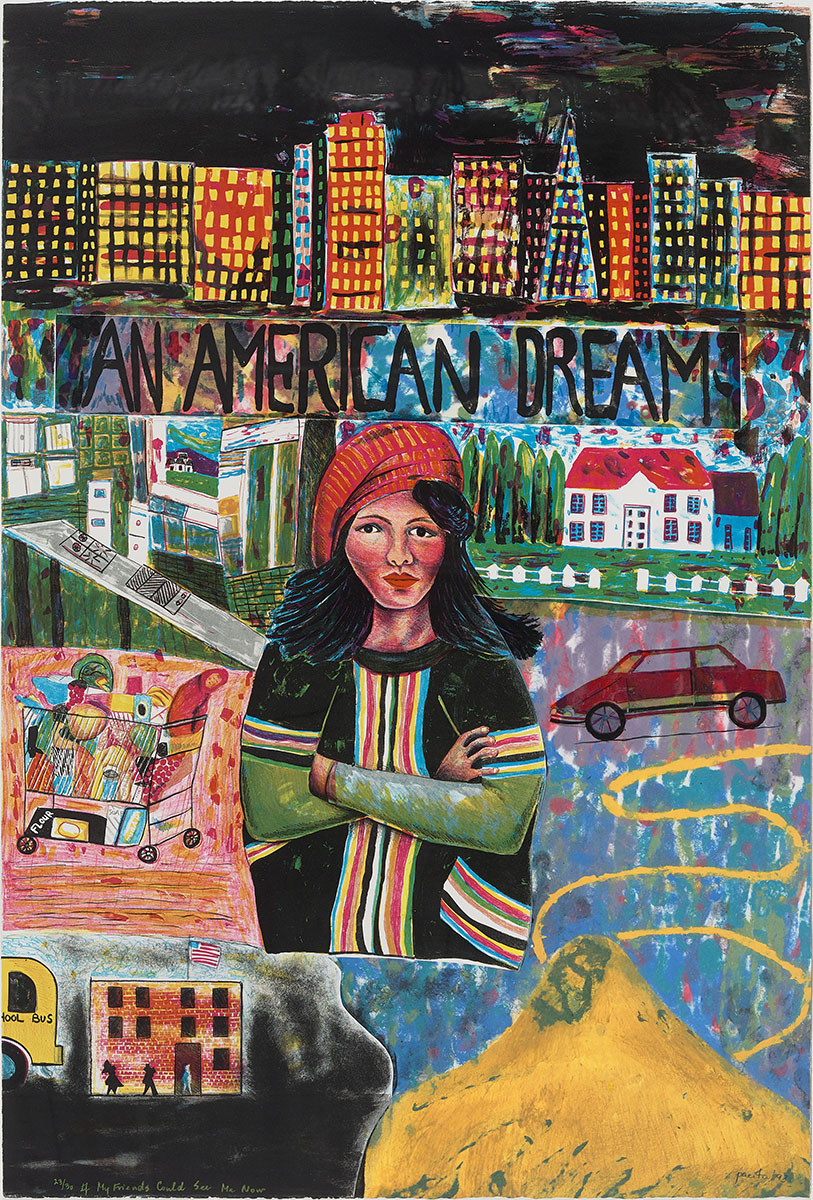
Pacita Abad’s If My Friends Could See Me Now (1993) entered as accession 2023.113, bought with the Robert E. and Mary B. P. Gross Fund. It is a lithograph with pulp-painted chine-collé and metallic powder on handmade paper, published with the Brodsky Center. Abad, born in the Philippines in 1946 and based for years in the United States until her death in 2004, is still best known for trapunto canvases that she stuffed, stitched, and loaded with beads until they behaved like soft sculpture. This sheet shows the same interest in materials moving into print.
The image belongs to her Immigrant Experience series from the early 1990s. A woman of color stands with arms crossed under the words “AN AMERICAN DREAM,” surrounded by a picket-fence house, a car, a grocery cart, a school bus, and a path climbing toward a gold mound. The Cantor now owns a work in which Abad’s argument about that dream lives in pulp and metallic powder as much as in subject matter.
Rupy C. Tut’s pigments in Oakland
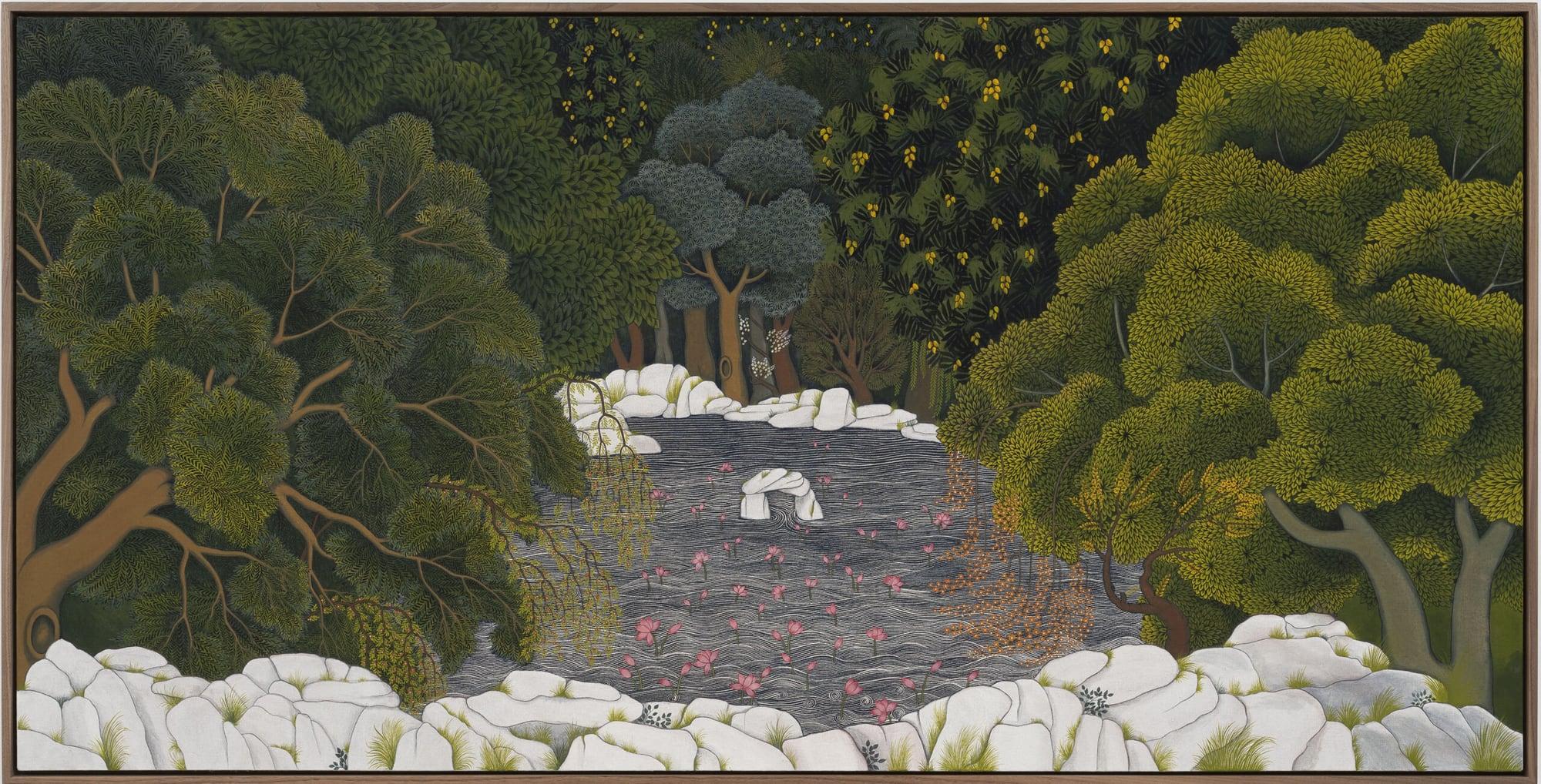
Rupy C. Tut’s Where Dreams Flow (2024) was purchased with funds from Pamela and David Hornik for the AAAI and accessioned as 2025.31. Handmade pigments sit on linen more than eighty inches wide: a rock-edged pond closed in by forest, pink lotuses on dark water, white stones along the bank. Tut was born in Chandigarh in 1985, works in Oakland, and spent years studying traditional Indian painting, including time at the King’s Foundation School of Traditional Arts in London. She grinds her own pigments and paints with fine brushes, keeping the discipline of that training while centering women and landscape.
The year of the Cantor purchase, SFMOMA’s SECA Art Award exhibition also gave Tut a solo room. Stanford’s acquisition puts a living Bay Area practice into a teaching collection, where students can return to the linen and the pigment for decades. Set next to Abad, the medium does different work. Both belong to the initiative; neither needs the other to explain itself.
Masami Teraoka’s woodblock invasion
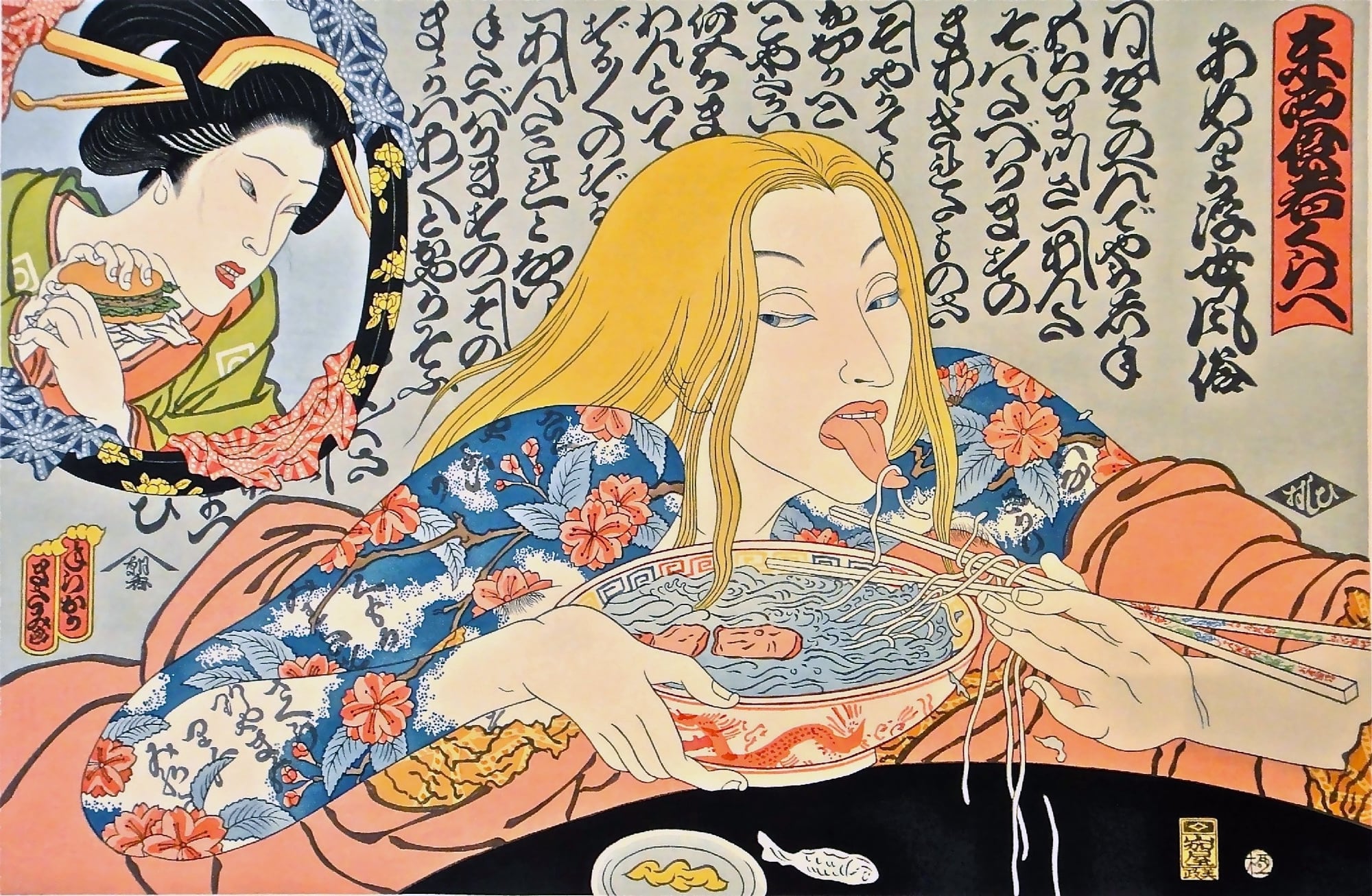
Masami Teraoka’s McDonald’s Hamburgers Invading Japan/Tattooed Woman and Geisha III (2018) came as a gift from the artist and Catharine Clark Gallery in support of the AAAI. Born in Onomichi in 1936 and long based in the United States, Teraoka has used the look of ukiyo-e for decades to stage modern appetite and collision. This sheet is part of his McDonald’s Hamburgers Invading Japan series. A blonde figure leans into a ramen bowl; a roundel shows another woman biting a hamburger; calligraphy and seals borrow the furniture of Edo prints.
A university museum that already teaches Asian art history gains a late woodblock carved and printed with multi-block discipline, and a subject that places American consumer culture inside that form. Together with Abad’s paper experiment and Tut’s pigment, the gift shows a collecting program that trusts craft as much as theme.
Admission is free. The museum is closed Tuesday and Wednesday; Thursday stays open until 8 p.m. In Focus is in gallery 211 through 22 February 2027.