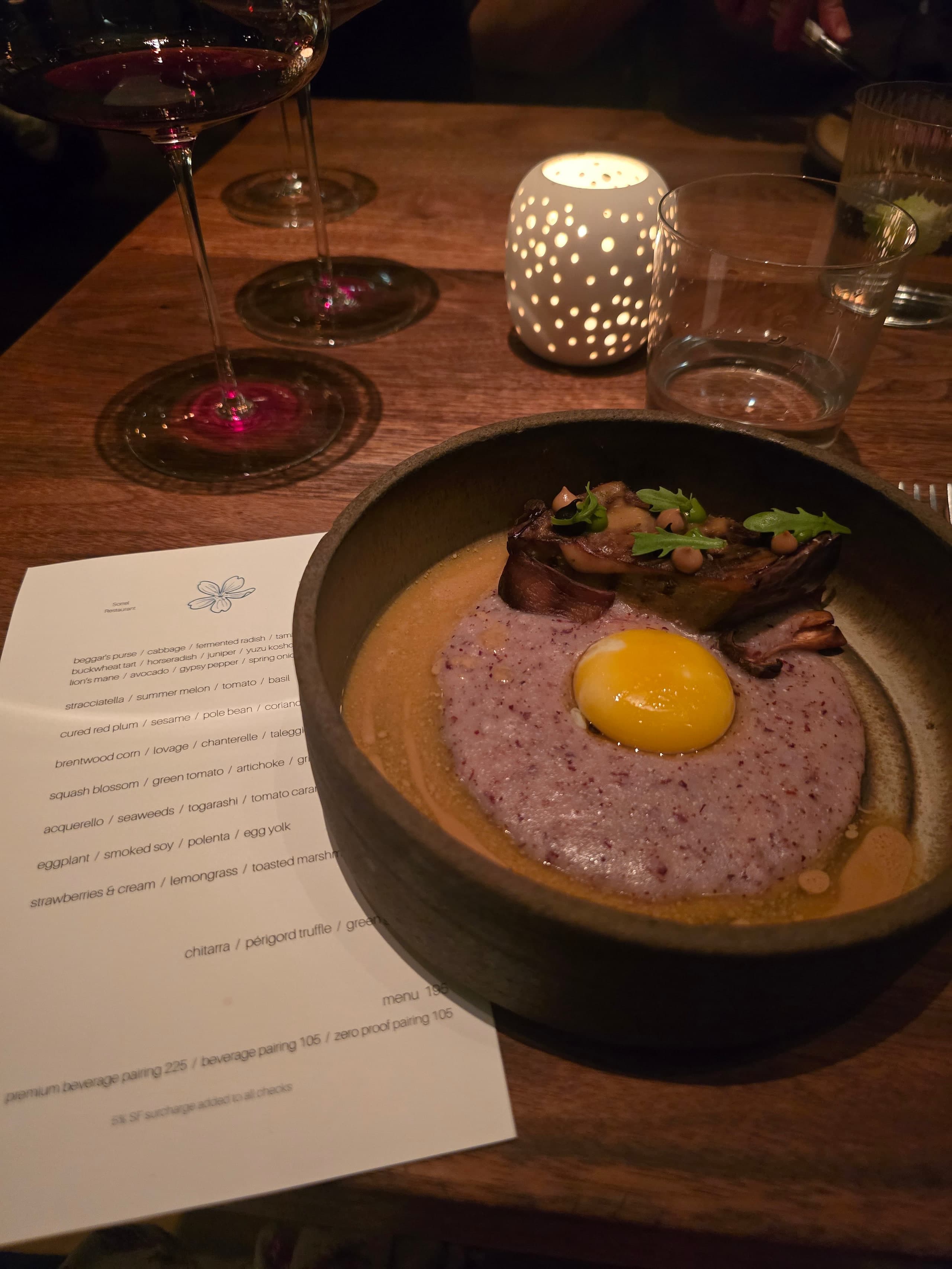
A chilly Wednesday in August, and Sorrel was full anyway: friend groups, a work table doing the thing where nobody mentions work, couples who had clearly done this before. No gala lighting, no pilgrimage hush. Just a Pacific Heights dining room doing what it has done since 2018 at 3228 Sacramento Street: selling out a one-star tasting menu on a night when plenty of San Francisco rooms would settle for half full.
We'll be blunt. In this city, longevity is the green flag. Hype gets you a waitlist. Eight years of Wednesdays gets you a restaurant.
“Sorrel in its pop up form was a way for me to test my boundaries, ‘play restaurant,’ and define my own cuisine.”
Alex Hong, chef-owner of Sorrel, on the three years before the Sacramento Street lease
A City Built to Eat Hard
San Francisco is a punishing place to run fine dining, and the scoreboard explains why. The 2026 MICHELIN Guide California, announced in June, put 25 starred restaurants inside city limits: four at three stars (Atelier Crenn, Benu, Californios, Quince), six at two, and fifteen at one, Sorrel among them. California holds ten three-star restaurants, more than any other state, and four of those sit in a city seven miles across. Californios became the first Mexican restaurant anywhere to reach three stars in the same announcement.
The one-star tier is where the pressure actually lands, because that is where most people spend. Brandon Jew's Mister Jiu's holds the star that once looked unlikely for Chinese American cooking in Chinatown. David Yoshimura named his Polk Street room Nisei, after the American-born children of Japanese immigrants, and has held a star since 2022. Naides, which the guide's inspectors called a new benchmark for chef-driven Filipino cooking, joined the list in this year's selection. Sorrel keeps its place in that same crowd without a cuisine hook to sell, which is harder than it sounds.
The audience, at least, is built in. Census estimates put San Francisco at roughly 35 percent Asian, among the highest shares of any large American city, and diaspora professionals and visitors from across the Pacific tend to treat the guide as a calendar rather than a souvenir. You don't need a lecture on why Asian Americans adopt early here. You need a reservation.
The same market eats its young. Noodle in a Haystack, the twelve-seat Inner Richmond counter with a waitlist reported around 15,000 people and a $306 ramen tasting menu, closed in May 2026 because two owners cooking every service could not make the arithmetic work. A cult following is not a balance sheet. Set against that, eight years of held stars on a residential hill starts to look less like heritage and more like competence.
Alex Hong Played the Long Pop-Up
Alex Hong, Sorrel's chef-owner, is Colorado-raised and came to food through an aunt and uncle who farmed in Missouri and turned up to family visits with produce. He trained at the Culinary Institute of America in Hyde Park, then worked at Jean-Georges in New York, Frasca in Boulder, and Quince in San Francisco, where he fell for hand-rolled pasta. It still shows on the menu.
Sorrel began in 2012 as a pop-up in a small Union Square boutique hotel, with a $25 tasting menu and a chef handing out flyers on the street to fill seats. He ran 135 of them across three years, changing the menu weekly in borrowed kitchens, before signing the Sacramento Street lease and opening the brick-and-mortar in April 2018 at twenty-eight. Within eighteen months he had a James Beard Rising Star nomination, three and a half stars from Michael Bauer at the San Francisco Chronicle, and a Michelin star that has not moved since.
That arc, from a $25 pop-up to a $195 tasting menu, is most of the argument. Hong never needed pho or dumplings on the card to matter to diaspora diners. He needed to hold a standard on a residential block while SoMa charged more for louder rooms. Cooking inside the European canon while keeping the ownership is its own Asian American luxury move, and a quieter one than opening a concept.
The city's own history sharpens the point. When Michelin inspectors first landed here in 2007, the rooms that actually defined San Francisco taste (Zuni Café, Slanted Door, Oliveto) came away with nothing. Charles Phan, who proved Vietnamese American cooking could carry a Ferry Building lease and a James Beard award, said he had always taken his reference points from Asia. Chez Panisse had already taught the region to treat the farmers' market as doctrine, and the guide arrived to grade all of it on a French curve. Sorrel belongs to the generation after that argument: Asian American ownership working inside the guide's grammar, with the produce politics intact.
What a Wednesday Tasting Actually Feels Like
The restaurant describes its eight-course seasonal menu as a two-and-a-half-hour experience. We sat for three and a half, and nobody rushed us. Service was warm without the performed intimacy that makes you feel handled, the sort where a server reads that the table wants to keep talking and adjusts the pacing instead of the script.
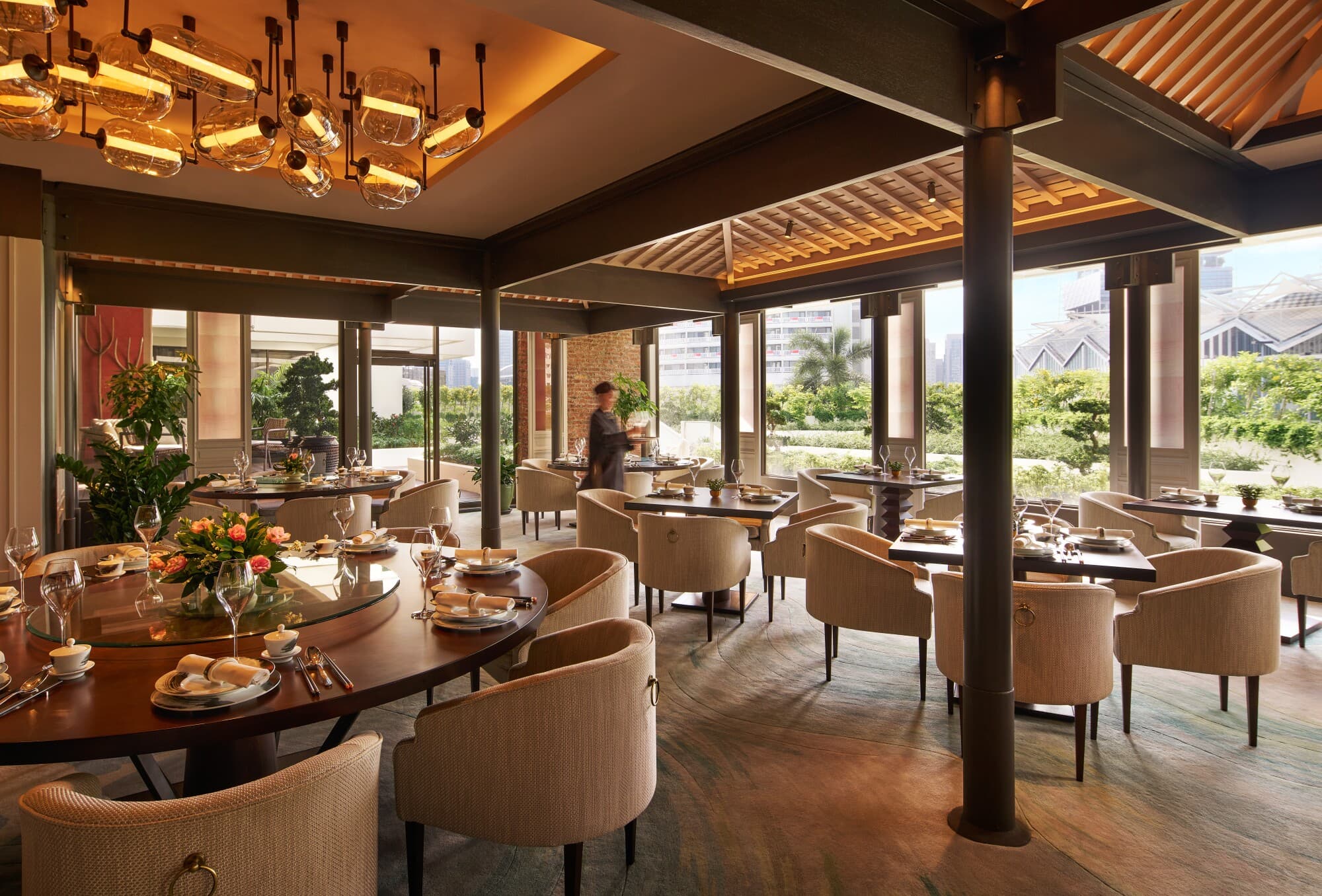
The room skewed underdressed for a $195 menu plus pairings, though that probably says more about San Francisco than about Sorrel. Fleece and clean sneakers sit next to $225 wine flights here without anyone blinking. Sacramento Street helps: this is a residential block where people walk dogs past the door, not a spectacle address.
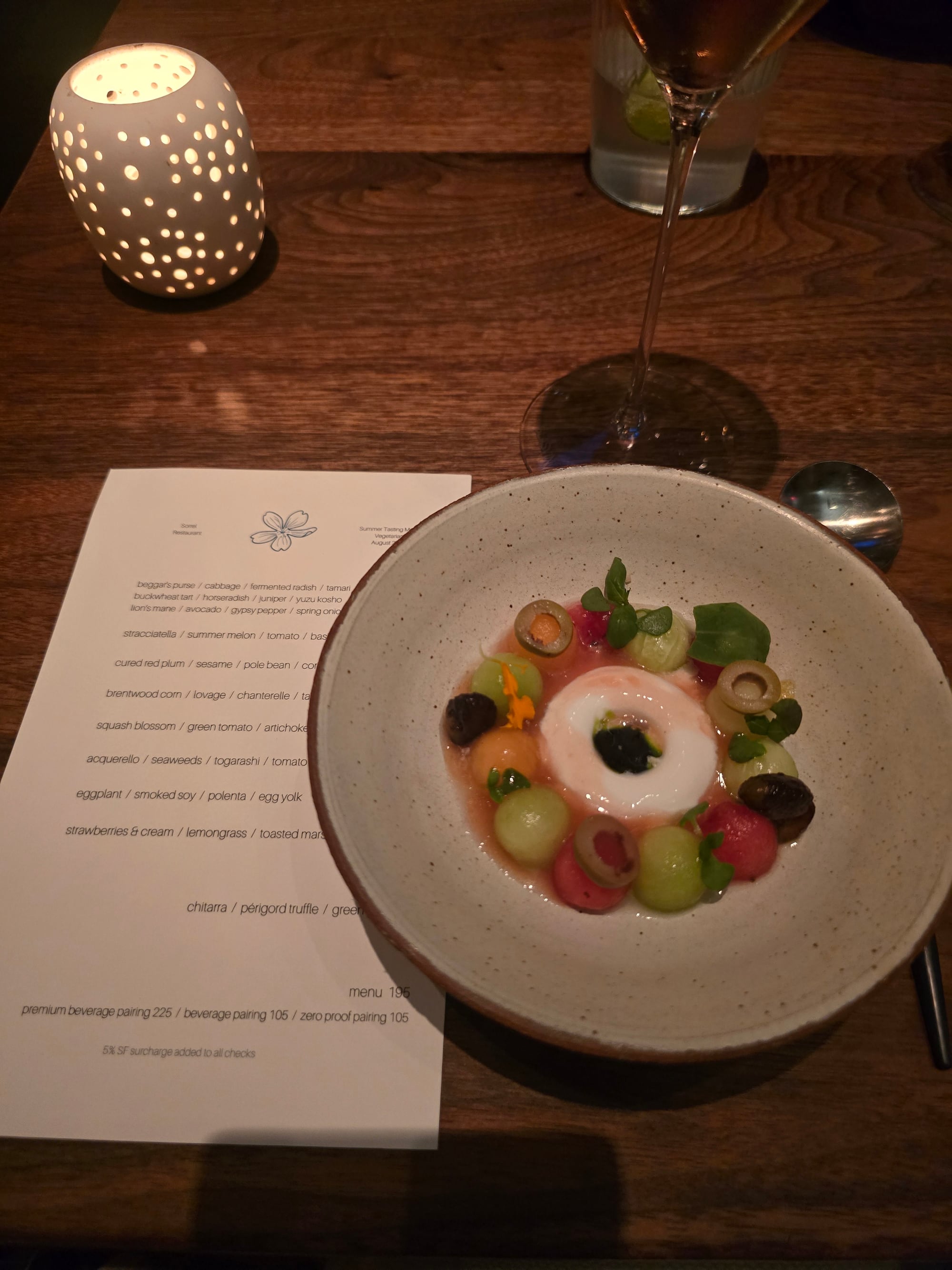
We split the table: one standard tasting, one vegetarian. The standard menu ran snacks, then stracciatella with summer melon and tomato, hamachi with red plum and sesame, Brentwood corn with nduja and taleggio, Devils Gulch rabbit with chamomile and squash blossom, sea urchin over acquerello rice with seaweeds and togarashi, king salmon with summer squash and trout roe, and strawberries and cream with lemongrass and toasted marshmallow to close.
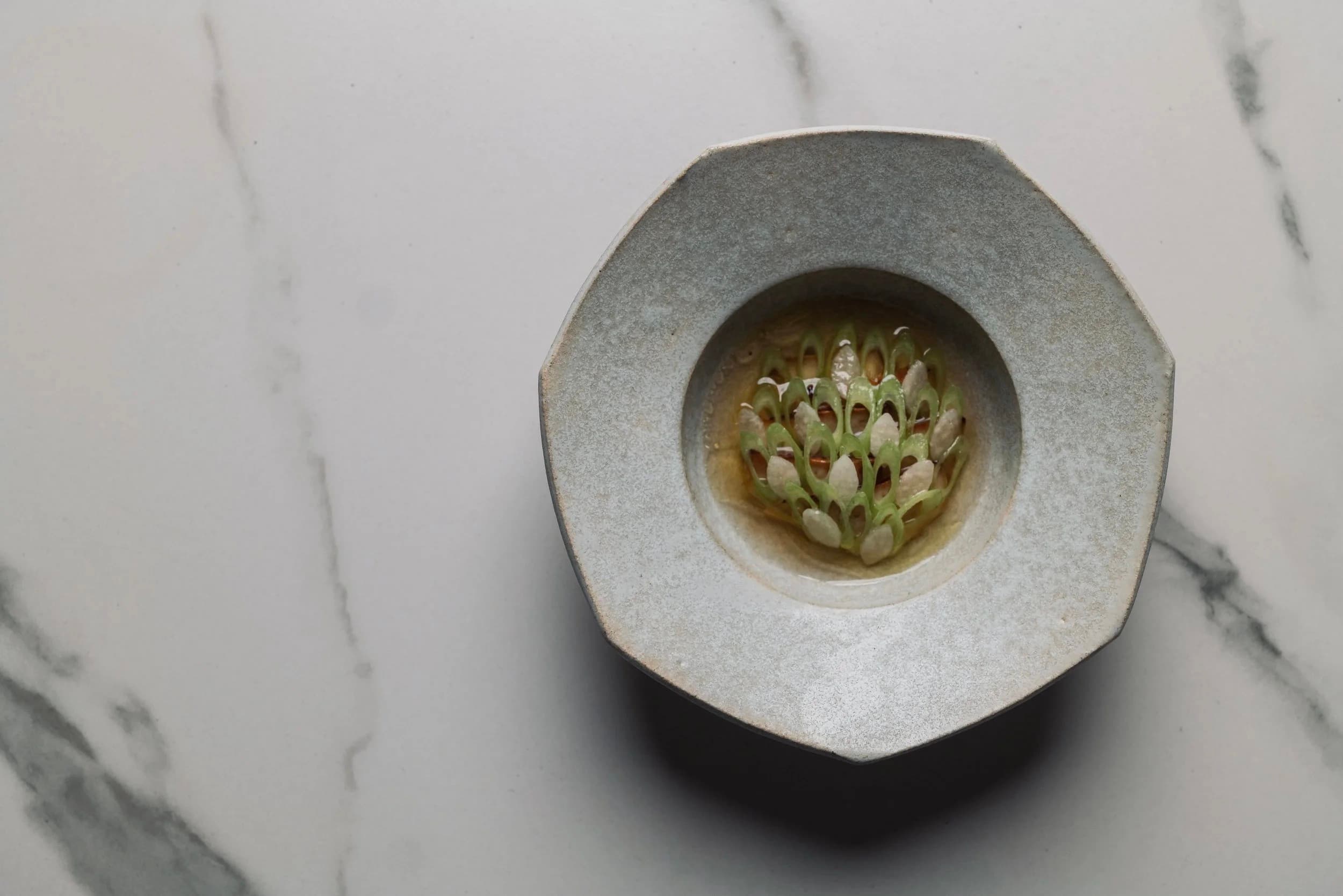
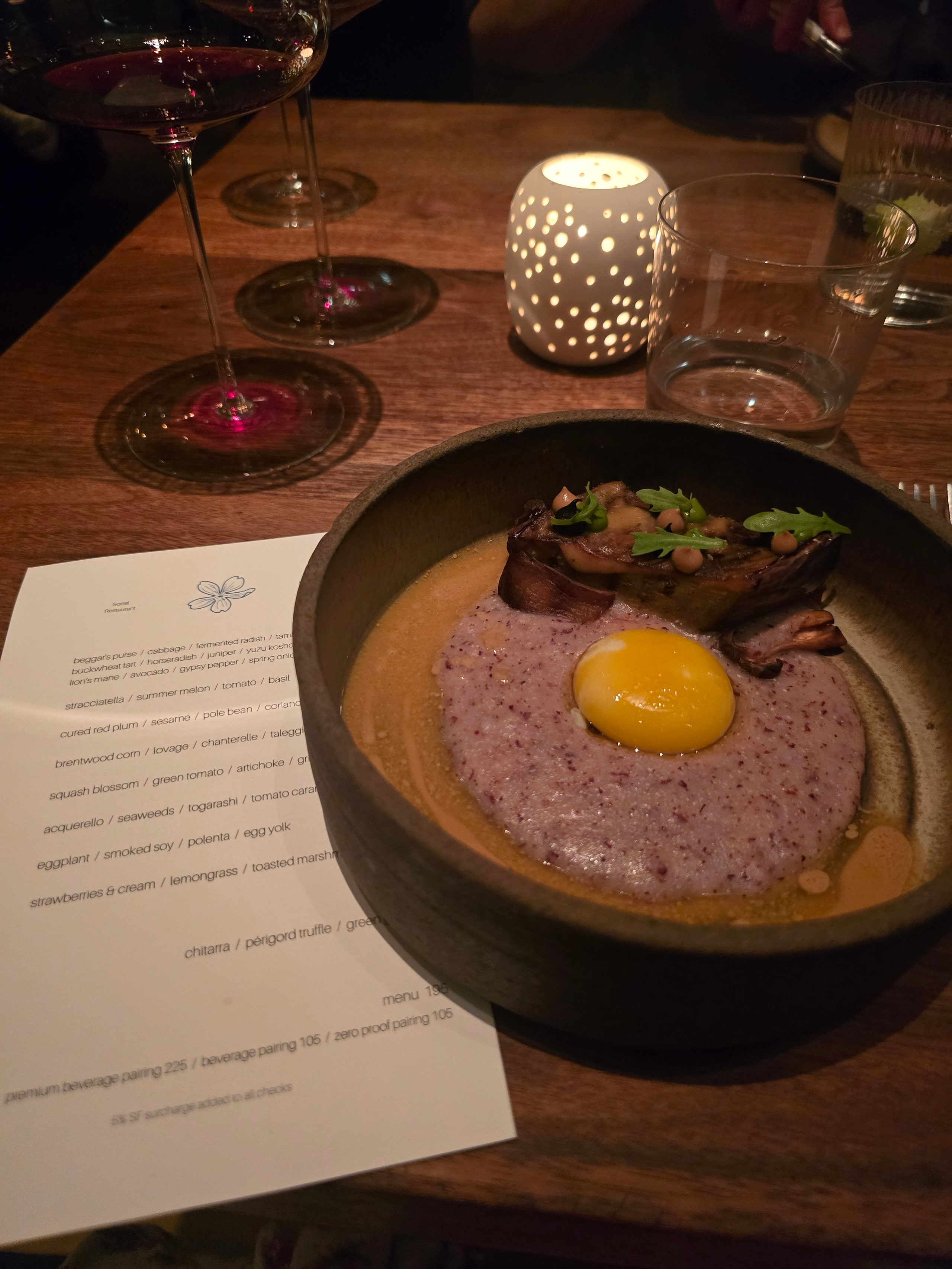
The vegetarian version tracked the same produce calendar and swapped the anchors out: chanterelle where the nduja went with the corn, artichoke and green tomato in place of the rabbit, seaweeds and rice without the sea urchin, and the eggplant course above standing in for the salmon. It was genuinely tasty and paced with the same care. But the substitutions read as subtraction more often than invention, and a table eating both menus will notice the gap in protein and in nerve.
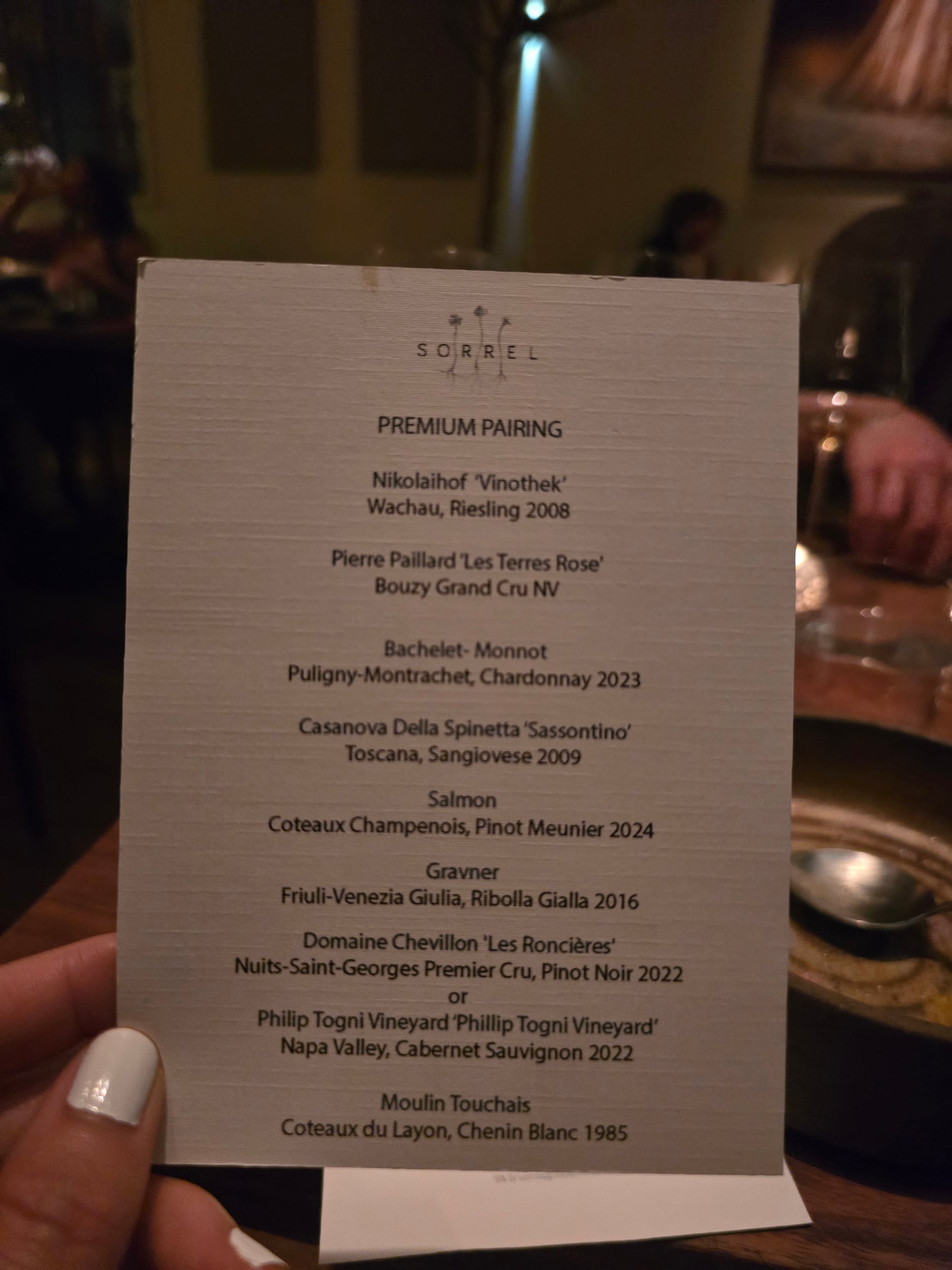
Both beverage programs turned out to be the surprise of the night. The $225 premium flight ran eight pours: Nikolaihof's Vinothek Riesling from the Wachau, 2008; Pierre Paillard's Bouzy grand cru rosé; a 2023 Puligny-Montrachet from Bachelet-Monnot; a 2009 Tuscan Sangiovese; a still Coteaux Champenois Pinot Meunier from the grower Salmon; Gravner's 2016 Ribolla Gialla, amphora-aged and orange and the kind of pour that separates a real list from a cautious one; then a fork between Chevillon's Nuits-Saint-Georges premier cru and Philip Togni's Napa Cabernet; and a 1985 Moulin Touchais Coteaux du Layon to finish.
The zero-proof pairing is priced at $105, identical to the standard wine flight, and it earned the parity. One of us drank it all night and never got handed the sweet consolation version. In a city where the mocktail is usually an afterthought with a garnish, that is worth saying.
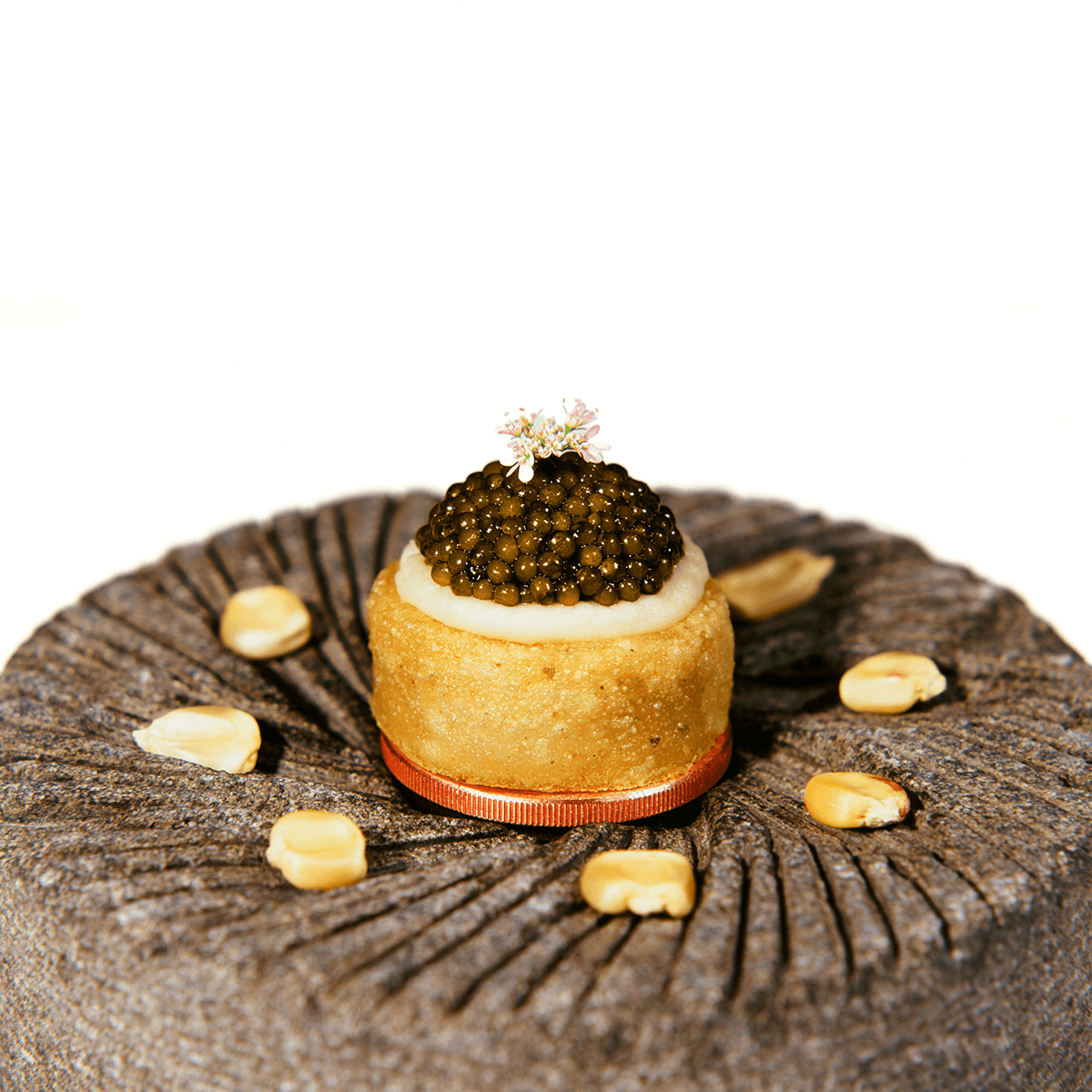
We added the white corn Basque cheesecake with osetra caviar, $42, which sounded exactly like the trend-forward supplement we would normally skip. The top arrives entirely covered in caviar. It ate like a proper savory close, rich and saline and faintly absurd, and we stopped apologizing for ordering it somewhere around the third bite.
Why the Star Still Matters Here
Sorrel works at neighborhood scale, which is the point. The rooftop herbs and farmers-market shopping still read on the plate, the pasta still shows the Quince years, and the Tock releases that drop thirty days out at 11:00 a.m. Pacific still vanish for weekend seatings. Eight bar seats go first-come, first-served from 5:00 p.m. for à la carte, which is the move if you want the kitchen without the calendar management.
Read Rare Vietnamese American Fine Dining at Kingfisher for the scarcity argument around ethnic-coded fine dining, and Vogue World Gets San Francisco Wrong Without Asia for why the city's luxury map should center diaspora makers over bridge photographs. Sorrel sits between those two stories: an Asian American-owned room that never made identity the product, still filling a Wednesday in its eighth summer.
So book it, for the reason nobody puts on a list. The chef who once chased strangers down a Union Square block with flyers is still in the kitchen, and the room is still full on the least glamorous night of the week.
Practical notes: Reserve on Tock thirty days ahead at 11:00 a.m. Pacific. Dinner runs Wednesday through Sunday, roughly 5:00 to 9:00 p.m.; closed Monday and Tuesday. The summer 2026 eight-course tasting is published at $195 per person, with a shorter five-course at $125; pairings run $105 seasonal, $225 premium, and $105 zero proof, and a 5 percent San Francisco mandate is added to all checks. Confirm current pricing on sorrelrestaurant.com. The house quotes two and a half hours; budget three or more. Eight bar seats are walk-in only for à la carte if the dining room is gone. Dress is San Francisco casual, and you will not be the only one in clean sneakers. Call (415) 525-3765 for larger parties or dietary questions.