

At Japan Society Gallery on East 47th Street, Gen'ichirō Inokuma’s Haniwa II (1956) fills a light ground with dark, blocky silhouettes, thin lines, and small washes of pink and gray. He painted it in New York the year after he arrived, and Willard Gallery included work of this kind in his first Manhattan solo. The canvas belongs to Japan Society. It is on the wall now for Gen'ichirō Inokuma’s NYC Salon, the first New York solo museum exhibition devoted to him, open through 10 January 2027.
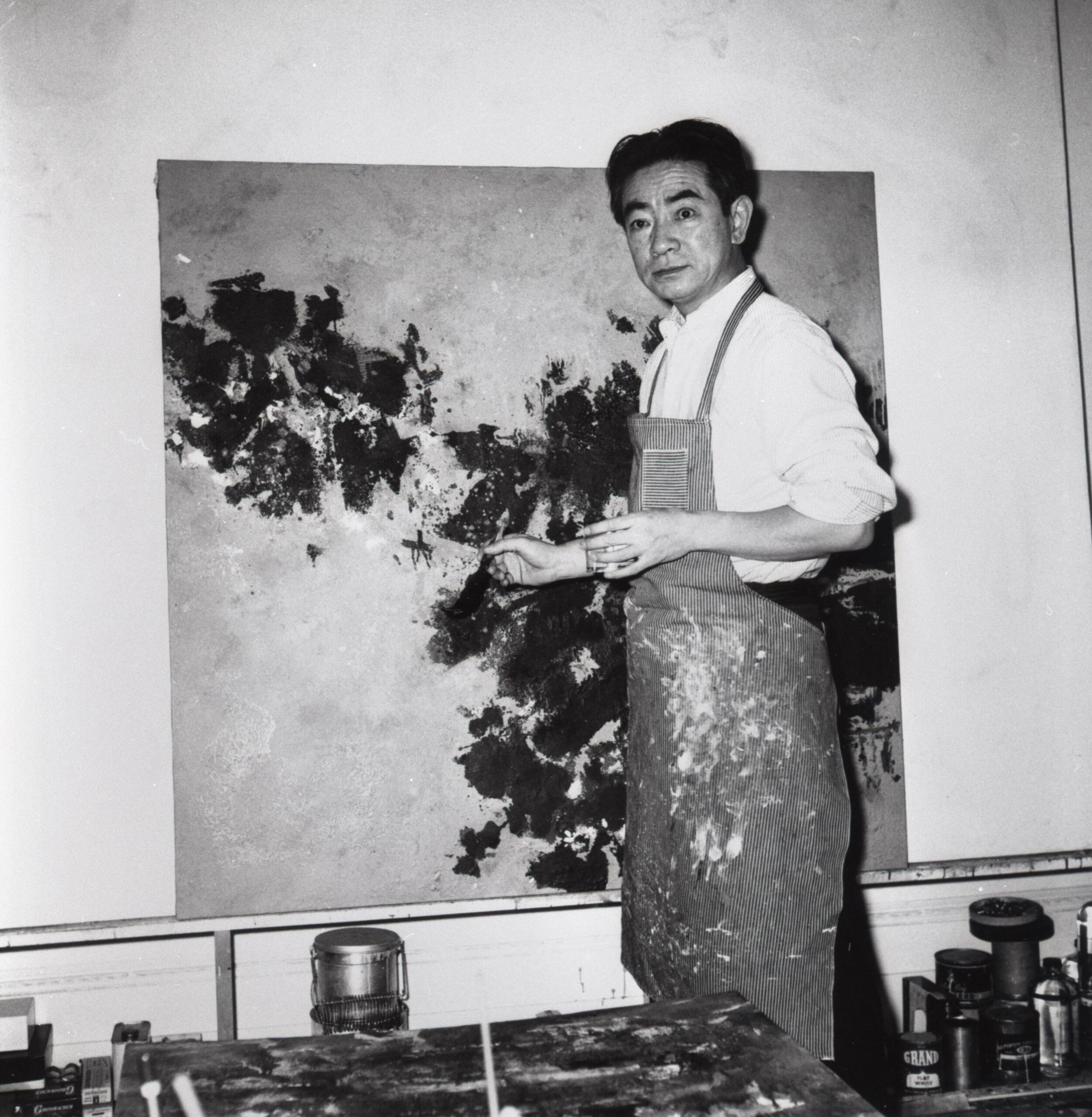
Inokuma was born in Takamatsu in 1902 and trained at the Tokyo School of Fine Arts. He lived in Paris before the war and met Picasso and Matisse there. In 1955 he left Japan intending to return to France, stopped in New York, and stayed for twenty years. He and his wife, Fumiko, lived at 115 East 95th Street and hosted a salon that brought Jasper Johns, Robert Rauschenberg, Isamu Noguchi, Yoko Ono, John Cage, Merce Cunningham, and visiting Japanese artists and architects into the same rooms. A members’ Gallery After Hours curator tour on 18 November walked that history after public hours. The two paintings below are the clearer record of what changed.
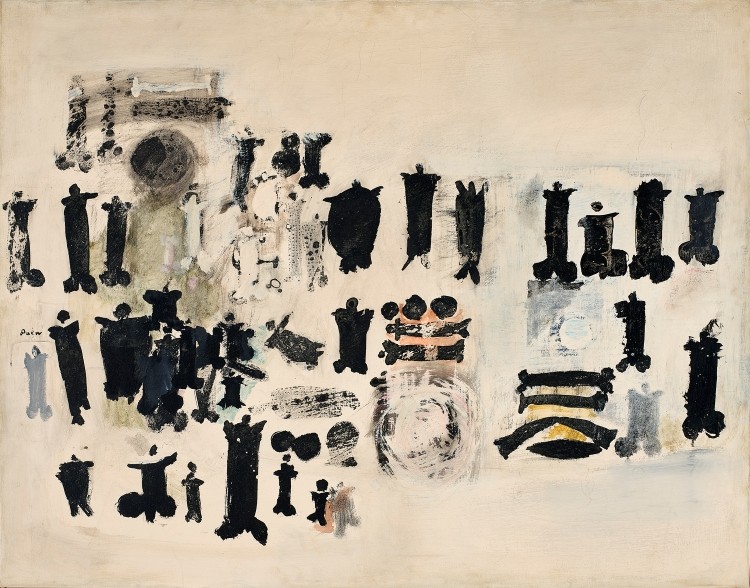
Gen'ichirō Inokuma, Haniwa II, 1956, oil on canvas. Collection of the Japan Society Gallery. Photograph by Go Sugimoto.
Haniwa II belongs to the early New York years, when Japanese clay tomb figures and calligraphic marks still organized the field. Willard showed him ten times between 1956 and 1972. MoMA and the Guggenheim acquired work in the mid-1960s. The friendships matter for context. The lasting contribution is how he rebuilt the picture once Manhattan itself became the subject.
“I hope that this museum, built by the people of Marugame, will help the whole town become a cultural environment.”
Gen'ichirō Inokuma, statement on the founding of MIMOCA, 1991
By the 1960s he had moved the studio to 23rd Street, looking down on Madison Square Park with the Empire State Building ahead. From that height he began painting the city as a plan: fine lines like tatami grain, circles set for rhythm, highways and blocks reduced to pattern. Green Highway (1967), from the Hirose Family Collection and also on view at Japan Society, is that later vocabulary in a single canvas. An emerald ground holds bands of white parallel strokes and dark dots, stacked and crossed like lanes seen from above. The figure of Haniwa II is gone. Traffic and the grid remain.
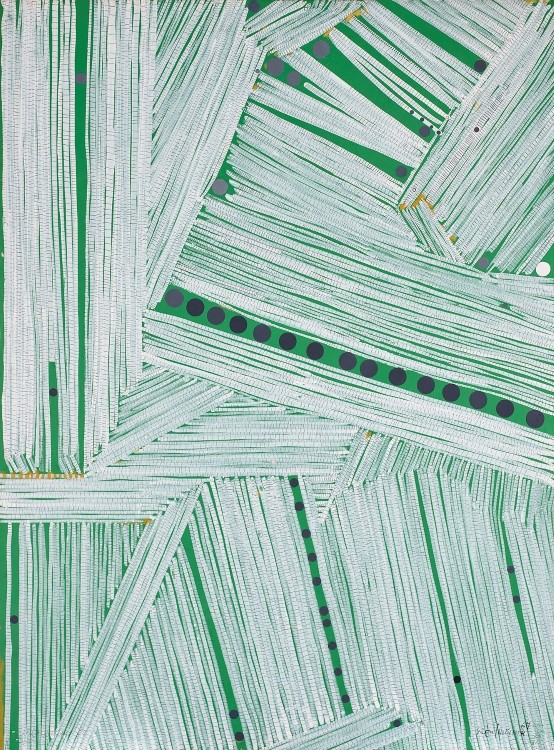
Gen'ichirō Inokuma, Green Highway, 1967. The Hirose Family Collection. Photograph by Go Sugimoto.
Look at the two canvases in order and the New York years read as a change of method. Early work carries Japanese motifs into large abstract scale. Later work treats the street grid, the highway, and the planner’s drawing as the paint’s job. The hang also keeps photographs, 8mm film, and salon papers nearby, so East 95th Street stays visible beside the paintings. Michele Bambling curated the exhibition with Kanako Furuno and Madoka Matsumura of MIMOCA.
Inokuma closed the New York studio in 1975 after illness, split time between Tokyo and Hawai'i, and in 1991 opened the Marugame Genichiro-Inokuma Museum of Contemporary Art with architect Yoshio Taniguchi. He gave the city about twenty thousand works and asked for a museum that would keep showing living art, not only his own. MIMOCA still does that work in Shikoku, opposite Marugame Station. In Manhattan this winter, start at Japan Society, 333 East 47th Street: find Haniwa II, then Green Highway, and take the twenty years between them at walking pace.
Gallery hours during the hang are Tuesday to Friday, 11:00 to 17:00, and Saturday and Sunday, noon to 18:00. Tickets are $20 for nonmembers and $15 for students and seniors; members enter free. The next Free First Friday evening is 4 December, 17:00 to 19:00. Take the 6 to 51st Street or Grand Central and walk east toward the United Nations. Confirm holiday closures on japansociety.org before you go. For another Midtown hang of Asian modernism this season, Whanki, Chun, and Ha at the Korean Cultural Center runs through mid-December.