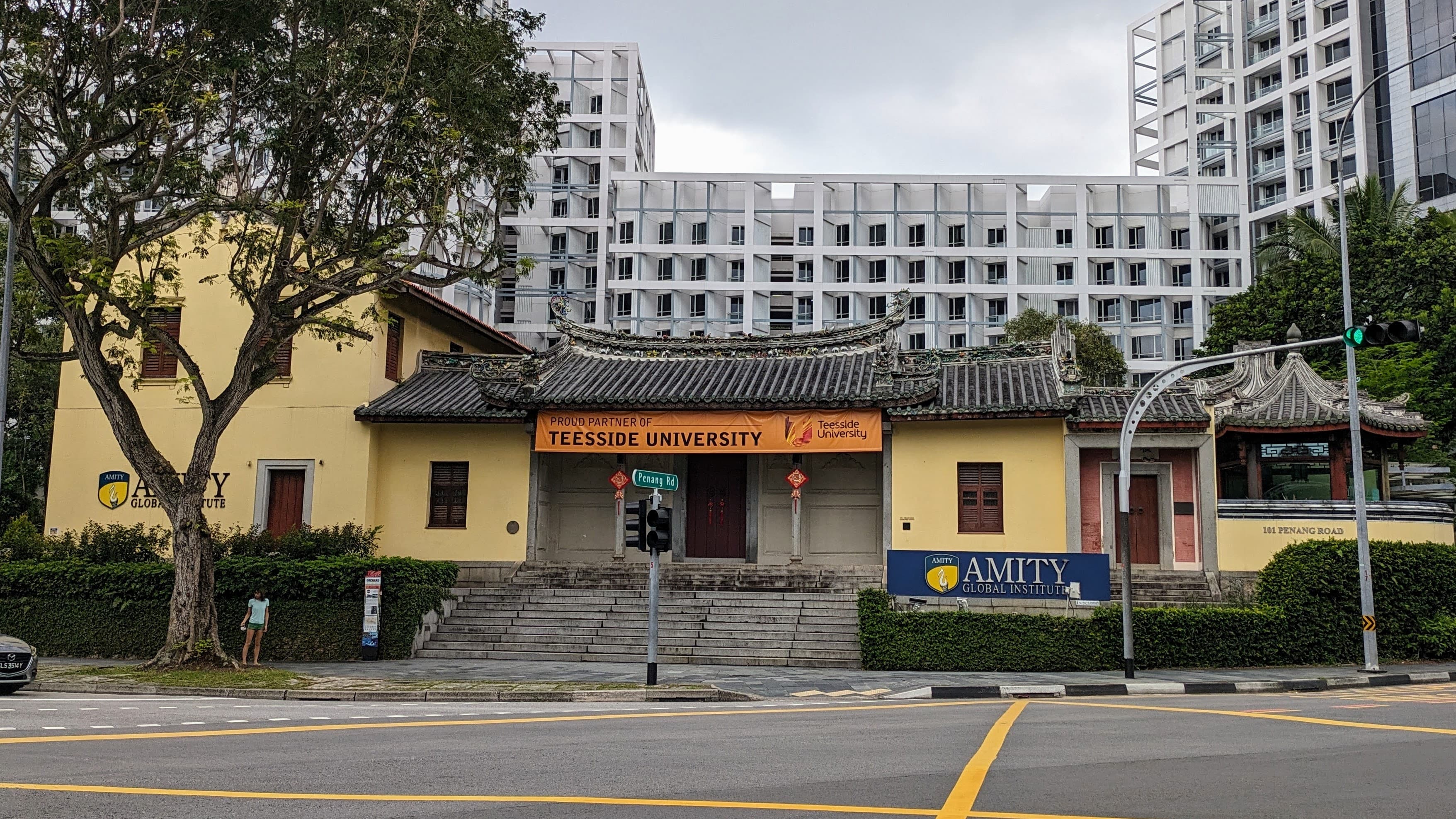

Most Singaporeans have walked past it without looking up.
At 101 Penang Road, where Clemenceau meets the Orchard corridor, a Teochew mansion sits in gilded timber and ceramic mosaic while glass towers lean over the pavement. For decades the building was headquarters, campus, clinic, or closed door. Since 1 November 2025, the House of Tan Yeok Nee has been open to the public for the first time in more than a century of civic life — gallery, events, and a fine-dining room inside the last survivor of Singapore's Four Grand Mansions (四大厝).
This is not shophouse heritage. It is towkay architecture: the cultivated side of nineteenth-century Nanyang, built to announce that a man who began as a cloth peddler had become indispensable to a sultan's revenue farms and a city's imagination of wealth.
The Man and the Four Houses
Tan Yeok Nee (1827–1902), also recorded as Tan Hiok Nee (陳旭年), left Chaoshan in poverty and built an empire in pepper, gambier, and — in the legal economy of his era — opium and spirit farms across Johor and Singapore. He succeeded Tan Kee Soon as leader of the Ngee Heng Kongsi, served as Major China of Johor, and was decorated by the court of Sultan Abu Bakar. In his hometown of Jinsha, Caitang, he spent fourteen years erecting Cong Xi Gong Ci (从熙公祠), an ancestral hall whose stone carving now ranks among China's protected national relics.
In Singapore he joined three other Teochew merchants — Tan Seng Poh, Seah Eu Chin, and Wee Ah Hood — in building four grand residences that announced Teochew arrival. Three were demolished or lost. Only Tan's remains.
Between 1882 and 1885, he raised this house on land his contemporaries considered auspicious: back to Oxley Hill, water from what is now Stamford Canal crossing the low ground of Dhoby Ghaut before him. He modelled the Singapore mansion on the hall rising simultaneously in Chaozhou, completing Cong Xi in 1884, a year before the Penang Road house. The parallel matters: this was not a colonial bungalow with chinoiserie trim. It was ermatuoche (二马拖车) courtyard typology — two houses with carriage wings — built by craftsmen brought from Chaozhou, reportedly a hundred workers over three to four years, at a cost of S$300,000 in nineteenth-century dollars.
Tan sold the house when the Federated Malay States Railway made Tank Road uninhabitable, then returned to China. He died in Chaoshan in 1902, outliving his sons. The mansion passed to grandsons who would chair the Singapore Chinese Chamber of Commerce and the Teochew Poit Ip Huay Kuan. The building, however, was only beginning its second life.
A Building That Refused to Disappear
Railway managers, Anglican girls' homes, boarding houses, the Salvation Army for more than fifty years, Japanese occupation headquarters, postwar bombing and looting, St. Mary's yellow paint, University of Chicago Booth seminars, Amity Global Institute lecture halls, a traditional-medicine clinic: the house accumulated layers without surrendering its bones.
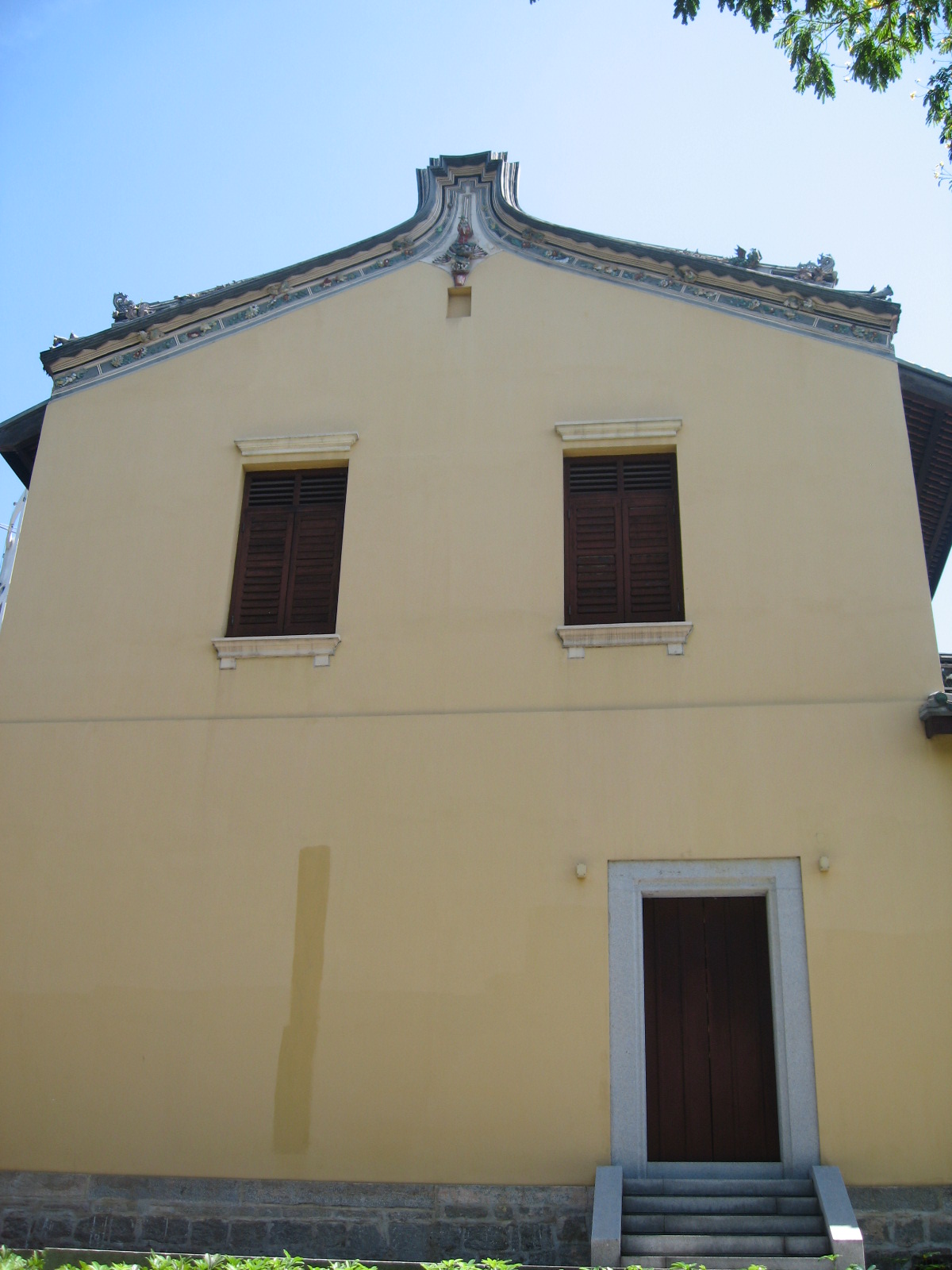
Gazetted a National Monument on 29 November 1974, it is one of two traditional Chinese mansions still standing in Singapore — the other being the River House at Clarke Quay — and the only one in Teochew style, with near-straight roof ridges, jian nian mosaic ornaments, cai hua paintings, and marble pillars carved with scenes from Chaoshan. The sidianjin plan — four double-pitched gables suggesting the character for gold — encodes Confucian order in timber and tile. Yin and yang, the five elements at the ceiling line: prosperity rendered as geometry.
Most passersby saw a yellow wall and a gate. Few saw what the National Heritage Board and conservationists have argued for decades: that Singapore's luxury today rests on a civilizational stack it rarely displays.
The Hundred-Million-Dollar Remembering
In 2022 the Karim Family Foundation — philanthropic arm of the Indonesian-Chinese Karim family — acquired the house in a transaction reported between S$85 million and S$92 million. Market observers estimate restoration pushed total investment past S$100 million.
DP Architects and Associate Professor Yeo Kang Shua of SUTD led conservation. In October 2023, project architects flew to Chaozhou and brought thirty craftsmen, including twenty Teochew masters, to Singapore to repair timber carving, roof jian nian, and clay ni su sculpture — craft exported back to the building that once imported it.
Cindy Karim, the foundation's lead principal, has framed the reopening as shifting the house from private tenancy to civic landmark. Minister Edwin Tong, at the November 2025 opening, called it a model for heritage funded through philanthropy rather than state alone. That is the Banquet reading: diaspora wealth choosing to make beauty public.
The ground-floor gallery traces the mansion's programmatic lives through digital narrative. Upstairs, Loca Niru serves contemporary Japanese-French cuisine in rooms where Teochew ancestors watch from carved marble — a tension worth naming, though the house itself is the argument. You do not need the tasting menu to understand why the building matters.
Why It Belongs in the Luxury Conversation
Luxury publishing defaults to Orchard openings and rooftop pools. The House of Tan Yeok Nee asks a harder question: what does cultivated Asia look like when it is not performing for export?
The answer is here in lacquer logic, ceramic roof stories, and a patron family willing to fund memory at civic scale. It is the same inheritance your readers chase in Kyoto joinery or Mumbai stone — material intelligence that survived empire, war, MBA programmes, and mall traffic.
Singapore forgot this mansion because forgetting is efficient. Remembering it is expensive. That is precisely why it belongs on the Grand Tour circuit of attention.
If You Go
House of Tan Yeok Nee, 101 Penang Road, Singapore 238466 (drop-off 103 Penang Road). Gallery open daily 10 a.m.–12 midnight per the official site. Near Dhoby Ghaut MRT. Start with the gallery; reserve Loca Niru separately if you want the dining room. Confirm hours before visiting.
Read The Banquet Guide to Singapore, Singapore's Hotels Finally Have a Point of View, and Architecture and the Art of Arrival.