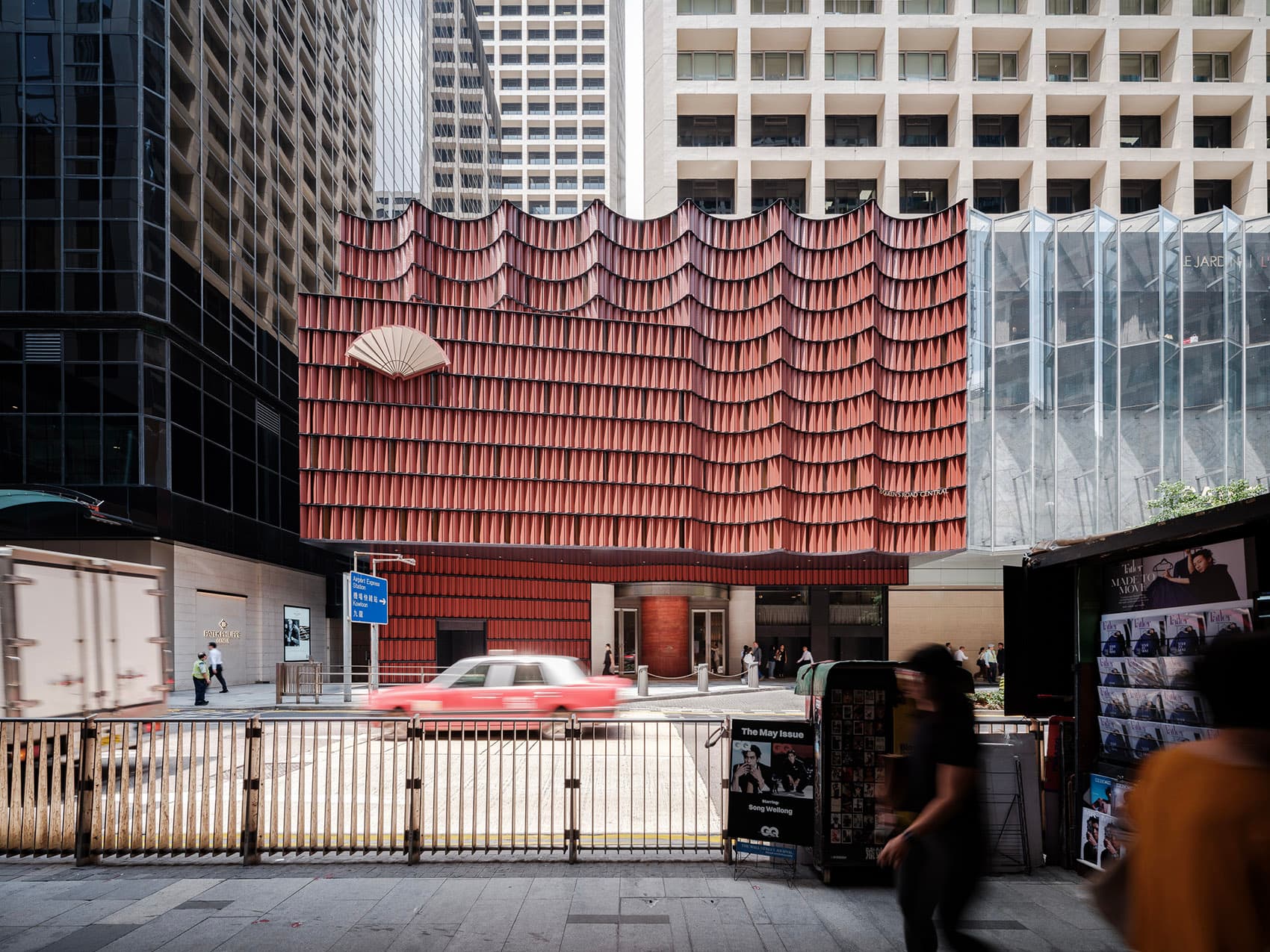
Mandarin Oriental has spent forty years selling a beautiful idea: that Asian hospitality can travel the world under one fan. Fair enough. The harder test is what happens when the brand has to prove that claim on Queen’s Road Central, in a mall hotel that used to hide behind glass.
Mandarin Oriental The Landmark, Hong Kong reopened on 1 June 2026 inside Hongkong Land’s LANDMARK complex, still at 15 Queen’s Road Central. The fan is still on the facade. What is new is who gets to dress the house: Joyce Wang Studio, the Hong Kong and London interior practice that first refreshed these rooms more than a decade ago, and Neri&Hu, the Shanghai studio of Lyndon Neri and Rossana Hu, who wrapped the street front in terracotta instead of another curtain wall.
“Our vision this time has a greater focus on local relevance and the heritage of the building.”
Joyce Wang, principal, Joyce Wang Studio, on returning to The Landmark
That line is the brief. If Mandarin Oriental’s “dual Asian heritage” is more than a 2025 logo refresh, this is where you feel it: not in Bangkok river mythology, but in whether Central can read as a Hong Kong house again.
Terracotta Before the Fan
The Landmark opened in August 2005 as the group’s second Hong Kong hotel, a compact lifestyle address above a luxury atrium rather than a harbour flagship. For years the Queen’s Road frontage behaved like a shop window. Neri&Hu’s job, commissioned by Hongkong Land as part of Tomorrow’s CENTRAL, was to re-cloth a stubborn skeleton: the former Harvey Nichols wedge, the drop-off, the jagged glass above.
What they built is an urban tapestry of custom cast terracotta tiles on darkened bronze shelves, with sparse cast-glass inserts that light at night. The fan still sits high on the terracotta field. The useful test for a walker is simpler. Does the building look like another Central glass box with a logo stuck on, or like a hotel that chose craft over reflection?
Stand on Queen’s Road for a minute. The terracotta holds. That matters more than any brochure paragraph about Asian roots.
Inside, Wang’s mansion foyer borrows warmth from historic New Territories houses rather than from a generic “Orient.” Press materials name Yu Yuen and Tai Fu Tai, the 1865 Qing scholar-gentry mansion in San Tin, Yuen Long, declared a monument in 1987. You are not meant to tour those houses from the lobby. You are meant to feel terracotta and deep green, a softened staircase, and a lounge that behaves like someone’s living room with better coffee.
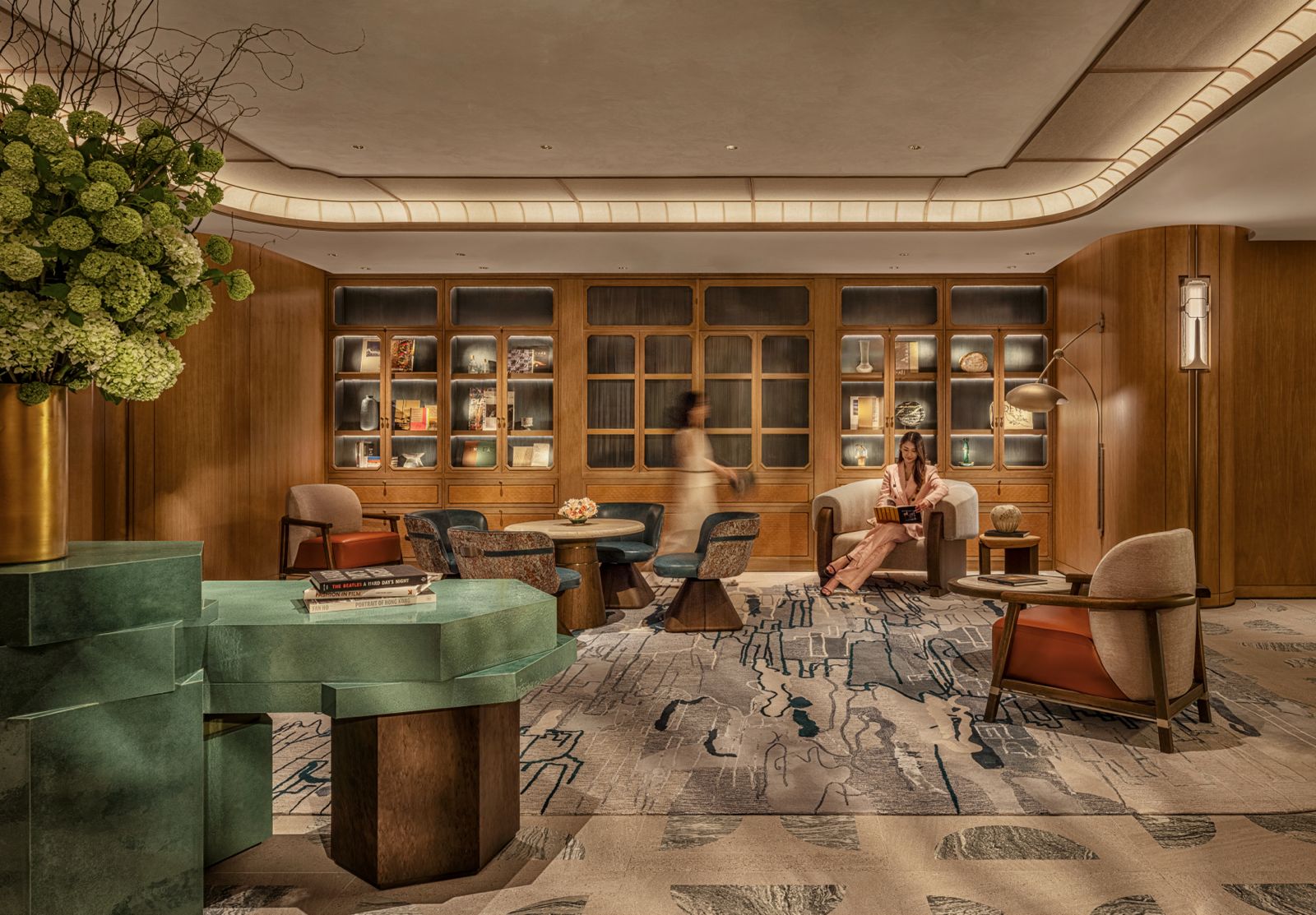
The local craft note that convinced me is small and specific. Wang’s team worked with Long River Label Maker Factory, described as Hong Kong’s last commercial weaving factory of its kind, on lobby textiles and lampshades. A label maker that once supplied fashion houses in the same mall now shows up as art. That is how you honor a place without painting dragons on the carpet.
What You Are Actually Booking
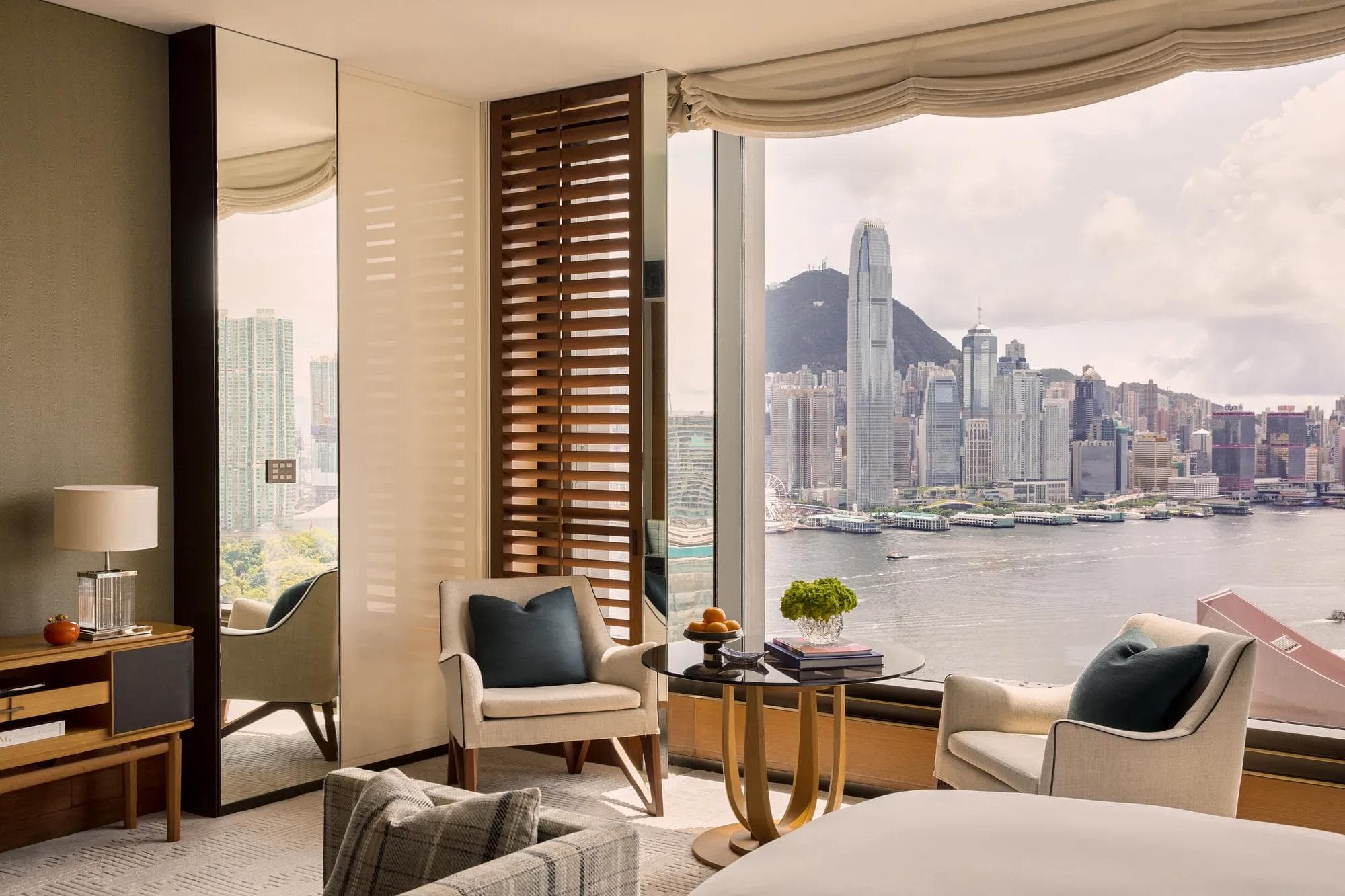
The hotel keeps 109 rooms and suites, starting around 42 square metres in the L450 category: lightened timber floors, Fromental silk, custom rugs that nod to historic brickwork. L600 rooms and above retain the Landmark’s curved glass bathrooms and the seven-foot round tub that regulars still ask for by name. Book the category you will actually sleep in.
Dining remains the house’s strongest argument for seriousness. On the seventh floor, under culinary director Richard Ekkebus, the MICHELIN Guide Hong Kong & Macau 2026 still lists Amber at three stars plus a Green Star, Sushi Shikon at three stars, and Kappo Rin at one. The hotel’s “seven stars under one roof” line counts those rooms; SOMM, Ekkebus’s French neo-bistro, is the unstarred workhorse next door. New for the reopen: Blanc de Noirs and Commune, the lobby coffee atelier. Book Amber or Shikon as their own projects; a room key is not a table.
Wellness is still finishing. An expanded spa, lap pool, gym, and thermal circuit was staged for July 2026, with further work into late 2026. Meanwhile the sister property, Mandarin Oriental, Hong Kong on Connaught Road, is in a summer recess through 30 September 2026, with spa guests pointed here. Confirm both calendars before you build a two-hotel week.
Opening rates under A Taste of the Next (book by 31 August 2026 for stays through 30 November) have floated near HKD 7,200 for an L600 with a HKD 3,000 daily dining credit, plus 10% service. Treat that as a planning band only.
How a Diaspora Traveler Should Use It
Use The Landmark when Central is the work, and when you want Mandarin Oriental service without pretending you need the harbour sister’s scale.
Arrive for the street. Walk in from Queen’s Road. Give yourself five minutes with the terracotta before you check in. If the facade already feels like mall scenery to you, this may not be your stay; try The Case for Rosewood Hong Kong when the week is Kowloon-and-museums instead.
Sleep residential, eat selectively. Book an L600 if the round tub is part of why you came. Put one serious table on the seventh floor, then use Commune and Blanc de Noirs as the easier public rooms. For Chinese lunch in the same mall geography, Dinner at China Tang remains the Landmark atrium option upstairs.
Hold the brand to the room. Mandarin Oriental’s dual Asian story (Hong Kong’s Mandarin of 1963, Bangkok’s Oriental of 1876, joined under the fan in 1985) only stays honest if local designers and makers keep getting the lead. The Landmark’s 2026 chapter is the cleanest place to check that. Read The Banquet Guide to Hong Kong for the wider city spine; use this hotel when the question is whether the fan still means Hong Kong craft, or only Hong Kong rates.
The Verdict
The Landmark does not settle the whole Mandarin Oriental argument. One hotel never does. What it does settle, for now, is whether the house can let Hong Kong lead: terracotta on Queen’s Road, a mansion foyer tuned to New Territories memory, and a weaving factory in the lobby instead of another imported mood board.
Book through mandarinoriental.com or +852 2132 0188. Ask for a Queen’s Road-facing category if the facade is why you came. Leave the fan to earn its keep after you have walked the street.