High jewelry press usually sells the stone. Cartier’s newest chapter also sells the hinge.
Le Chœur des Pierres, unveiled in mid-May 2026 at a Provençal château outside Saint-Tropez, opens with about 126 unique pieces and more than 85,000 hours of Paris atelier work. Centre stones run near 1,900 carats; roughly a dozen clear 20. Guests that night included Zoe Saldaña, Shu Qi, and Tilda Swinton; the rooms held Damien Hirst, Yves Klein, and Anselm Kiefer. Useful atmosphere. The Banquet brief starts later, at the jeweler’s bench.
The title plays French for itself: chœur (chorus) sounds like cœur (heart). Pierre Rainero, Cartier’s director of image, style and heritage, treats that homophony as the brief. Stones as voices. Stones as emotional centre. Fine. The narrower question is why a house that can still command a 50-carat Ceylon sapphire spends years of workshop time on jewels that come apart on purpose.
“Modularity is not something that is new… a piece of jewellery is literally an investment. So we have to propose many different ways to wear them.”
Pierre Rainero, on transformable high jewelry, to Options, The Edge
We’ll be blunt: carat theater still sells the night. The workshop hours that matter for a client who actually wears the piece are the ones spent on the second silhouette: ring flipped, earring unpinned, hair ornament rebuilt without a second invoice.
The Pieces That Prove the Thesis
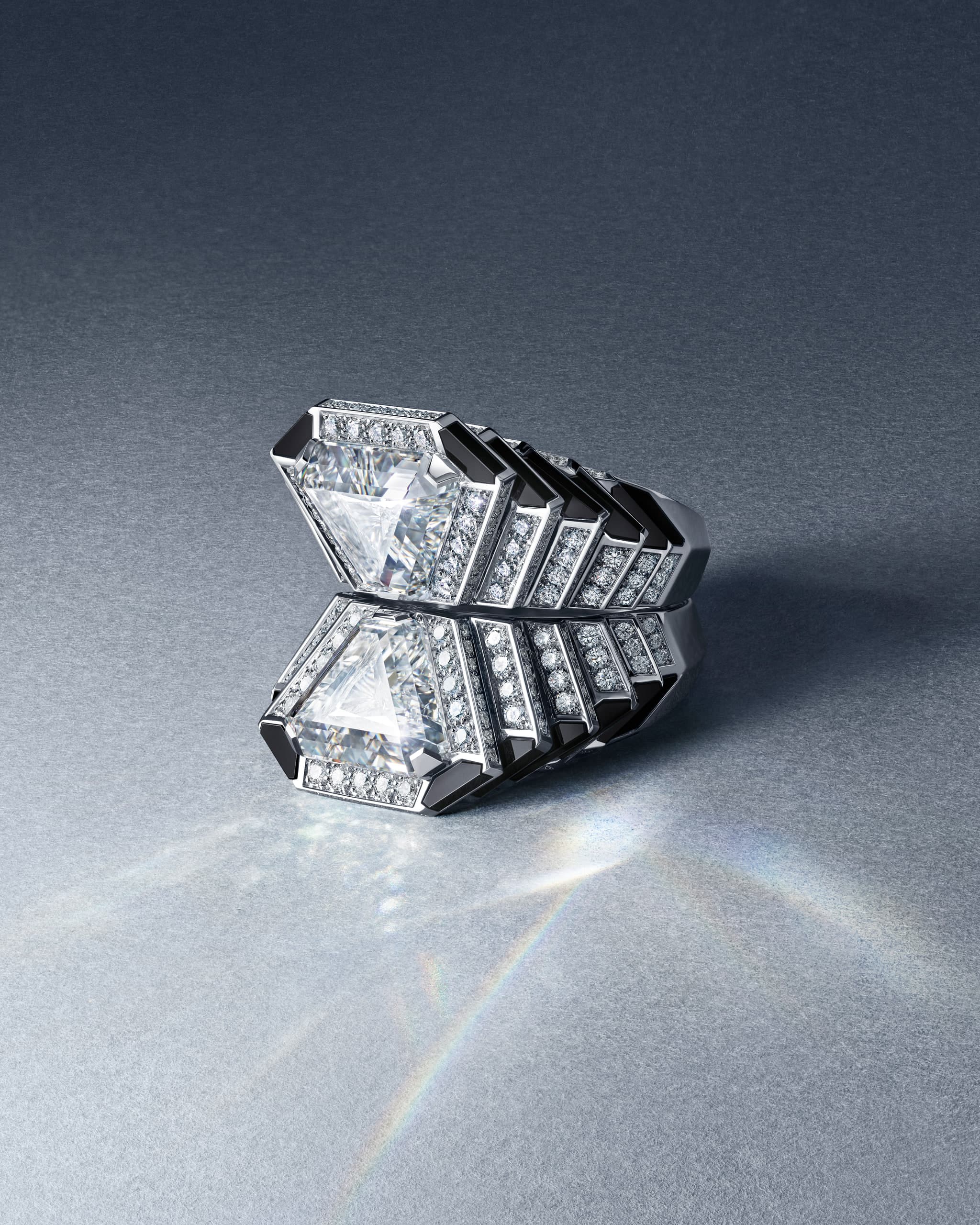
Specula is the cleanest classroom object. A modular Toi & Moi in white gold, onyx, and two triangular diamonds totaling 6.44 carats, it reads as ascending chevrons one way and opens across the hand the other. No new motif. New architecture. The workshop hours are inside the reversal.
Pyra is the hairline version of the same idea. Orange diamonds (6.85 carats among white) rework an early-twentieth-century tiara grammar into mobile earrings that convert into a brooch or a hair ornament. Transformability is old Cartier; scattering diamonds through the hair as if mid-fall is the contemporary nerve. Enrubanne, the ribbon suite Taiwanese actress Shu Qi wore in Saint-Tropez, splits its earrings into two distinct pairs so the client can wear denser or lighter without buying a second story.
Those are the innovations that do not photograph as fireworks. They photograph as service: an investment jewel that clears a white shirt at lunch and a gala neckline at night without a second commission.
Even the loud pieces carry quiet mechanics. Tutti Kanya, the Tutti Frutti return with a 30.33-carat carved Zambian emerald, hides a strung ruby tassel that can fall front or back and a main motif that detaches as a brooch. The carved leaves still do the Cartier handshake. The convertibility is what makes the commission travel.
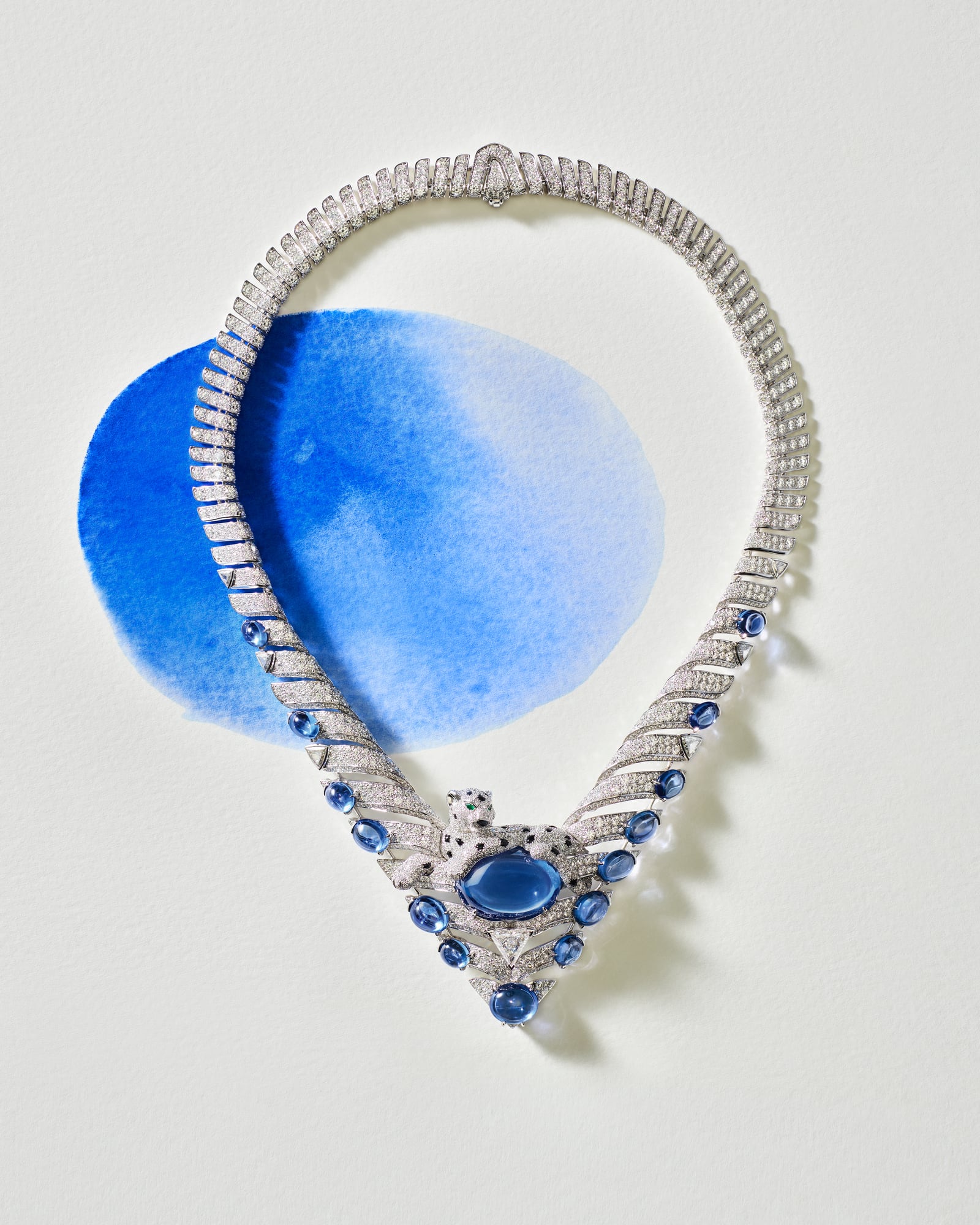
Panthère Kentia builds a fully articulated panther around a 50.13-carat Ceylon sapphire cabochon. Olorra promotes turquoise and lapis beside Colombian emeralds. Colored diamonds appear across more than eight hues, including pink pears from the closed Argyle mine. Alexa Abitbol, director of the high jewelry workshops, called the chapter a symphony in which each gem sings. Read past the music metaphor. The choir only works if the setting can move.
For how Cartier learned polychrome seriousness from Indian courts, keep Paris Learned Color from India nearby. For stone literacy before a Vendôme appointment, The Gem Palace and the Education of Stones still earns the reread. Le Chœur des Pierres is the modular sequel. Color still leads. The hinge is the plot.
Why Modularity Counts as Innovation Now
High jewelry used to prove ambition with carat weight and uniqueness alone. Clients still want both. They also want a jewel that earns its keep across a calendar: airport lounge, museum dinner, wedding week, inheritance photograph. Rainero’s line about investment is blunt client language. Modularity is how a maison answers without putting “versatile” on a campaign board.
That is why 85,000 hours is not only a lapidary brag. Hours go into invisible mechanics: light structures, secure conversions, settings that survive being taken apart and put back by staff who are not the original jeweler. Jacqueline Karachi-Langane, director of high jewelry creation, still insists the stone’s “soul” leads. The discreet contemporary skill is making that soul wearable in more than one silhouette. Art Deco Cartier already knew transformable tiaras; this chapter simply puts that grammar back at the centre of a stones-first story.
Cartier plans further chapters in Asia later in 2026 and again in February 2027. Diaspora readers who will never sit in the Saint-Tropez château can still use the filter. Ask which pieces transform. Ask how many ways the earring can leave the case. Ask whether the atelier hours bought a bigger stone or a smarter hinge.
If Paris is already on the diary, book Place Vendôme at 23 place Vendôme (typically Monday–Saturday 11:00 to 19:00, closed Sunday; +33 1 70 65 38 00) and confirm high-jewelry appointments on cartier.com. Ask for daylight when you compare colored diamonds and sapphire cabochons. Ask the associate to demonstrate any conversion at the desk before you leave. Same-day high jewelry is rarely available; treat the appointment as the visit, not a walk-in. The chorus is loud. The innovation clicks.