

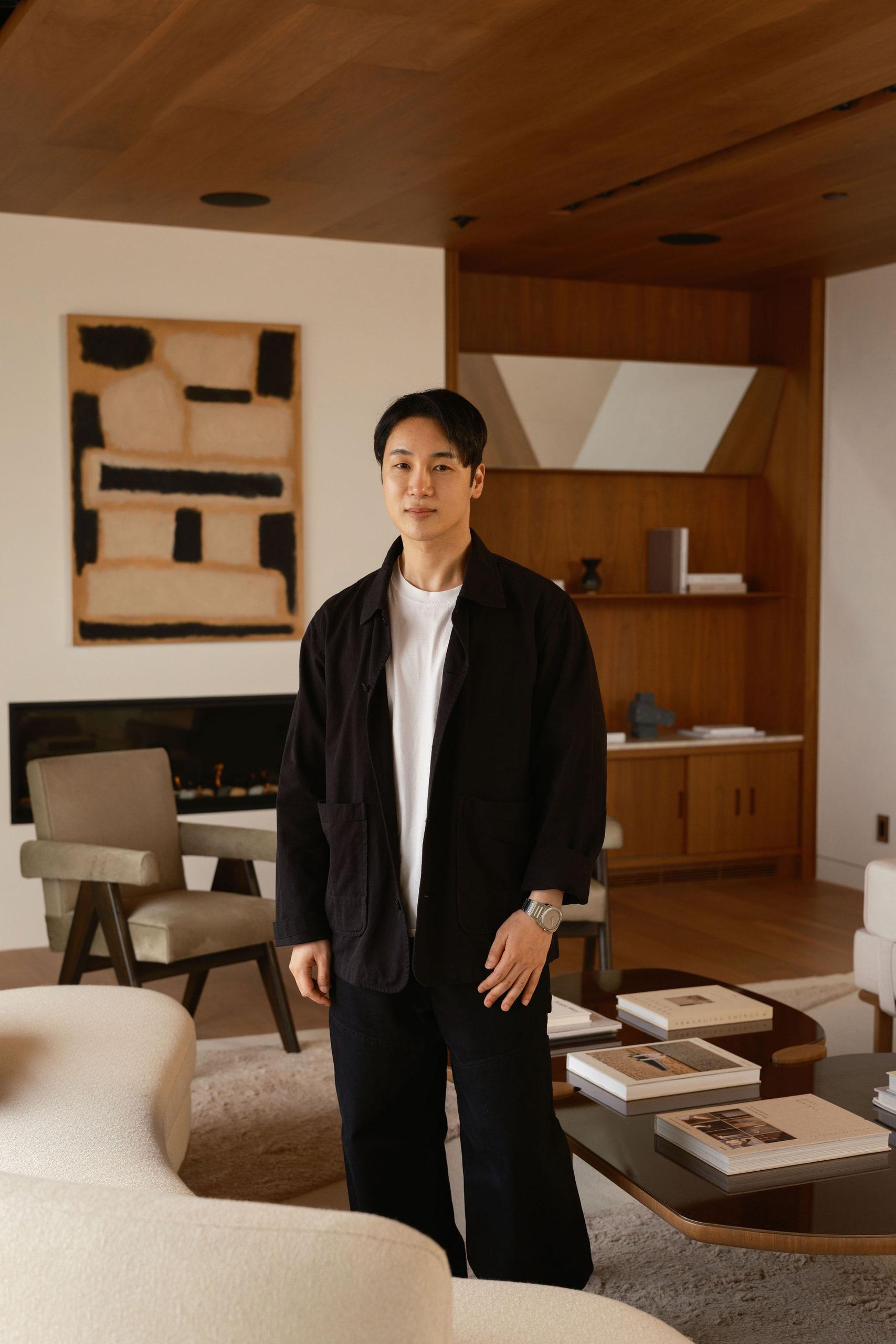
The Boryo lounge chair at NUOVO sits about ninety-four centimetres high, with a seat near fifty-three centimetres, dark ash arms around fabric cushions you meet the way you meet any lounge opposite a coffee table. The Korean room it comes from sat lower. A traditional boryo was a thick mattress laid on the ondol in an anbang or sarangbang, stuffed with cotton or animal hair, covered in silk, and set toward the warm araenmok where the household received guests. Teo Yang, the Seoul designer who co-founded Eastern Edition, kept the supported leisure and the woodwork that steadies a frame. He raised the seat so the same hospitality works in a chair-height Hong Kong flat.
Yang grew up in Seoul, studied interior architecture at the School of the Art Institute of Chicago and environmental design at ArtCenter in Pasadena, then worked with Marcel Wanders in Amsterdam before founding Teo Yang Studio in 2009. Restored Bukchon hanoks became his home and office, and the practice turned toward heritage that could still furnish everyday rooms. During the pandemic he launched Eastern Edition with Korean woodworkers and local materials. Museums and galleries in Korea already knew his interiors. The furniture is how that work enters living rooms abroad.
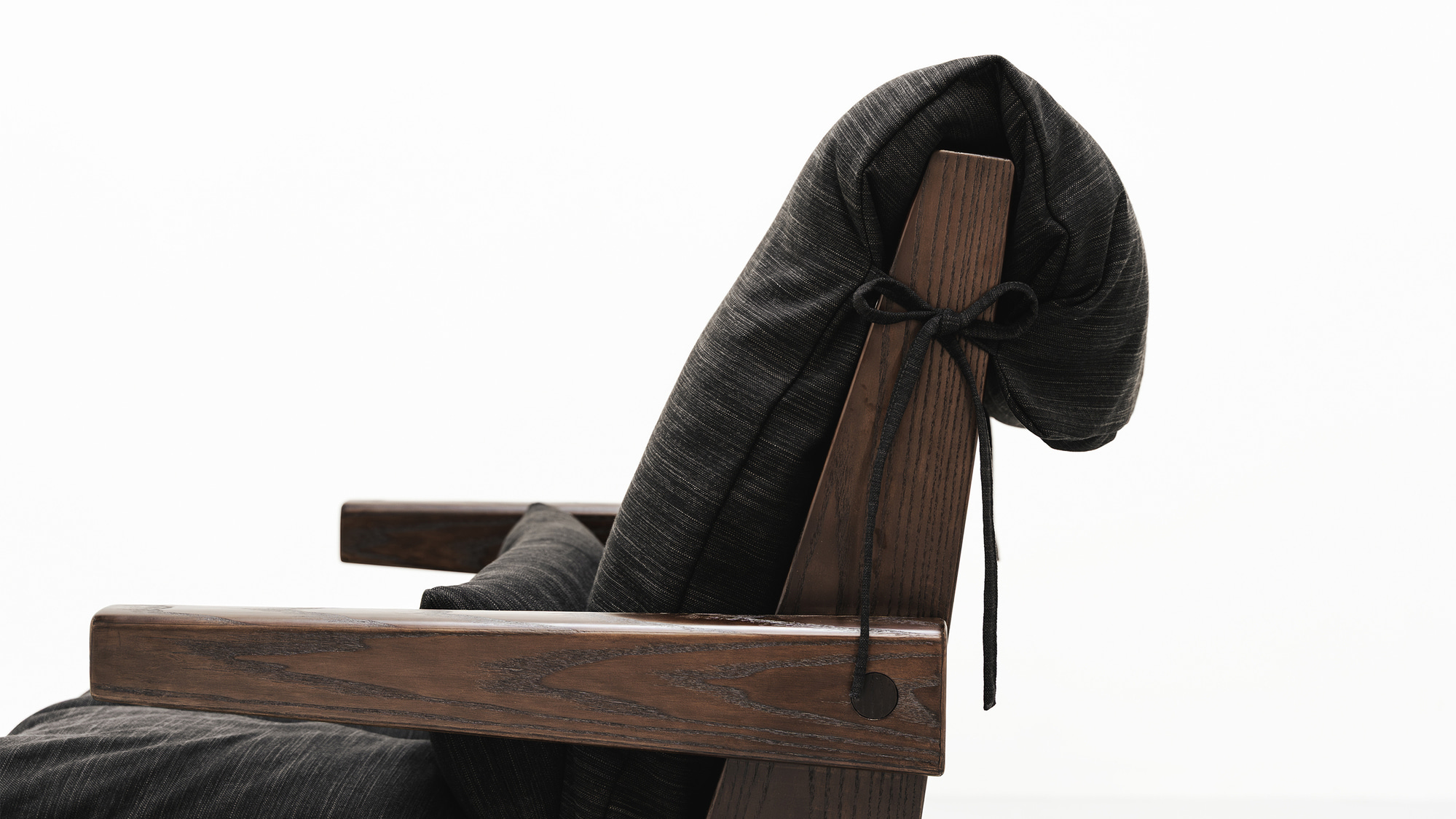
Eastern Edition Boryo Lounge Chair: dark ash veneer frame with fabric cushion tied to the backrest. Photograph courtesy Eastern Edition.
The frame is ash veneer finished dark. Where members cross, Eastern Edition uses half-tuck joinery, a Korean lap joint that cuts half the thickness from each piece so they lock and hold the silhouette steady. The soft top still behaves like a mattress: a fabric cushion about fifty-five centimetres wide and twenty centimetres high, tied to the wooden back rather than built into a hidden chassis. At MUMI, the free NUOVO hang running through 31 January 2027, Design@HKG also lists a Boryo finished with two-tone “crack” textile by Hong Kong label PONDER.ER, designed by Alex Po and Derek Cheng with colours developed alongside Textile Library in Hangzhou. The cloth belongs to the Hong Kong collaboration. Under it, the ash frame, the half-tuck joint, and the tied cushion are still Yang’s Korean room, raised onto legs.
Encyclopedia of Korean Culture measurements for an older boryo run roughly eighty centimetres wide, nearly two metres long, and only five to seven centimetres thick, a long pad for sitting and light rest on a heated floor. Yang’s lounge keeps a deep pitch and thick arms, then lifts the body to a seat height that can face a Western coffee table. On the araenmok, the boryo marked the place of honor for receiving. In Central the chair does quieter work: a seat opposite a guest, a place to read, or a pause after a Queen’s Road errand, without asking anyone onto the floor.
“There is a Korean philosophy called ‘no taste.’ It’s like taste beyond taste. You’ve had all the best things in your life. But now you know that materialism doesn’t make you happy.”
Teo Yang, on the idea behind Eastern Edition, to Architectural Digest
He and the brand also call that mood mumi, the title of the NUOVO hang. The Boryo shows what the word means in wood: joinery left visible, a cushion offered as hospitality, deep rest raised until a Hong Kong living room can use it. Yang has carried the same translation into wallpapers for de Gournay, museum galleries in Gyeongju, and retail rooms from Lane Crawford in Pacific Place to Eastern Edition showrooms in Seoul, Paris, and Los Angeles. This winter the clearest meeting is the chair on the Galleria floor.
Enter The Galleria from Queen’s Road Central and ask for G03. MUMI runs Monday to Saturday, 10:00 to 18:30, through 31 January 2027; Sunday the desk is closed. Confirm holiday hours before a weekend plan. What Teo Yang Kept From Traditional Korean Furniture in His New Hong Kong Show maps the Nabi stool and open cabinet beside this lounge if you want the wider line. The half-tuck where the arm meets the upright, and the seat height against a coffee table, are the parts worth standing with longest.