

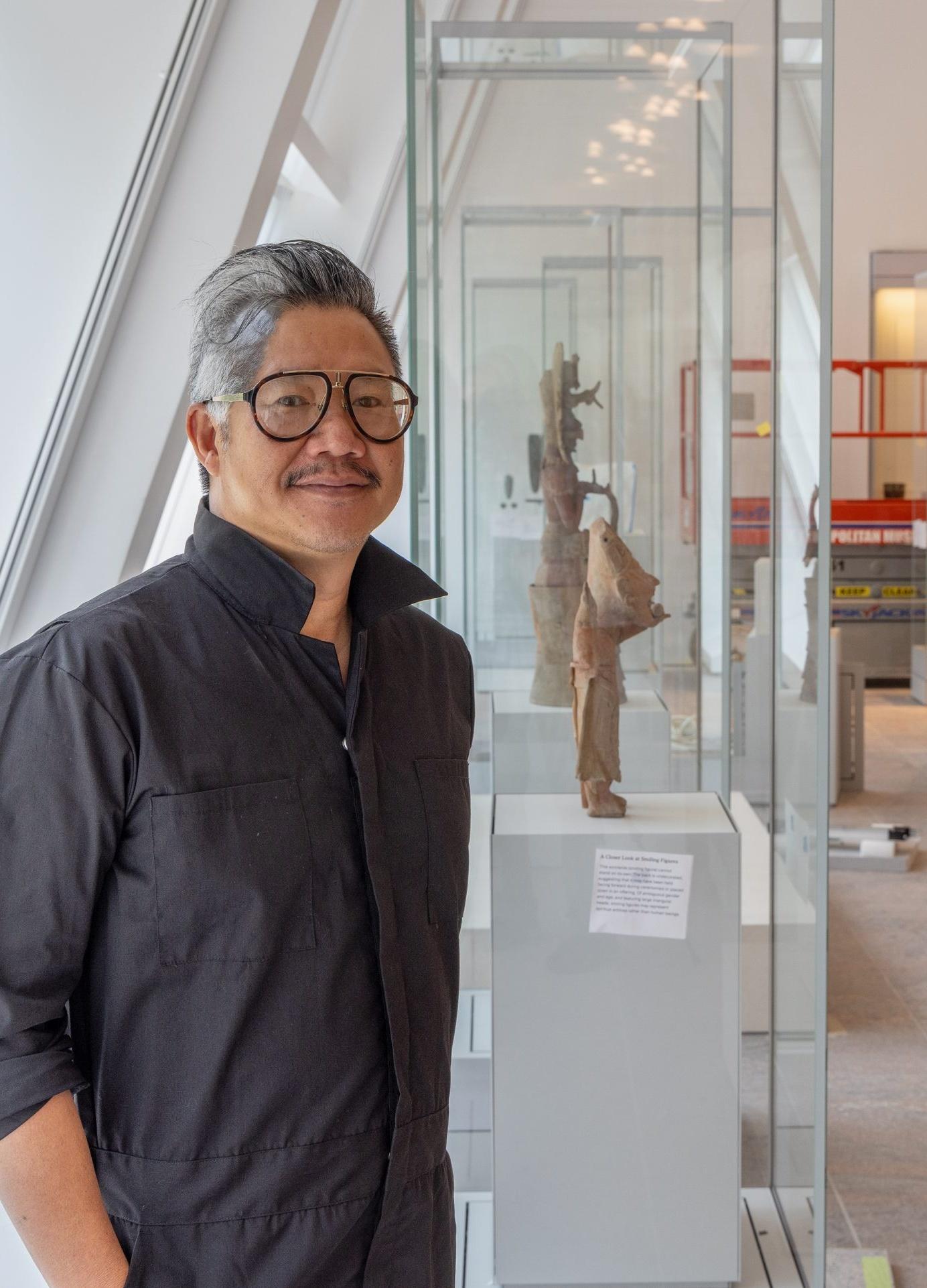
Visitors climb past tall grasses and a pool to reach the main floor of Kulapat Yantrasast’s Venice Beach house, raised the way a Thai dwelling sits above the ground. Living rooms open to the garden and the sound of traffic off the Pacific. A guest suite sits below with a porthole into the water. He built the concrete-and-glass house in 2012 on a cul-de-sac among wood-frame cottages, and for years he used it the way he uses museums: as a place to put people and objects in the same air. Monthly salons brought fifteen or twenty guests, drinks from a mechanic’s tool chest, and a conversation that outlasted dinner. Sometimes the subject was music, sometimes design or art; the point was animation, not a lecture. A Gabriel Orozco feather-and-bamboo mobile, the first artwork he bought, hangs in the open living space. He has said he keeps it because good work should feel effortless.
Yantrasast grew up in Bangkok, trained in Tokyo, and spent nearly eight years with Tadao Ando before founding WHY Architecture in Los Angeles, later adding New York. Japanese work, he has said, taught him tension and control; Thai life pulled toward openness and mix. Ando’s rooms behave like Japanese cooking, precision first. His own rooms want the improvisation of a Thai kitchen. That temperament is why he distrusts the white box that isolates art until the visitor feels scolded. He wants culturally specific space: varied light, different proportions, a sense of city and climate still in the room.
“A museum is a matchmaker between people and art. You set the atmosphere so that both will be comfortable, and then you leave the room.”
Kulapat Yantrasast, speaking to Interior Design
At the Metropolitan Museum of Art, that leave-the-room habit shows up as light and route. WHY’s renovation of the Michael C. Rockefeller Wing reopened on 31 May 2025 after the galleries closed in 2021, a roughly 40,000-square-foot rethink of rooms that had first opened in 1982. The arts of Africa, Oceania, and the ancient Americas no longer share one dim sweep that could confuse proximity with sameness. Each collection holds its own rooms inside the wing, with fritted glass bringing Central Park in without cooking light-sensitive wood. Yantrasast has been blunt about the inherited darkness: Africa and Oceania were too often lit as if gloom were a cultural fact. Materials change as you move. Portals stay wide enough that you choose your path. You look longer when the room stops arguing with the object.
At the Institute of Contemporary Art, Los Angeles, on East Seventh Street in the Arts District, he renovated a former clothing factory so the first thing through the single entrance is other people: education workshops, a bookshop, a boardroom, and offices most museums hide. He has said that one entrance became an advantage, because it forces transparency. Admission is free, Wednesday through Sunday. The galleries still matter. The building simply refuses to pretend that looking is a private act. Across the bay, the Akiko Yamazaki and Jerry Yang Pavilion at San Francisco’s Asian Art Museum, opened in 2020, gives Civic Center a clear contemporary hall and terrace against Gae Aulenti’s adapted Beaux-Arts library. If you already go for the permanent collection, you now walk his pavilion for temporary shows.
In Bangkok the same hospitality lands in a warehouse courtyard between Rama IV and Sukhumvit 40. Dib Bangkok, at 111 Soi Sukhumvit 40 in Khlong Toei, opened on 21 December 2025 as Thailand’s first international contemporary art museum, designed with Architects 49 for the Osathanugrah collection. A porcelain-mosaic Chapel and James Turrell’s first permanent work in Southeast Asia sit inside a public room made for Thai visitors as much as for the international calendar. For the longer institutional story, read Kulapat Yantrasast and the Asian Museum Century. For the timed morning, use the Address Book.
The Venice Beach salons were the domestic version of that job: enough daylight, a group small enough to argue, and an architect willing to leave once the room was set. The Rockefeller Wing, ICA LA, and Dib simply ask the same thing of a larger public. The meeting is the point. His work is to make it feel possible.