

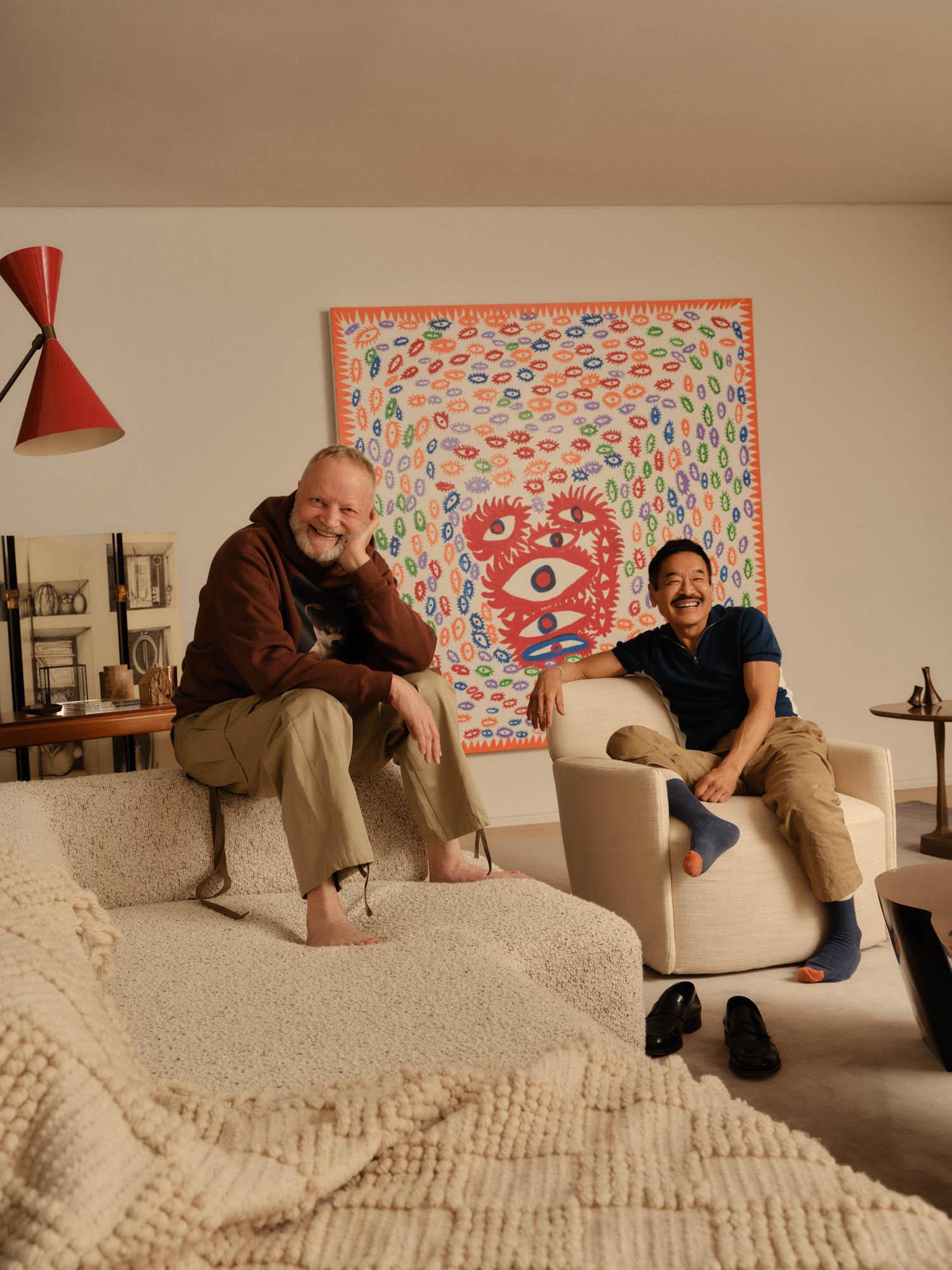
Close the door of a hotel room and the lobby stops mattering. What is left is smaller and harder: light that settles, a chair that takes a laptop and a drink, quiet that feels held instead of vacant. George Yabu has spent forty-five years with Glenn Pushelberg answering that test.
"When I close my eyes in one of our hotel rooms, I want to feel like I'm at home. I need to feel transported the minute I close the door to my room."
George Yabu, speaking to Business Traveller about Yabu Pushelberg's hotel rooms
Yabu, a Japanese Canadian designer raised in Toronto's Cabbagetown, co-founded Yabu Pushelberg with Pushelberg in 1980 after they met as interior design students at what is now Toronto Metropolitan University. The studio still runs from Toronto and New York. Yabu leads the aesthetic edit. Pushelberg steadies the brief and the business. Studio lore still quotes Yabu's favorite kill line: "It's nice, but I don't like it." A drawing leaves the desk only after both of them have lived with it.
Their parents were makers before any hotel brief arrived. Yabu's father built wooden boats; his mother sewed. The family carried Japanese Canadian wartime displacement into postwar Toronto, and Yabu has said the respect for craft never left the house. You can hear that patience in the way the studio pushes a wood grain until it feels expensive, or lets concrete stay sensual. He and Pushelberg call the approach high humble: take a common material and finish it until the room feels richer than the invoice suggests.
In Yorkville, the Canadian claim is physical. When Four Seasons opened its Toronto flagship in October 2012, Yabu Pushelberg designed interiors that felt local without turning into a lecture: hand-painted walls, mahogany, carefully cut stone floors, and a gallery of Canadian art in the public rooms. Guest rooms stayed restful and neutral. They replaced the old rectangular desk with a round activity table because that is how people actually work now. In 2013 both partners became Officers of the Order of Canada for exporting that standard while still hiring and funding Canadian design talent. Yorkville remains the clearest Canadian proof you can walk into.
Furniture made the same point at domestic scale. With Stephan Weishaupt they co-founded Avenue Road in 2007 so custom pieces could leave the project and enter a living room. Weishaupt later took full ownership; they kept designing for the line. The Perry Street sofa began as a boomerang for the awkward geometry of their own West Village apartment in a Richard Meier building, then became a production piece because the shape solved a seating problem no catalog sofa would. Salone collections with houses such as Molteni&C keep sending that habit into chairs and lamps the studio will never install itself.
At Park Hyatt New York, opened in 2014 opposite Carnegie Hall, they invented a fictional Upper East Side couple who collected art and mixed decades of furniture, then designed the hotel as that couple's apartment. Guests were meant to feel they had entered a private house near Central Park, not a tower lobby. The ballroom was meant to be the city's best, not its biggest. Bergdorf Goodman's Level of Beauty had already shown the instinct in 1999, when they moved cosmetics downstairs and made the basement a place to linger. Atmosphere was part of the purchase.
The current map is farther afield. Raffles Sentosa Singapore put sixty-two private-pool villas into the hillside as the brand's first all-villa resort. Hotel The Mitsui Hakone opens on 15 December 2026 with Yabu Pushelberg interiors and a private onsen in every key; Hotel The Mitsui Hakone Opens on the Family's Kowakudani Land covers the booking. In Tokyo, Aman Residences at Azabudai Hills translated the same calm into ninety-one sky homes. Glenn's line about floating in the sky of Tokyo still describes the pool level better than a brochure can; When the Building Becomes the Country Club picks up that amenity argument.
A Sentosa villa on a quiet Singapore week, a Kowakudani key in December, an afternoon through Four Seasons Toronto: any of those will tell you more than another render. After forty-five years beside Pushelberg, Yabu's question has barely moved. Once the door clicks shut, does the room still want you there?