

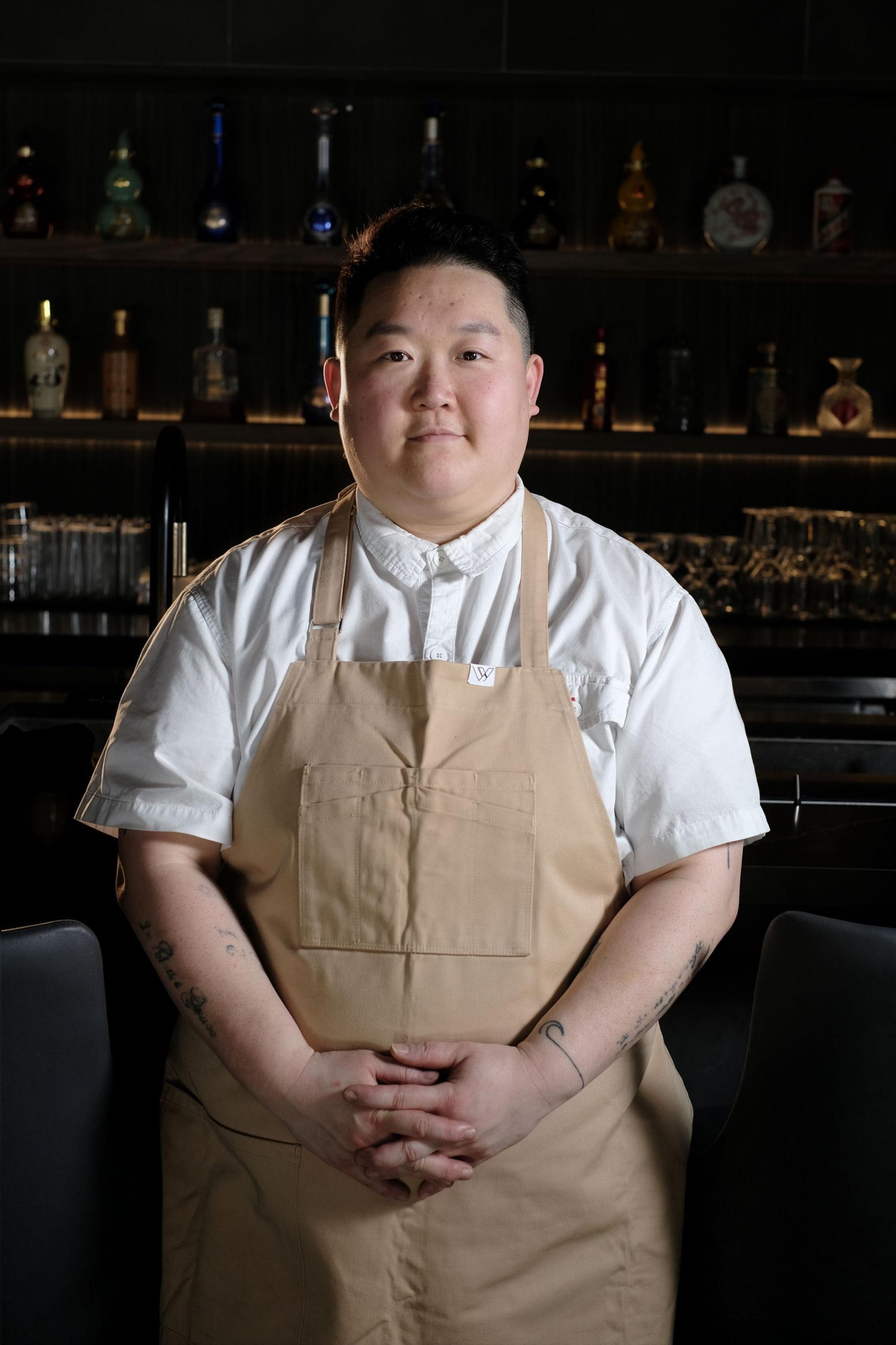
The first thing Eva Chin pours is soup. At Yan Dining Room, in the private room at the back of Hong Shing on Dundas Street West, the cup arrives before the tasting menu finds its shape, and on a cold Toronto night the broth does half the hosting. One version she has simmered for days with coconut water instead of the usual pot water, a Cantonese comfort move with a Hawaiian childhood still in it: slightly sweet, nutty, and deeply savoury. Guests walk through the busy dining room up front, where General Tso and chow mein still move for the late crowd, then into a darker banquet room of about two dozen seats. What follows is Chinese in structure and Canadian in what she can source.
She calls the cooking neo-Chinese: nostalgia carried forward with modern technique, regional Chinese knowledge cooked through Ontario farms and Atlantic and Pacific waters. Colleagues and guests have tried to file it as fine dining or Chinese omakase. She asks for a different name. Omakase, she has said with respect, deserves its own genre. Neo-Chinese is for cooks who feel both authentically Chinese and shaped by North America, bridging the kitchens that raised the diaspora and the ones that keep changing. At Yan that argument arrives as a monthly tasting menu she still introduces herself, dish by dish.
“The word yan means banquet. Here, every meal should feel like a celebration, like I’m welcoming you into my home for a feast.”
Eva Chin, speaking to Toronto Life
She grew up on her grandmother’s farm in Kahuku, on Oahu’s North Shore, gathering eggs and fruit, fishing, and learning to butcher with a Hawaiian sense of land she still names as ʻāina. Her father is Chinese Singaporean; her mother Chinese Samoan and Hawaiian. After university she cooked through Japan, Australia, and Europe, then hit a wall in Hong Kong when a customs officer mocked her pronunciation of her own name. She spent years cooking in China, including Beijing, Guangzhou, and Nanjing, to learn the depth she felt she had been circling. Canada held her differently. Farm work and kitchens in British Columbia, then Royal Dinette and Boulevard Kitchen & Oyster Bar in Vancouver, showed her how Pacific produce could carry Chinese cooking. Toronto, from March 2020 at Momofuku Kōjin onward, gave her a Chinese community that texted welcome before she had finished unpacking. Colin Li at Hong Shing became the partner who let her build Yan inside a family room that already knew how to feed the city at midnight.
The Canadian proof is on the plate. Digby scallops from Nova Scotia have sat under Asian pear and a Sichuan verde. Quillback rockfish and British Columbia sea urchin have met Southern Ontario radishes from Broadfork Produce. Spadina Avenue elders selling produce call her handsome boy, and she buys from them on purpose. A fish course has paired aged sea bream with preserved local cherries in a sweet-sour jus. Clam-and-baijiu butter has dressed Cantonese noodles with an Italian length of patience. She has joked that fusion is confusion, then served the tangle anyway, because her life does not stay in one Chinese province or one Canadian aisle.
Yan means banquet, and the service still behaves like one. A gong marks when she speaks; any formality left in the room tends to go with it. Courses go out together so the table starts talking at the same moment. Her wife, Theresa Walsh, runs the front of house. Leftovers leave in bags because a host who means it wants you fed tomorrow too. The menu changes by the month; the shape stays closer to banquet logic than to a trophy tasting: broth, cold seafood and snacks, a hot-cold hinge, mains, something sweet. Three nights a week, Friday through Sunday, keeps the private room feeling like a supper she is still hosting.
Book Yan through Tock at Hong Shing, 195 Dundas Street West, and confirm the current prepaid price before you lock a Friday, Saturday, or Sunday. Seats go early on Tock. Walk in through the old Chinatown dining room first. By the time that first soup cup is empty, you already know whose table you are at.