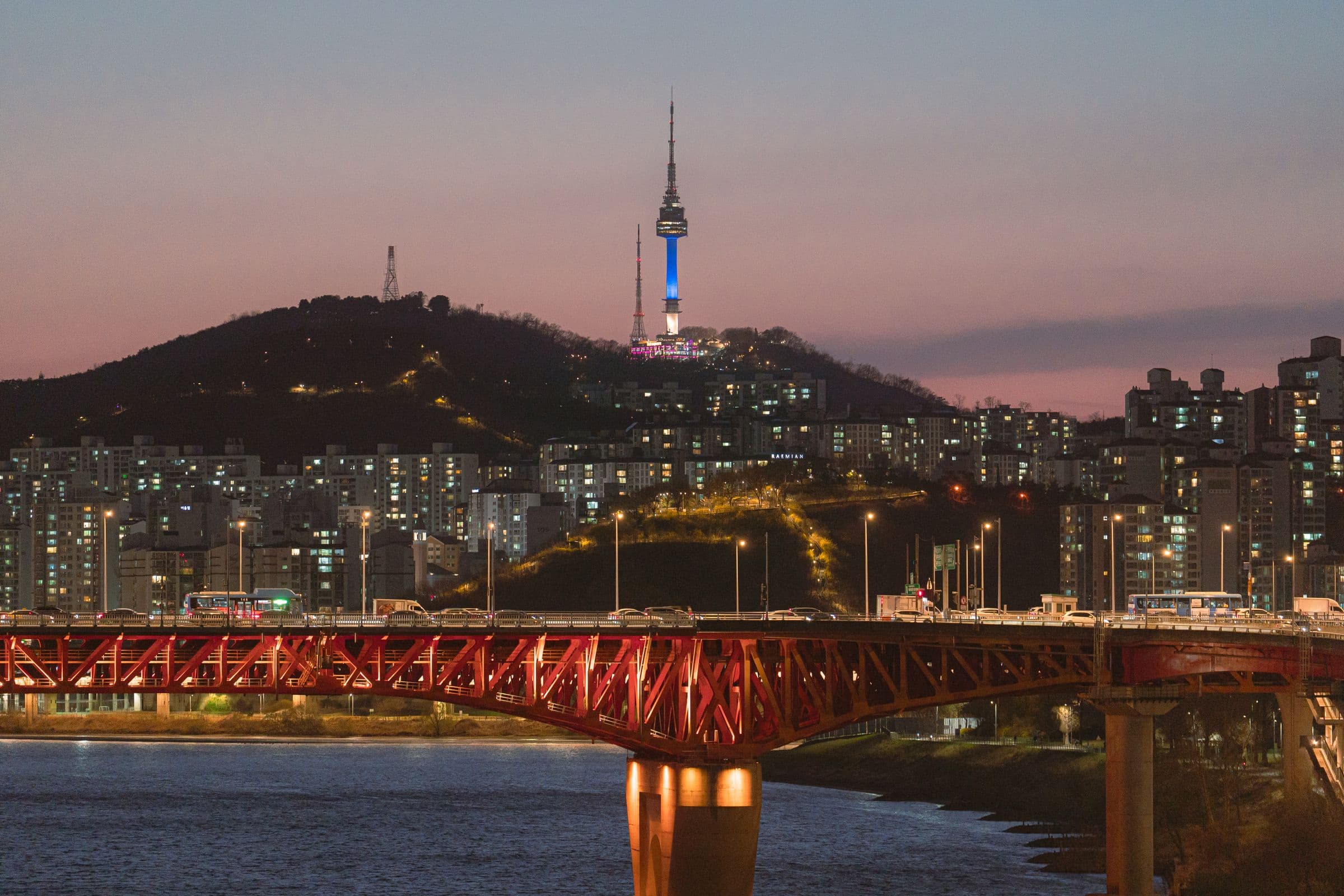

On the 23rd floor of The Shilla Seoul, La Yeon still makes a persuasive case for ceremony. The room looks across Namsan; the cooking arrives through the disciplined sequence of a luxury hotel that has hosted decades of diplomatic and business meals. South of the river, Mingles uses jang and fermentation with the confidence of a chef-owned dining room. Jungsik supplied the early vocabulary for “New Korean” cooking. Mosu and Evett widened the field again.
Together, these rooms explain Seoul’s modern fine-dining canon more accurately than a simple ranking does. It runs from institutional Korean hospitality to chef-led reinterpretation, with different answers to the same question: how should inherited technique behave in a contemporary tasting menu?
The MICHELIN Guide Seoul & Busan 2026, announced on March 5, 2026, gives Seoul one three-star restaurant, ten two-star restaurants, and 31 one-star restaurants. Mingles stands alone at three. Yet the most useful route through the city begins before Michelin arrived.
Before Michelin: the rooms that set the terms
Jungsik Yim opened Jungsik in Seoul in 2009, followed by New York in 2011. His importance extends beyond any current star count. “New Korean” became legible internationally through a restaurant that treated Korean ingredients and memories with the structure, saucing, and visual grammar of contemporary Western fine dining.
La Yeon followed in 2013, replacing The Shilla’s former Korean restaurant Seorabeol. Its institutional path was different. Chef Kim Sung-il, who joined The Shilla in 1988, worked within a hotel able to build dedicated sourcing and service systems around refined Korean food. When Michelin unveiled its inaugural Seoul selection in November 2016, La Yeon and Gaon received three stars.
Then came Mingles, opened by Kang Mingoo in 2014. Kang’s kitchen made fermentation and jang central rather than decorative, while its pacing and service felt fluent to diners accustomed to tasting menus in Paris, Tokyo, or New York.
“It is important to respect tradition at the core while adding modernity.”
Kang Mingoo, discussing Korean culinary identity in a 2025 interview with Robb Report Hong Kong
That sequence matters. Seoul’s current hierarchy did not appear suddenly when Michelin arrived. It grew from restaurant owners, hotel kitchens, researchers, and cooks arguing over how much a modern Korean room should preserve, translate, or invent.
The current canon: Mingles and Jungsik
Mingles retained three Michelin stars for a second consecutive edition in 2026, making it Korea’s only restaurant at that level. That distinction is useful, although the kitchen’s real significance is easier to taste in its handling of time.
Jang is not treated as a fashionable accent. Fermentation provides depth, acidity, and continuity across seafood, vegetables, and meat. Seasonal Korean ingredients move through an internationally recognizable tasting-menu structure without being reduced to explanatory theatre. The dining room in Cheongdam is polished, but the meal’s identity remains in the pantry.
Kang trained at Martín Berasategui and Nobu before opening Mingles, experience that helps explain the restaurant’s ease with global fine-dining expectations. It also makes the restraint important. The meal works because technique supports the ingredient rather than announcing the chef’s résumé.
Mingles is at 2F, 19 Dosan-daero 67-gil, Gangnam-gu. As of March 2026, the official reservation channel listed lunch at KRW 320,000 and dinner at KRW 420,000. Reserve through Catchtable from the restaurant’s official website and confirm current pricing when booking.
Jungsik holds two Michelin stars in 2026, but its place in this story is larger than its position below Mingles. Yim gave a name and a durable restaurant form to New Korean cooking before the city had a Michelin guide. The Seoul flagship remains the clearest address for understanding that first wave.
The cooking uses French technique and contemporary plating, but the references remain Korean. What once looked radical now reads as the foundation beneath much of Seoul’s tasting-menu culture. That is a measure of influence, not staleness.
Jungsik is at 11 Seolleung-ro 158-gil, Gangnam-gu. Reservations are released through Catchtable on a scheduled cycle, currently two months at a time. The booking channel listed menu formats at KRW 230,000 and KRW 330,000 when checked in July 2026; confirm service and pricing before committing. The New York outpost appears in our United States chapter.
Reopening the argument: Mosu and Evett
Mosu Seoul returned to the guide with two stars in 2026 after a consequential reset. Chef-owner Sung Anh, also known as Ahn Sung-jae, opened Mosu in San Francisco in 2015 and moved it to Seoul in 2017. The restaurant closed in early 2024 after Anh ended an investment partnership with CJ CheilJedang, then reopened in Yongsan in March 2025.
The current room, at 4 Hoenamu-ro 41-gil, should be understood as a reopened independent restaurant rather than a continuation without interruption. Mosu’s cooking resists an easy national label. Korean ingredients sit within a personal vocabulary shaped by Anh’s Korean-American life and international kitchens. Reservations are handled only through Catchtable; the official site specifically excludes telephone, email, and social-message bookings.
Evett offers another outsider’s inquiry, handled with unusual persistence. Australian-born chef-owner Joseph Lidgerwood opened the restaurant in 2019 and moved it near Dosan Park in 2023. Evett rose to two stars in 2025 and retained them in 2026.
Its work with Korean ingredients, foraging, meju, and regional food culture can be illuminating, provided the framing stays precise. Lidgerwood is interpreting a place he has studied deeply; he is not a spokesman for Korean identity. Official prices currently run KRW 190,000 for an eight-course Friday and Saturday lunch and KRW 330,000 for the 12-course dinner, served Tuesday through Saturday. Evett is at 1F, 10-5 Dosan-daero 45-gil, Gangnam-gu.
Tradition as service: La Yeon and Kwonsooksoo
La Yeon now holds two Michelin stars, down from the three it carried through the 2021 edition. A lower ranking has not erased its role. The restaurant represents a particular Korean luxury tradition: formal service, carefully sourced ingredients, composed banchan, and a room designed for occasions when hospitality itself carries institutional weight.
Chef Kim Sung-il’s long tenure at The Shilla gives the restaurant continuity unusual in a fast-moving dining capital. La Yeon occupies the hotel’s 23rd floor at 249 Dongho-ro, Jung-gu. Book directly through The Shilla and ask for the current menu price; the official restaurant page did not publish a durable standalone figure when we checked.
For a chef-led treatment of researched Korean tradition, add Kwonsooksoo. Chef Kwon Woo-joong uses doksang, the individual Korean dining table, alongside traditional spirits, uncommon kimchi, and recipes grounded in culinary study. The restaurant holds two stars in the 2026 guide and sits at 4F, 37 Apgujeong-ro 80-gil, Gangnam-gu.
Kwonsooksoo is a stronger part of the modern Korean canon than a restaurant chosen merely because it ranks highly. It connects heritage recipes and contemporary service without turning either into a museum display.
What the star list does not explain
The 2026 guide promoted Sosuheon to two stars. It is an eight-seat counter in a hanok, led by chef Park Kyung-jae, and may be an excellent reservation for diners interested in seasonal seafood and Edomae technique. Michelin, however, classifies it as sushi.
That distinction is editorially useful. A guide’s upper tier maps inspection results across cuisines; it does not automatically define the canon of modern Korean cooking. Sosuheon belongs in the wider account of Seoul’s luxury dining culture, just as Japanese, Chinese, and French rooms do. It should not displace a Korean restaurant in an article specifically tracing modern hansik.
The same caution applies to sustainability labels. Korea’s 2026 Green Star recipients are Gigas, Fiotto, Mitou, and Gosari Express. None of the six core rooms above holds one. Stars can organize a booking week, but they cannot carry the entire cultural argument.
Practical Notes
If this is your first serious Seoul dining trip: Choose Jungsik for historical context, Mingles for the current summit, and La Yeon or Kwonsooksoo for a more formal conversation with Korean tradition. Add Mosu or Evett when you have another evening and want a distinctly personal interpretation.
Reservations: Mingles, Jungsik, Mosu, and Evett use Catchtable. Release schedules vary, and prime Friday and Saturday tables disappear quickly. La Yeon books directly through The Shilla. Use official restaurant links rather than resale or concierge marketplaces.
Geography: Mingles, Jungsik, Evett, and Kwonsooksoo cluster in Gangnam, Cheongdam, and Apgujeong. La Yeon is north of the river in Jung-gu; Mosu is in Yongsan. Avoid planning two long tasting menus in one day, and allow for cross-river traffic before an evening reservation.
Prices: Published menu prices change, sometimes between guide editions. The figures above were checked in July 2026 against official restaurant pages or their linked booking channels. Wine, pairings, and service policies can materially alter the total.
For hotels, neighborhood planning, and casual contrasts, use The Banquet Guide to Seoul. For the wider regional sequence, continue to The Banquet Guide to Tokyo or The New Banquet: United States.